Interfacing a TV's headphone's output to an amplifier's line-in inputs

crutschow

Joined Mar 14, 2008
38,598
........................
That seems to argue for the highest voltage you can get out of the TV because the signal to noise ratio is cleaner there.
I know I crossed swords with crutschow, but I can't imagine the scenario to which he is referring. The one where attenuation followed by more gain fixes this. With this new information about the worst hum being in the amplifier, that seems to nail down the right procedure.
So my thought was that, if the hum is a fixed output from the TV, then attenuating the signal and upping the TV volume would improve the signal level relative to the hum level at the receiver.

If the hum is caused by a ground loop that is unaffected by an attenuator then, of course, that will not work.
 

#12

Joined Nov 30, 2010
18,224
Thanks for explaining that. I worked as a TV tech for 3 years and never saw that scenario, so I couldn't bring it to the front of my mind. (Senior moment)
 

Thread Starter

cmartinez

Joined Jan 17, 2007
8,803
Wow.. this thread turned out to be more interesting than I expected at first... thank you all for all your help. I'll let you know in a few days how everything went in the end.
 

GopherT

Joined Nov 23, 2012
8,009
Wow.. this thread turned out to be more interesting than I expected at first... thank you all for all your help. I'll let you know in a few days how everything went in the end.

I was thinking...

Option 1
You could add a difference amplifier to the output of your headphone and reference it to ground on your old amplifier (assuming my Class D theory is correct - mentioned above)

Option 2
You could make a voltage controlled amplifier (VCA) and use the RCA outputs on your TV (that are not controlled by volume) to feed the VCA. Then make a peak detector circuit for the headphone output (the peak detector output provides the control voltage for the VCA). You would need some bleed resistor to constantly (slowly) reset the peak detector so (a) it knows when you change volume, while (b) does not jump around as dialog gets loud/quiet.

Option3
Some variation of Option 2 (e.g. Some sort of subtracting circuit based on the RCA output and the headphone output).
 

Thread Starter

cmartinez

Joined Jan 17, 2007
8,803
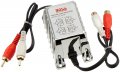
71FDJ-HWwmL._SL1500_.jpg


So I bought the above audio isolation transformer and connected it between my amplifier's line-in inputs and the headphone's output of my tv, and this is what happened:
  • The hum was somewhat diminished at exactly the volume setting that I had before in the amplifier, which is about 30% of its power capability, in my estimation.
  • If I turn the volume up in the amplifier, the hum gets proportionally louder too.
  • But here's the thing... if I turn the amplifier's volume down, even all the way to zero, the hum gets louder too, with its loudest point at zero volume output. At zero volume the hum sounds just as loud as if the volume were turned up to 60%

What gives? :confused: ... is there some sort of impedance matching circuit that I need between my tv's headphones output and the amp's line in input? ... the amp produces no hum if I disconnect it from the tv, btw.
 

Thread Starter

cmartinez

Joined Jan 17, 2007
8,803
So it's been a year, and the damn thing's still humming (though a little less, thanks to the isolation transformer) ... as I was watching my tv last night, a thought popped into my head (yeah, that happens every now and then) ... the two devices (stereo amp and tv) have three-pronged connectors and are plugged to the same strip... therefore their grounds are still connected! no wonder the stupid thing keeps humming! ... what should I do now? I don't want to cut the ground pin of either of them!
 

GopherT

Joined Nov 23, 2012
8,009
So it's been a year, and the damn thing's still humming (though a little less, thanks to the isolation transformer) ... as I was watching my tv last night, a thought popped into my head (yeah, that happens every now and then) ... the two devices (stereo amp and tv) have three-pronged connectors and are plugged to the same strip... therefore their grounds are still connected! no wonder the stupid thing keeps humming! ... what should I do now? I don't want to cut the ground pin of either of them!
Try temporarily disconnecting the ground wire from the outlet used by the stereo amp. If the humming stops, we know where a solution is. If it doesn’t stop, then look somewhere else.

No cost, no damage and easily returned to original condition.
 

Thread Starter

cmartinez

Joined Jan 17, 2007
8,803
Try temporarily disconnecting the ground wire from the outlet used by the stereo amp. If the humming stops, we know where a solution is. If it doesn’t stop, then look somewhere else.

No cost, no damage and easily returned to original condition.
Yeah... already thought of that too... will do, and get back here with the results.
 

GopherT

Joined Nov 23, 2012
8,009
Also, I assume you have a Dolby 5.1 system with various audio effects. Try turning off all digital
Yeah... already thought of that too... will do, and get back here with the results.
Also, measure the resistance between the two ground plug pins in the outlet. Hopefully you have a meter that can zero out the resistance of the test leads. It should be close to zero.
 

bassbindevil

Joined Jan 23, 2014
924
It's hard if not impossible to feed stereo headphones from a bridged switching amplifier. (Yamaha's YDA138 class-D chip amp includes a linear headphone amp because of that.) So, I doubt that's the problem.

Now, if you have cable TV, that can create a ground loop since the cable system ground is different than your house AC ground. It's easily fixed by connecting the cable TV signal through two 75 to 300 ohm adapters back to back, or you can buy an isolator that achieves the same result somewhere. Or wind your own.
 
Last edited:

Thread Starter

cmartinez

Joined Jan 17, 2007
8,803
It's hard it not impossible to feed stereo headphones from a bridged switching amplifier. Yamaha's YDA138 class-D chip amp includes a linear headphone amp because of that. So, I doubt that's the problem.

Now, if you have cable TV, that can create a ground loop since the cable system ground is different than your house AC ground. It's easily fixed by connecting the cable TV signal through two 75 to 300 ohm adapters back to back, or you can buy an isolator that achieves the same result somewhere. Or wind your own.
Very good points... yes, I do have cable TV, and I hadn't considered that as the source of the problem. Exactly what sort of isolator did you have in mind? Can it be bought through Amazon?
 

ebeowulf17

Joined Aug 12, 2014
3,307
Very good points... yes, I do have cable TV, and I hadn't considered that as the source of the problem. Exactly what sort of isolator did you have in mind? Can it be bought through Amazon?
Before buying more parts, you could test this theory by disconnecting cable from the tv and seeing if other tv (OTA, Tivo, DVD, etc.) still has the hum.

If breaking the ground loop by disconnecting the cable kills the hum, you're on the right track. If not, save your money!
 

Thread Starter

cmartinez

Joined Jan 17, 2007
8,803
If breaking the ground loop by disconnecting the cable kills the hum, you're on the right track. If not, save your money!
Yeah, that occurred to me too last night... I'll definitely do that before spending more on this thing.
 
Last edited:

Externet

Joined Nov 29, 2005
2,645
If other methods become unsuccessful, explore bringing the L, R lines that exit the audio volume controlling chip in the TV to added RCA jacks by the rear panel.
If all audio management is integrated in one chip, the L,R inputs to the audio final amplifier IC could be the ones to be brought to added RCA jacks.

Check the data sheets for the ICs you see in the TV to discern the L,R pins to tap.
 

bassbindevil

Joined Jan 23, 2014
924
Connecting the fork terminals of two coax (75 ohm) to twinlead (300 ohm) adapters will also act as an isolator. Those are the cylindrical things with a coax jack on one end, and a length of flat twinlead cable terminated in fork terminals on the other. They were used for old TVs or FM receivers that lacked a coax jack.

I've solved ground loop issues several times with this trick.
 
Top