Analog gas sensor interfacing with ADC Do I need a resistor to ground.

Thread Starter

hoyyoth

Joined Mar 21, 2020
528
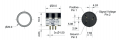
I am interfacing this sensor to ADC of CC1352P . Below is the pinout of ADC.I have two questions about connecting this sensor to ADC of CC1352P.
1760019317643.png

1)Can I connect the Signal Voltage pin (PIN 2) directly to ADC of CC1352P or do I need to place a resistor is series with signal voltage pin and ADC input.

2)Assume not connecting series resistor.Do I need to connect a resistor from ADC I/P to GND so that it won't read some fault values when gas sensor is not working(No gas is present)
 

Irving

Joined Jan 30, 2016
5,065
The internal resistance/output impedance of the sensor appears to be quite low (~300ohm) so a direct connection to the ADC is fine assuming sensor and MCU are colocated on same PCB - a series resistor up to 1k is only necessary for intrinsic safety if the signal passes through into a different 'zone' - the PIDX detectors themselves have no requirement for that as they are intrinsically safe in their own right.. When no gas present the output is ~40mV rising to ~2.85v @ 50ppm VOC. A voltage < 38mV is a fault condition, ie sensor missing or lamp failure. No additional resistors are needed. The supply is internally stabilised so a direct power connection to 3.3 - 5v is acceptable. A decoupling capacitor to ground from the supply pin is always advisable as with any active component. The device draws about 18mA so factor that into your 3.3v power budget.
 
Last edited:

Reloadron

Joined Jan 15, 2015
7,870
Pin 2 is the voltage out of your sensor, proportional to gas sensed. No you do not need a series or parallel resistor.

I see Irving already nailed it. :)

Ron
 

Thread Starter

hoyyoth

Joined Mar 21, 2020
528
Thank you very much.
The datasheet says offset of 40-100mV.
Does that mean without any gas the voltage at the output pin can vary from 40mV to 100mV
 

Irving

Joined Jan 30, 2016
5,065
Thank you very much.
The datasheet says offset of 40-100mV.
Does that mean without any gas the voltage at the output pin can vary from 40mV to 100mV
Yes.

Its 55 mv/ppm ±10% starting from the offset so 10ppm will be in the range 495 - 605 with a mean of 550 + whatever offset you measured in a known 'clean' atmosphere. Its not clear if the device comes with a calibration certificate stating offset and actual mV/ppm; I suspect not. What they do guarantee is the offset won't be <40mV so if it is then that's a fault condition. These devices are primarily for go/no go checks ie "is it <=20ppm or >=30ppm", rather than "is it =25ppm". If you want absolute values you'll need to calibrate it yourself.
 

Thread Starter

hoyyoth

Joined Mar 21, 2020
528
Its not clear if the device comes with a calibration certificate stating offset and actual mV/ppm;
I will check with the customer support team.

These devices are primarily for go/no go checks ie "is it <=20ppm or >=30ppm", rather than "is it =25ppm". If you want absolute values you'll need to calibrate it yourself.
In my project if any gas crosses the threshold(20ppm) the system should raise an Alarm
 

MrChips

Joined Oct 2, 2009
34,698
Gas sensors should be calibrated before usage. Standard calibration procedure is zero and gain calibration. Zero calibration is done with nitrogen. Gain calibration is done with target gas at a known concentration covering the desired range. For quality assurance, you should run a zero and gain check at two extreme temperatures.

All calibration and test are performed on the final assembly using raw ADC readings. Any correction and conversion required is done in system software.
 

Reloadron

Joined Jan 15, 2015
7,870
Keep in mind if your application requires any degree of accuracy the cheap off the boat sensors are not a good idea. You may also want to look at calibrated gas to periodically check your system. A simple Google of "calibrated gasses" will give you an idea of what is needed to make sure of your sensor calibration. Next, if your exact application involves any form of safety all bets on cheap or inexpensive sensors are off the board and should not be considered. :)

Ron
 

Thread Starter

hoyyoth

Joined Mar 21, 2020
528
Without calibration that would be 1.17 +/- 0.18v or approx 20 +/- 3.2ppm. Is that acceptable?
Thank you.
I am about to post a question similar to this.

May I know do I need add the offset (40-100)mv along with this.

1.17 + 40 or 100
 

Thread Starter

hoyyoth

Joined Mar 21, 2020
528
Its 55 mv/ppm ±10% starting from the offset so 10ppm will be in the range 495 - 605 with a mean of 550 + whatever offset you measured in a known 'clean' atmosphere. Its not clear if the device comes with a calibration certificate stating offset and actual mV/ppm; I suspect not. What they do guarantee is the offset won't be <40mV so if it is then that's a fault condition. These devices are primarily for go/no go checks ie "is it <=20ppm or >=30ppm", rather than "is it =25ppm". If you want absolute values you'll need to calibrate it yourself.
I received the below message from the Vendor.

We can provide you with sensor test data for these PIDs.They will state the Offset voltage (mV) and sensitivity (mV//ppm).

May I know does that mean I can use the sensor directly without doing any calibration from our side
 

MrChips

Joined Oct 2, 2009
34,698
I received the below message from the Vendor.

We can provide you with sensor test data for these PIDs.They will state the Offset voltage (mV) and sensitivity (mV//ppm).

May I know does that mean I can use the sensor directly without doing any calibration from our side
Yes you can. But wouldn’t you like reassurance that your device meets specifications?
 
Top