Interesting Zener Diode Observation/Question

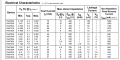
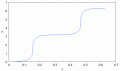
Is the knee intersected by line: 1. Green, 2. Red, 3 Violet

  • 1. Green

    Votes: 0 0.0%
  • 2. Red

    Votes: 9 75.0%
  • 3. Violet

    Votes: 3 25.0%

  • Total voters
    12
  • Poll closed .

Thread Starter

MrAl

Joined Jun 17, 2014
13,722
What is your metric for "better"? For instance, given the statistical nature of real devices, a marginal improvement of fitting a particular, single diode's characteristic may not be viewed as "better" if it comes in significantly increased computational costs.
Hi,

Actually less, and it can be used to do calculations by hand also like sometimes we do here.
It's partly for the interest in the ways to do it too.
 

WBahn

Joined Mar 31, 2012
32,939
Hi,

Actually less, and it can be used to do calculations by hand also like sometimes we do here.
It's partly for the interest in the ways to do it too.
Sounds promising. I assume it takes temperature and parasitics into account as well, too?
 

Thread Starter

MrAl

Joined Jun 17, 2014
13,722
Sounds promising. I assume it takes temperature and parasitics into account as well, too?
Hi,

Yeah it is derived from the diode equation similar to the regular spice model(s) but there are no conditionals so it's a smooth transition from any mode to the next (such as positive to negative bias there are no abrupt changes).

I misspoke before though there are six data points required three for negative bias and three for positive bias.

Parasitics are easy to add but measuring them might be hard to do. Maybe better to get off the data sheet.

Really though the idea for this is really simple. Use two completely different diode models assumed to be connected in antiparallel. If done right there is no need for any conditional statements because when one diode is conducting the other diode is quite far reverse biased so it conducts only a little, except for leakage. So the two models coexist nicely without having to check any voltage or current levels in order to determine anything that needs to change. Since leakage is never modeled that carefully anyway there is only one resistor required for leakage, or we could add a current source instead.
 

Bordodynov

Joined May 20, 2015
3,428
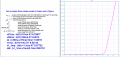
2019-05-20_11-04-18.png
Hi

Maybe a different approach is needed...
Repectfully MrAl....What problem are you trying to solve that isn't already solved using current spice modelling methods? Or maybe your just experimenting?

Just curious...

Edit: Oh...you posted just before I did...

eT
See
2019-05-20_10-45-21.png 2019-05-20_10-46-01.png
 
Last edited:

ebeowulf17

Joined Aug 12, 2014
3,307
Hi,

Yes i agree. What i was hoping for was maybe too great.
I had hoped to allow the user to set the knee voltage as one of the parameters in a zener model. But with all the confusion it may not work out in the long run.
What i found was that right now i can set three different voltage parameters and get a good fit to though three voltages, but one of the voltages has to be with low current while the other two more or less should be with higher current. For example i chose to start with current levels 0.001, 0.010, and 0.100 amps. But now i have to choose three voltage levels for each current level. I am looking at the best way to choose those voltages and i thought if there was any common ground with zeners maybe the knee voltage could be the middle one.
Still looking at this however and have not settled on anything yet.
Cool - it sounds like an interesting bit of investigation. FWIW, my earlier comment wasn't meant to be discouraging or anything. I think it's interesting to look at different ways of characterizing parts and systems.

And the point you raised at the beginning is a critical one. The way we perceive the meaning of graphed/charted data is *highly* dependent on how that data is presented. Anyone in the business of making design or purchasing decisions based on graphs should be very conscious of how that data is being shaped!
 

Thread Starter

MrAl

Joined Jun 17, 2014
13,722
Hi again,

Yes i agree. There are a lot fo specs too in the spice model as Bordo shows.

Now for a little possible humor, although this could be serious too.
I call this the "Wacky Zener" and by looking at the graph you will see what i mean.

Now the same question, more jokingly though, where is the knee now? ha ha

Now more seriously, i wonder if there could be a use for such a diode.
This one is a 3v zener for lower currents and a 6v zener for higher currents.

x axis is current, y axis is voltage

WackyZener-1.gif
 

Thread Starter

MrAl

Joined Jun 17, 2014
13,722
Quick, patent it.
You might be on to something.
Hi,

Yeah but then technicians would be complaining, "Where the heck is the God dang knee on this God dang zener?". Ha ha.

After this though i was giving some thought to a "designer" zener. I'll see what comes out of it. Calvin Klein zener diode ha ha.

This is all sort of a recouping of my affecting for multiple diode circuits in the 1980's.
One actual use was in a nonlinear sine converter where we input a triangle wave and get a sine out (typically used transistors back then).
 
Top