input resistance

MrAl

Joined Jun 17, 2014
13,704
They are reasonable to an extent. They suffer from the very big problem that they assume that you know what beta is, or at least that it is constrained to be within a pretty narrow margin. But with most small-signal transistors, the uncertainty in beta covers a range of a factor of five to ten, making the biasing selections difficult.

That paper uses one of four common large-signal models. Two are T-shaped topologies and two are pi-shaped topologies. In each topology, one is a current-driven model and the other is a voltage-driven model. They are all equivalent, but computationally they are not (meaning you do different computations but end up with the same end results). Which one is "best" depends on what you know and what you don't and how the transistor interacts with the circuitry around. One big problem with using either of the current-driven models is that you don't know beta very well, so it is usually better to use the voltage driven models when possible.

For small-signal models you have the same four options as far as models go. There is no requirement to use the same model for large signal as for small signal. In fact, that paper uses a current controlled pi model for large signal and a T-model for small signal. The hybrid-pi model is by far the more commonly used model, especially for some circuit topologies, because it can often neatly separate the input side of the circuit from the output side of the circuit with a very simple interaction between them. This is usually not the case with the T-model.

But in the cases of all of the models, the origin of all of the small-signal parameters is the application of superposition:

Define the following relations
i_C(t) = f(v_BE(t)) <<== Total response to total input
I_C(t) = f(V_BE(t)) <<== Large-signal response to large-signal input (almost always DC)
i_c(t) = f(v_be(t)) <<== Small-signal response to small-signal input

Then we HOPE to have the following:
v_BE(t) = V_BE(t) + v_be(t)
i_C(t) = f(V_BE(t) + v_be(t))
i_C(t) = f(V_BE(t)) + f(v_be(t)) <== This step uses superposition and therefore requires the circuit to behave linearly.
i_C(t) = I_C(t) + i_c(t)

The problem is that this DOES NOT WORK because f(v_be) is highly nonlinear. If you attempt to use the same model for both, you will get wrong results because the overall circuit behavior is highly non-linear and superposition is only valid for linear models.

The solution is use a DIFFERENT model of the transistor for the small-signal case than is used for the large-signal case.

I_C(t) = f(V_BE(t)) <<== Large-signal response to large-signal input (almost always DC) using a LARGE-SIGNAL model
i_c(t) = g(v_be(t)) <<== Small-signal response to small-signal input using a SMALL-SIGNAL model

Now we have
i_C(t) = f(V_BE(t)) + g(v_be(t)) <== This step uses superposition and therefore requires the circuit to behave linearly in the vicinity of f(V_BE(t)).
i_C(t) = I_C(t) + i_c(t)

Well, f(V_BE(t)) is whatever model adequately describes the relationship between i_C(t) and v_BE(t) for the entire region of interest (usually just the active region, as we generally want to avoid cutoff and saturation (but not always)). In other words, it simply the same model as would be used for f(v_BE(t)).

The Ebers-Moll model, either the basic model or one of the variants that incorporate other effects, such as the Early effect and high-frequency parasitics, are the usual choice.

But how due we get g(v_be)?

That comes down to calculus.

Given any continuous function, y(x), we can approximate y(x) in the vicinity of X_o using The first two terms of a Taylor series expansion:

\(
y \left( x \right) \; \approx \; y \left( X_0 \right) + y'(X_0) \left( x \; - \; X_0 \right)
\)

In case, y(x) is f(v_BE) which relates a current (the collector current) to a voltage (the base-emitter voltage).

X_o is the bias point, V_BE, and (x - X_o) is (v_BE - V_BE), which is simply v_be per our definition above.

Hence

\(
y \left( v_{BE} \right) \; \approx \; f \left( V_{BE} \right) + f'(V_{BE}) v_{be}
\)

Note that f'(v) is the rate of change of a current with respect to a voltage, hence it will have units of current per voltage. These happen to be the same units as conductance, and hence the reciprocal has units of resistance. However, in both cases it is NOT a conductance nor a resistance, which relates the voltage across a device to the current through that device, but rather a transconductance or a transresistance because it relates the current at one port (the collector) to the voltage across a different port (the base-emitter). Hence, just like a voltage-controlled current source in a DC circuit analysis problem, it is NOT a physical resistor.

So we define the small-signal transconductance, g_m, as

\(
g_m \; \equiv \; \left. \frac{ di_C \left( v_{BE} \right) ) }{ dv_{BE} } \right|_{V_{BE}}
\)

This means our g() function is

\(
g \left( v_{be} \right) \; = \; g_m \cdot v_{be}
\)

So what is gm for the basic Ebers-Moll model for a BJT transistor?

\(
i_C \; = \; I_S \left( e^{\frac{v_{BE}}{V_T}} \; - \; 1 \right) \; \approx \; I_S e^{\frac{v_{BE}}{V_T}} \\

g_m \; = \; \left. \frac{ di_C \left( v_{BE} \right) ) }{ dv_{BE} } \right|_{V_{BE}} \\

g_m \; = \; \left. \frac{d}{dv_{BE}} I_S e^{\frac{v_{BE}}{V_T}} \right|_{V_{BE}} \\

g_m \; = \; \left. \frac{ I_S e^{\frac{v_{BE}}{V_T}}}{V_T} \right|_{V_{BE}} \\

g_m \; = \; \frac{ I_S e^{\frac{V_{BE}}{V_T}}}{V_T} \\

g_m \; = \; \frac{ I_C }{V_T}
\)

Do you NOW see that THIS is how gm came to be associated with Ic/VT? That is was NOT defined as I_C/VT and then somehow, miraculously, we discovered that it was useful for small-signal analysis? It evolved directly from the very concept of crafting a linear small-signal model of the transistor's response in the vicinity of a large-signal bias point.

Furthermore, it ONLY has meaning within the small-signal portion of the response. It has NO meaning in the DC response. The DC current does NOT flow through re (which comes directly from backing out the T-model circuit equivalent using the small signal model relation above).

The DC response is ENTIRELY determined by the Ebers-Moll model (or whatever model is used) with NO NEED for ANY use of ANY of the parameters or results from g(v_be).


Also, do you see that re is NOT 1/gm?

It's close. Close enough that we often use it as an approximation. But can you see what it needs to be in order to make the T-model consistent with the mathematics of the small-signal model?

Now, if you want to expand the response so that it remains sufficiently valid for larger values of v_be, then the place to start is to add a quadratic term to the Taylor series expansion. But doing so would almost always (notice I am not saying always) be counterproductive, because the entire reason for using gm is because we either want a response that is very close to being linear or because we want to leverage the powerful tools we have at our disposal for designing and analyzing linear systems (and often both). If we don't want either of those, then there would seldom be a reason not to simply use the full model.

Hello again,

Well again you seem to be talking about other models and other techniques. That's not the point of this all the point is to start with the model they are calling "T" and go from there. It just doesnt matter what other techniques there are they will be a side note that's about it, and that is even if they are better than that one model shown.
I feel that you are right about some of this stuff but it just doesnt matter at least right now. The main point was if you understood the model they were showing on that and many other web sites and in books around the world.
I think you do though, at least in part, be cause you mentioned something about it being ok if we know what Beta is. But, that's another detail not needed at this time as that will come later just like any other design check would have. Later we can check on the effect of Beta.

I would think by now we all know there are better techniques to start with but I will still go over your notes though it looks interesting also.

So to recap:
There are better techniques to START with. This idea start with a PARTICULAR technique and goes from there. The idea is to improve on that particular technique and show an interesting problem that comes up.
It should be noted that the technique that is shown in that image before is an accepted technique and it isnt extremely bad but there are interesting ways to improve it that are not that hard to do or to implement.
This will all come out later.

I guess i have to say though if you are not interested in this then this idea will not do you any good. It's not the end of the world you can use whatever method you like im not suggesting that everyone suddenly switch to this method either. It's just another new look at an old method.
 

LvW

Joined Jun 13, 2013
2,027
As far as a know this model and technique have been around for years so if you dont accept that then you will have to just ignore this thread. I cant do anything about that sorry.
May I repeat my reply from post#99:
Do you want to discuss the validity of a small-signal model for the BJT which does exist since a long time and can be found in many textbooks?

Did I say I do not "accept" this model?
But again: What do you want? It is a model that reflects the same equations as the other two models (based on beta resp. transconductance). Do you want to discuss these equations again?

A quick look back:
In 5 contributions you wrote:

* post#92: "I think i should make a drawing too that could help explain what is happening and why i am doing this.
.......................
I think you should wait to reply again until i can supply a drawing to help explain what is happening here."

* post#93: „What i did do is try to explain that if we had a more ideal transistor it would have no 're'.................
However, i think you should wait until i can provide a drawing so i can help to clear up how the connections are made and where everything is.“


* post#94: „I think we do deserve a decent explanation of what anything new entails though, and since this is a new idea i hope to provide more details in a more clear way to explain the concepts involved.“

post#97: "...i have to ask a question .... I found this drawing and procedure on the web ..... some sites call this the "T" model ....Referring to the drawing, do you agree that the these steps shown are correct?

* post#100: "If you can not answer that there is no point in going any farther, that's why i asked. If you reject even that which has already been written in textbooks and apparently accepted main stream then i dont know what else to tell you.
If you cant answer yes or no without a huge discussion, then i have to take that as a 'no'.
As far as a know this model and technique have been around for years so if you dont accept that then you will have to just ignore this thread. I cant do anything about that sorry.

*****
My comments: Several times you have annouced to explain the thing you call "a new idea".
So I was waiting to learn something about the "ideal transistor" and the "new idea".
And what happens?
You suddenly are asking us in post#100 if we agree that the T-model would be correct.
Is it really necessary to confirm that I also consider Ohms and Kirchhoffs laws as correct - so that I don't have to be told by you that I would "reject" (your word) these laws? Funny "discussion".....
Again: What do you want ? I am waiting for the announced new ideas.
 
Last edited:

WBahn

Joined Mar 31, 2012
32,829
The main point was if you understood the model they were showing on that and many other web sites and in books around the world. I think you do though, at least in part, be cause you mentioned something about it being ok if we know what Beta is.
Understand it? At least in part?

Hell, I can derive it, and the three other standard models, directly from the Ebers-Moll equation without reference to any notes. Sit me in a room with some blank sheets of paper and a pen and I will walk through the derivation, step by step, of where those four circuit models, and each of the parameters in them, comes from. The models are extracted directly from the mathematical relationships.

You keep talking about them like they are some deep, dark, mysterious secret incantations from on high that are so difficult to understand.

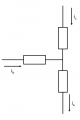
So for the current-driven T-model that you so love, let's do that.

We've already established the small-signal relationship between the collector current and the base-emitter voltage. Since ß (if constant) forms a linear relationship between the collector current and the base current, and since KCL is valid for the small-signal model as well (at the frequencies we are talking about, anyway), those survive to the small signal world. Leaving us with the following equations governing the small-signal relationships:

\(
1) \; g_m \; = \; \frac{I_C}{V_T} \\
2) \; i_c \; = \; g_m \cdot v_{be} \\
3) \; i_c \; = \; \beta \cdot i_b \\
4) \; i_e \; = \; i_c \; + \; i_b
\)

Equations 1 and 2 were derived in my prior post. Did you follow and do you agree with the validity of those derivations? If not, let's stop and come to agreement on them before proceeding.

Now all we need to do is construct a circuit that is governed by those three equations. There are multiple such circuits (four of which are the standard models that are widely used and covered in textbooks). We'll construct the current-driven T-model.

Would you agree that the following covers Equation 4?

1666536638416.png

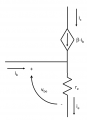
Would you agree that Equation 3 is that of a current-controlled current source located in the collector path, giving us:

1666537011855.png

Now let's come up with the relationship between vbe and ie.

\(
i_e \; = \; i_c \; + \; i_b \\
i_e \; = \; i_c \; + \; \frac{i_c}{\beta} \\
i_e \; = \; \left( 1 \; + \; \frac{1}{\beta} \right) \cdot i_c \\
i_e \; = \; \frac{\left( \beta \; + \; 1 \right)}{\beta} \cdot i_c \\
i_e \; = \; \frac{\left( \beta \; + \; 1 \right)}{\beta} \cdot g_m \cdot v_{be} \\
i_e \; = \; \left( \frac{\left( \beta \; + \; 1 \right)}{\beta} \cdot g_m \right) \cdot v_{be}
\)

Are we still in agreement?

So now I can write this last equation in the familiar form of Ohm's Law and define the proportionality constant as re, noting that it is NOT a physical resistance, but merely a constant of proportionality in a mathematical relationship.

\(
v_{be} \; = \; i_e \cdot \left( \frac{ \beta}{ \left( \beta \; + \; 1 \right) \cdot g_m} \right) \\
v_{be} \; = \; i_e \cdot r_e
\)

This is clearly modeled in our circuit as a resistor in the emitter path located between the base and emitter terminals as follows

1666539455182.png

So what is the value of re?

\(
r_e \; = \; \frac{ \beta }{ \left( \beta \; + \; 1 \right) \cdot g_m } \\
r_e \; = \; \frac{ \beta }{ \left( \beta \; + \; 1 \right) \cdot \frac{I_C}{V_T}} \\
r_e \; = \; \frac{V_T} { \left( \frac{ \left( \beta \; + \; 1 \right)}{ \beta } \cdot I_C \right) }
\)
At this point, we can recognize the denominator above as the emitter bias current

\(
I_E \; = \; \frac{ \left( \beta \; + \; 1 \right)}{ \beta } \cdot I_C
\)
leaving us with

\(
r_e \; = \; \frac{V_T}{I_E}
\)

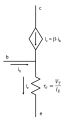
This gives us our final current-controlled T-model small-signal equivalent circuit.

1666539892928.png

I hope that constitutes, to your way of thinking, an understanding, at least in part, of this model.

So to recap:
There are better techniques to START with. This idea start with a PARTICULAR technique and goes from there. The idea is to improve on that particular technique and show an interesting problem that comes up.
It should be noted that the technique that is shown in that image before is an accepted technique and it isnt extremely bad but there are interesting ways to improve it that are not that hard to do or to implement.
This will all come out later.

I guess i have to say though if you are not interested in this then this idea will not do you any good. It's not the end of the world you can use whatever method you like im not suggesting that everyone suddenly switch to this method either. It's just another new look at an old method.
Frankly, I have no idea whether I'm interested in your idea or not, because you still haven't shown what it is. You have asked me several times to give you examples and I have. I have walked through numerous derivations for you. But every time I have asked you to show this new technique of yours, you have shifted the discussion. So it's pretty much time to put up or shut up, as this has long since started to sound like all of the other snake-oil sales pitches I have heard.
 

MrAl

Joined Jun 17, 2014
13,704
May I repeat my reply from post#99:
Do you want to discuss the validity of a small-signal model for the BJT which does exist since a long time and can be found in many textbooks?

Did I say I do not "accept" this model?
But again: What do you want? It is a model that reflects the same equations as the other two models (based on beta resp. transconductance). Do you want to discuss these equations again?

A quick look back:
In 5 contributions you wrote:

* post#92: "I think i should make a drawing too that could help explain what is happening and why i am doing this.
.......................
I think you should wait to reply again until i can supply a drawing to help explain what is happening here."

* post#93: „What i did do is try to explain that if we had a more ideal transistor it would have no 're'.................
However, i think you should wait until i can provide a drawing so i can help to clear up how the connections are made and where everything is.“


* post#94: „I think we do deserve a decent explanation of what anything new entails though, and since this is a new idea i hope to provide more details in a more clear way to explain the concepts involved.“

post#97: "...i have to ask a question .... I found this drawing and procedure on the web ..... some sites call this the "T" model ....Referring to the drawing, do you agree that the these steps shown are correct?

* post#100: "If you can not answer that there is no point in going any farther, that's why i asked. If you reject even that which has already been written in textbooks and apparently accepted main stream then i dont know what else to tell you.
If you cant answer yes or no without a huge discussion, then i have to take that as a 'no'.
As far as a know this model and technique have been around for years so if you dont accept that then you will have to just ignore this thread. I cant do anything about that sorry.

*****
My comments: Several times you have annouced to explain the thing you call "a new idea".
So I was waiting to learn something about the "ideal transistor" and the "new idea".
And what happens?
You suddenly are asking us in post#100 if we agree that the T-model would be correct.
Is it really necessary to confirm that I also consider Ohms and Kirchhoffs laws as correct - so that I don't have to be told by you that I would "reject" (your word) these laws? Funny "discussion".....
Again: What do you want ? I am waiting for the announced new ideas.
Yes this is a tiny pause because if you do not accept the T model and re then you wont be interested in this so there would be no point in showing a bunch of circuits and details if you are only going to run it down into the ground again with tales of gm (ha ha).
But if you accept this then i think you may find it interesting if nothing else.
See it all starts with the T model with re and the standard procedure used to initiate a new design (one transistor for now).
I do hope you find it interesting at some point.
 

MrAl

Joined Jun 17, 2014
13,704
Understand it? At least in part?

Hell, I can derive it, and the three other standard models, directly from the Ebers-Moll equation without reference to any notes. Sit me in a room with some blank sheets of paper and a pen and I will walk through the derivation, step by step, of where those four circuit models, and each of the parameters in them, comes from. The models are extracted directly from the mathematical relationships.

You keep talking about them like they are some deep, dark, mysterious secret incantations from on high that are so difficult to understand.

So for the current-driven T-model that you so love, let's do that.

We've already established the small-signal relationship between the collector current and the base-emitter voltage. Since ß (if constant) forms a linear relationship between the collector current and the base current, and since KCL is valid for the small-signal model as well (at the frequencies we are talking about, anyway), those survive to the small signal world. Leaving us with the following equations governing the small-signal relationships:

\(
1) \; g_m \; = \; \frac{I_C}{V_T} \\
2) \; i_c \; = \; g_m \cdot v_{be} \\
3) \; i_c \; = \; \beta \cdot i_b \\
4) \; i_e \; = \; i_c \; + \; i_b
\)

Equations 1 and 2 were derived in my prior post. Did you follow and do you agree with the validity of those derivations? If not, let's stop and come to agreement on them before proceeding.

Now all we need to do is construct a circuit that is governed by those three equations. There are multiple such circuits (four of which are the standard models that are widely used and covered in textbooks). We'll construct the current-driven T-model.

Would you agree that the following covers Equation 4?

View attachment 279150

Would you agree that Equation 3 is that of a current-controlled current source located in the collector path, giving us:

View attachment 279151

Now let's come up with the relationship between vbe and ie.

\(
i_e \; = \; i_c \; + \; i_b \\
i_e \; = \; i_c \; + \; \frac{i_c}{\beta} \\
i_e \; = \; \left( 1 \; + \; \frac{1}{\beta} \right) \cdot i_c \\
i_e \; = \; \frac{\left( \beta \; + \; 1 \right)}{\beta} \cdot i_c \\
i_e \; = \; \frac{\left( \beta \; + \; 1 \right)}{\beta} \cdot g_m \cdot v_{be} \\
i_e \; = \; \left( \frac{\left( \beta \; + \; 1 \right)}{\beta} \cdot g_m \right) \cdot v_{be}
\)

Are we still in agreement?

So now I can write this last equation in the familiar form of Ohm's Law and define the proportionality constant as re, noting that it is NOT a physical resistance, but merely a constant of proportionality in a mathematical relationship.

\(
v_{be} \; = \; i_e \cdot \left( \frac{ \beta}{ \left( \beta \; + \; 1 \right) \cdot g_m} \right) \\
v_{be} \; = \; i_e \cdot r_e
\)

This is clearly modeled in our circuit as a resistor in the emitter path located between the base and emitter terminals as follows

View attachment 279154

So what is the value of re?

\(
r_e \; = \; \frac{ \beta }{ \left( \beta \; + \; 1 \right) \cdot g_m } \\
r_e \; = \; \frac{ \beta }{ \left( \beta \; + \; 1 \right) \cdot \frac{I_C}{V_T}} \\
r_e \; = \; \frac{V_T} { \left( \frac{ \left( \beta \; + \; 1 \right)}{ \beta } \cdot I_C \right) }
\)
At this point, we can recognize the denominator above as the emitter bias current

\(
I_E \; = \; \frac{ \left( \beta \; + \; 1 \right)}{ \beta } \cdot I_C
\)
leaving us with

\(
r_e \; = \; \frac{V_T}{I_E}
\)

This gives us our final current-controlled T-model small-signal equivalent circuit.

View attachment 279157

I hope that constitutes, to your way of thinking, an understanding, at least in part, of this model.


Frankly, I have no idea whether I'm interested in your idea or not, because you still haven't shown what it is. You have asked me several times to give you examples and I have. I have walked through numerous derivations for you. But every time I have asked you to show this new technique of yours, you have shifted the discussion. So it's pretty much time to put up or shut up, as this has long since started to sound like all of the other snake-oil sales pitches I have heard.
Ok but you have to pay me 5 dollars first (ha ha).

Ok i can agree with your synopsis but really you went through all that when all you had to do was reply with "yes" :)

Ok i'll get back here with a circuit which explains everything. The sad part is this is a very simple idea maybe not worthy of so much discussion, but it is interesting.

@Jony130
I think it was you that i gave the equation for this too a while back. I dont remember the date unfortunately, but if you still have it you can post it here if you like.
 

LvW

Joined Jun 13, 2013
2,027
Yes this is a tiny pause because if you do not accept the T model and re then you wont be interested in this so there would be no point in showing a bunch of circuits and details if you are only going to run it down into the ground again with tales of gm (ha ha).
Are you really interested in a technical discussion?
You announced five times that you would surprise us with a completely new idea - and what happens?
Instead, you try to insinuate with false claims that I would no longer have any interest in your invention.
Are you looking for an explanation for not showing your "new idea"?
I can no longer take your statements seriously.

May I remind again you what I wrote in this context?

* The same applies to the so-called T-form for a small-signal equivalent circuit diagram
..................
* There is absolutely no necessity to have a third small-signal representation (in addition to the well known two diagrams) - even if it works ........
* Do you want to discuss the validity of a small-signal model for the BJT which does exist since a long time and can be found in many textbooks?


So - I have mentioned only that I do not use these models (and especially consider the T-model as misleading).
But all models visualize the known (simplified) transistor equations. How can you claim that I "do not accept" them?

I am still waiting for your invention (your "new design").
 
Last edited:

LvW

Joined Jun 13, 2013
2,027

MrAl

Joined Jun 17, 2014
13,704
No need to get rude and uppity i am preparing the drawings and the calculations.
I may start a new thread for this though leave this one alone.
The other thread somebody started looks interesting too about the transistor gain calculations. I may not get time to reply in that one though unfortunately.
 

MrAl

Joined Jun 17, 2014
13,704
Hello again,

Any ideas on the best section on this forum to start the new thread?
I'm not sure it would be good in the homework section as it will reveal possibly too much about a common homework type circuit. Equations for Vdc out and AC gain and the like.
 

WBahn

Joined Mar 31, 2012
32,829
Hello again,

Any ideas on the best section on this forum to start the new thread?
I'm not sure it would be good in the homework section as it will reveal possibly too much about a common homework type circuit. Equations for Vdc out and AC gain and the like.
If the focus is on the math, then General Science, Physics & Math is a possibility, but Analog & Mixed Signal Design might be a better match.
 
Top