input resistance

BobTPH

Joined Jun 5, 2013
11,515
The single resistor biasing scheme is essentially driving the base with a current source, and the collector current varies with beta.

A stiff voltage divider biases it with a voltage source and the collector current rises to the level at which the emitter resistor drop is roughly 0.6V less than the base voltage. This does not depend strongly on beta.

It is obvious to me which is preferred.
 

LvW

Joined Jun 13, 2013
2,026
The single resistor biasing scheme is essentially driving the base with a current source, and the collector current varies with beta.

A stiff voltage divider biases it with a voltage source and the collector current rises to the level at which the emitter resistor drop is roughly 0.6V less than the base voltage. This does not depend strongly on beta.

It is obvious to me which is preferred.
Yes - undoubtly, this is true. It has been shown that biasing with a low-resistive voltage divider - together with Re-feedback - is the best method to compensate for undesired temperature effects as well as B tolerances (B=Ic/Ib), see also WBahn`s contributiuion in post#49 (comparison of two biasing schemes).
 
Last edited:

MrAl

Joined Jun 17, 2014
13,704
What's so amazing about it?


So? What is your point? You are acting like a troll.


Who's in love with gm but hates re?

Both are simply components in slightly different, but equivalent, versions of the T-model BJT small-signal equivalent circuit.


By all means, PLEASE show how you would design your single resistor biasing circuit for the base in order to park the quiescent output voltage near the 5 V goal you specified.


You still don't seem to be able to grasp the huge difference between these two situations. It appears that you think that assuming that gm is constant at a particular bias point is no different that assuming that beta is constant at a particular bias point. Fine. Let's make both of those assumptions (both of which are quite reasonable).

Here's the difference. Please. Try to follow this. It's important.

Give me a bias point and I can give you a value for gm and re that varies only modestly from the calculated values regardless of which transistor you pull out of a bag. Pull out a 2n3904 manufactured a year ago, or a 2n2222 manufactured twenty years ago, or a BC847 manufactured a decade ago it doesn't matter. The actual gm (or re) for that transistor will be reasonably close to that value.

But what value are you going to use for beta? Even if we stipulate that the value for a given transistor operating at a given bias point is reasonably constant, what is that value? Is that value going to be reasonably close to the actual value regardless of which transistor you pull out of that bag?


That would be a refreshing change.

I repeated your reply and for my reply to that i used the markers ">>" because it's faster to reply.


MrAl said:
It's amazing how much has been written about a single three terminal component in books and on the web.

What's so amazing about it?
>>There are only three terminals yet hundreds or thousands of books written on it.


But dont you use gm in a small signal analysis? That would mean you keep it constant for that ONE level of dc bias. That's what i was talking about not about the same gm for every circuit no matter what the dc bias is.

So? What is your point? You are acting like a troll.
>>You should know by now my interest in this stuff means that cant possibly be true.
>>One of my points was that we dont have to keep gm a constant, even in the same circuit. In other words, make:
>>gm=gm(i) where i is emitter current.

Also, so what would be wrong with using 're' then if it is just the inverse of gm. I see people in love with gm but hate re for some reason.

Who's in love with gm but hates re?
>>Most of the posts i have read so far talk about gm but none about re except in a negative light.

Both are simply components in slightly different, but equivalent, versions of the T-model BJT small-signal equivalent circuit.

I'm not too worried about single resistor or double resistor biasing in fact i would rather use a voltage divider too as i said i just wanted to use the single resistor to keep things simpler, but in fact it's not that much more of a bother to use the voltage divider so i can stick to that.

By all means, PLEASE show how you would design your single resistor biasing circuit for the base in order to park the quiescent output voltage near the 5 V goal you specified.
>>I am not sure why you are still asking about the single resistor bias didnt we agree the voltage divider was better.

The Beta varies and so does gm, but gm is usually taken to be constant for one bias point for SS analysis.

You still don't seem to be able to grasp the huge difference between these two situations. It appears that you think that assuming that gm is constant at a particular bias point is no different that assuming that beta is constant at a particular bias point. Fine. Let's make both of those assumptions (both of which are quite reasonable).
Here's the difference. Please. Try to follow this. It's important.
Give me a bias point and I can give you a value for gm and re that varies only modestly from the calculated values regardless of which transistor you pull out of a bag. Pull out a 2n3904 manufactured a year ago, or a 2n2222 manufactured twenty years ago, or a BC847 manufactured a decade ago it doesn't matter. The actual gm (or re) for that transistor will be reasonably close to that value.
But what value are you going to use for beta? Even if we stipulate that the value for a given transistor operating at a given bias point is reasonably constant, what is that value? Is that value going to be reasonably close to the actual value regardless of which transistor you pull out of that bag?
>>Yes i understand what you are saying, but i was not saying that we should keep Beta constant just that gm is always taken to be constant for SS analysis. As you say, maybe Beta can be too that's fine. You dont see this too often if at all though you mostly see gm being held constant.

I'll show some calculations soon.

That would be a refreshing change.
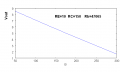
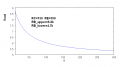
>>Ok i provided two plots: one for single R bias and another for voltage divider bias. As expected, the voltage divider scheme is better as the single resistor version is only useful within a small range of Beta. But i never brought that up you did. That was never part of my point(s).
>>My point was going to be that gm never has to be held constant. If we know how to calculate gm why keep it constant. It's only held constant to 'simplify' the circuit calculations which it in fact does. But if we dont keep it constant but make it a variable just like any other variable we get to use it in a more unrestricted way.
>>Let me quickly illustrate this idea using a different, simple approach.
>>If we have an equation y=x+K then we simply add the two x and K, but if K varies for other reasons, we can make K very simply a function instead of a constant, then we dont have to pussy foot around the fact that it is not always constant. It's that simple. So we simply include the variation in the analysis, that's all there is too it. What do you think about that.
 

Attachments

MrAl

Joined Jun 17, 2014
13,704
The single resistor biasing scheme is essentially driving the base with a current source, and the collector current varies with beta.

A stiff voltage divider biases it with a voltage source and the collector current rises to the level at which the emitter resistor drop is roughly 0.6V less than the base voltage. This does not depend strongly on beta.

It is obvious to me which is preferred.
Hi,

I dont know why this was brought up i didnt see anyone mention that it had to be any different than that. I sure didnt yet i got replies that somehow implied that we should talk about that. Maybe it is important, but the single resistor bias we just meant to make calculations simpler not to prove that it was somehow adequate and certainly not better than the voltage divider bias. See my plots in my previous post and the difference is very clear even though i used a more favorable resistor value for RE.
 

LvW

Joined Jun 13, 2013
2,026
>>My point was going to be that gm never has to be held constant. If we know how to calculate gm why keep it constant. It's only held constant to 'simplify' the circuit calculations which it in fact does. But if we dont keep it constant but make it a variable just like any other variable we get to use it in a more unrestricted way.
Do you know the physical meaning of the transconductance gm ?
It is the slope of the Ic=f(Vbe) characteristic in the selected (and fixed) bias point - determined by the DC current Ic.
So - why do you think that "gm never has to be held constant" and what do you mean with "..make it a variable..."?

I remember one important application where gm is not held constant: A differential amplifier (long-tailed pair) used as a multplier (AM modulator).
In this case, the current source in the common emitter path delivers a modulated current to the amplifying transistors. This results in varying bias conditions for the two transistors (gain is modulated).
 
Last edited:

BobTPH

Joined Jun 5, 2013
11,515
Hi,

I dont know why this was brought up i didnt see anyone mention that it had to be any different than that. I sure didnt yet i got replies that somehow implied that we should talk about that. Maybe it is important, but the single resistor bias we just meant to make calculations simpler not to prove that it was somehow adequate and certainly not better than the voltage divider bias. See my plots in my previous post and the difference is very clear even though i used a more favorable resistor value for RE.
I was simply adding my perspective on why the voltage divider is needed, not trying to argue with anyone. A beginner, reading this thread, might not know this.
 

WBahn

Joined Mar 31, 2012
32,829
>>Ok i provided two plots: one for single R bias and another for voltage divider bias. As expected, the voltage divider scheme is better as the single resistor version is only useful within a small range of Beta. But i never brought that up you did. That was never part of my point(s).
>>My point was going to be that gm never has to be held constant. If we know how to calculate gm why keep it constant. It's only held constant to 'simplify' the circuit calculations which it in fact does. But if we dont keep it constant but make it a variable just like any other variable we get to use it in a more unrestricted way.
>>Let me quickly illustrate this idea using a different, simple approach.
>>If we have an equation y=x+K then we simply add the two x and K, but if K varies for other reasons, we can make K very simply a function instead of a constant, then we dont have to pussy foot around the fact that it is not always constant. It's that simple. So we simply include the variation in the analysis, that's all there is too it. What do you think about that.
If you want to work in a less restricted way, then don't bother with gm at all -- simply use the full Ebers-Moll in your analysis.

The whole point of gm and the other small-signal models is to create a LINEAR model of the circuit behavior about an operating point. As soon as you let gm vary about that point, you have a nonlinear model and have defeated the entire purpose.

Please show a practical circuit example where you let gm vary and where you use that in a meaningful and useful way.
 

MrAl

Joined Jun 17, 2014
13,704
Do you know the physical meaning of the transconductance gm ?
It is the slope of the Ic=f(Vbe) characteristic in the selected (and fixed) bias point - determined by the DC current Ic.
So - why do you think that "gm never has to be held constant" and what do you mean with "..make it a variable..."?

I remember one important application where gm is not held constant: A differential amplifier (long-tailed pair) used as a multplier (AM modulator).
In this case, the current source in the common emitter path delivers a modulated current to the amplifying transistors. This results in varying bias conditions for the two transistors (gain is modulated).
Hi,

That sounds like a good example.
When we have a variable like gm that is held constant for whatever reason and then we see a reason to make it a function, it doesnt change much except then we can work it into the equations.
A resistor might be a good example.
Say we have a resistor R that is used in a circuit. It has a variable resistance depending on some other variable, but to linearize it at a given operating point we call it constant. That simplifies things sometimes when it is practical. if we dont mind just a little more work though then we can keep it a variable and keep the dependency on the other variable.
This example is simple:
E=i*R
where i varies and R is held constant for some operating point where i does not change too much.
If we used the full definition though, it would be (example):
E=i*R(i)
where we can see that R depends on i.
What this does is it gives us more flexibility in that we dont have to be bothered with a single value of R and have to keep recalculating for every new circuit or new operating point. So this tells the whole story in a nutshell.
It's a little more complicated because now we need to know the function of R such as:
R(i)=i*2.345
or some more complicated function, but now we never have to linearize R again.
So there are advantages as well as a bit more complication. If the complications are not that much more, then maybe we have something better to use now. But also, sometimes we can get rid of R(i) altogether. When we write it now it becomes:
E=i*i*2.234
which is of course:
E=2.234*i^2
and now we dont even have to think about R(i) itself anymore.
So by letting gm vary as gm(ie) where ie is the emitter current, we can eliminate gm altogether. We do have to keep VT in it though (the thermal voltage) i think because that's part of the original definition, but we never have to calculate gm again with a new formula. This goes the same with re or as sometimes written r'e.
 

MrAl

Joined Jun 17, 2014
13,704
If you want to work in a less restricted way, then don't bother with gm at all -- simply use the full Ebers-Moll in your analysis.

The whole point of gm and the other small-signal models is to create a LINEAR model of the circuit behavior about an operating point. As soon as you let gm vary about that point, you have a nonlinear model and have defeated the entire purpose.

Please show a practical circuit example where you let gm vary and where you use that in a meaningful and useful way.
Hello again,

If you want to see a practical example just go back to the two plots i had shown in post #63. They came from this kind of analysis.

Yes i realize we can use other models, this is just another way of doing it. Yes another book (ha ha).
 

WBahn

Joined Mar 31, 2012
32,829
Hello again,

If you want to see a practical example just go back to the two plots i had shown in post #63. They came from this kind of analysis.

Yes i realize we can use other models, this is just another way of doing it. Yes another book (ha ha).
Those are not practical examples of letting gm vary, they merely show the impact in the variation of output voltage with beta for two different biasing schemes.
 

MrAl

Joined Jun 17, 2014
13,704
Those are not practical examples of letting gm vary, they merely show the impact in the variation of output voltage with beta for two different biasing schemes.
Ok not sure what you want here, but those plots were done by letting gm vary as explained earlier and then plotting the output DC voltage vs Beta which is what i thought we were after. After letting gm vary as explained it disappears from the formula for output DC voltage. I dont think this should be too much of a surprise though because when we have a circuit with a dependent source (even though that may not the exactly the same thing) we can often come up with a formula that does not have to include that dependent source. It gets absorbed into the equations.
A simpler example would be:
y=i*R1+R(i)
where R1 is fixed and R(i) varies with current. If we know that R(i)=K*i then we can reduce that to:
y=i*R1+K*i
which of course reduces to:
y=i*(R1+K)
which can in turn reduce to:
y=i*R2
So we went from an expression with a function to a simpler expression.

Unfortunately it does not always turn out to be simpler in fact can come out more complicated. That is a drawback but the advantage is we get away with not having to keep specifying that extra function in the final expression and that means it becomes very compatible with an automatic computer calculation algorithm which can be embedded into a larger program that does something useful. I guess another benefit is we dont have to keep calculating something like gm over and over again for each new circuit or new bias point, because that itself becomes embedded into the new formula(s).

I used the proverbial 're' to start with but if someone wanted to start with the actual gm that would be interesting to see, and it should come out the same. Instead of eliminating 're' we would be eliminating 'gm'.

I guess what spurned this on was that so many people kept quoting 'gm' in some formula and i realized that we had to keep recalculating it for each new bias point and i though that was not quite modern enough. It's not that i want everyone to start using some new formula, i just wanted to look into it myself and see what would come of it. It turned out to be interesting. In fact, since the usual goal is to set the output DC to 1/2 of Vcc, that could be built into it also and that simplifies the formula as well. We can then start to specify the circuit in terms of what we really want to set, such as AC gain, output impedance, input impedance.
 

LvW

Joined Jun 13, 2013
2,026
To MrAl.
Hello again,
I am trying to understand your point and the meaning of the two plots you have provided in post#63.
For my opinion, you should have given some more information about your analysis.
Therefore my question here.

Post#63: "Ok i provided two plots: one for single R bias and another for voltage divider bias. As expected, the voltage divider scheme is better as the single resistor version is only useful within a small range of Beta."

Please, tell me which plot belongs to which case - and why one plot looks "better" as the other one ?
More than that, to me it is not clear how to interpret these plots: A varying bias point for varying the paramemer B?

Post#71: "those plots were done by letting gm vary as explained earlier and then plotting the output DC voltage vs Beta which is what i thought we were after. After letting gm vary as explained it disappears from the formula for output DC voltage "

Here you state that the transconductance is varied - that means: You have varied the DC collector current (and with it the DC operating point)? How then can you plot Vc=f(B) ? Did you vary gm and B at the same time? I am a bit confused.
Could you, please, clarify?
More than that, may I ask which formula do you refer to in your last sentence?
 

WBahn

Joined Mar 31, 2012
32,829
Ok not sure what you want here, but those plots were done by letting gm vary as explained earlier and then plotting the output DC voltage vs Beta which is what i thought we were after.
How does gm have ANYTHING to do with plotting the DC output voltage vs beta?

You varied beta!

After letting gm vary as explained it disappears from the formula for output DC voltage.
Of COURSE it disappeared! Because it has NOTHING to do with the DC output voltage! The DC output voltage is the LARGE-SIGNAL response and gm parameterizes the SMALL-SIGNAL response.

To get your single-resistor bias plot, all you have to do is look at the large-signal response.

Vout = Vcc - Ic·Rc

Ic = ß·Ib

Ib = (Vcc - Vb) / Rb

Vb = Ve + Vbe

Ve = Ie·Re

Ie = Ib + Ic

Six equations and seven unknown (including ß), so we can solve for Vout as a function of ß.

No gm anywhere in sight.

The result is

\(
V_{out} \; = \; V_{CC} \; - \; \frac{ \left( V_{CC} \; - \; V_{BE} \right) R_C }{ \frac{\beta}{\left( \beta + 1 \right) }R_E \; + \; \frac{1}{\beta}R_B}
\)

I'm going to go out of a limb here and guess at what you did.

You took the equation that yields gm as a function of Ic (or Ie, depending on which source you refer to)

gm = Ic/VT

and inverted that to get

Ic = gm·VT

and then let gm vary to yield different values of Ic. But that's a sham, since Ic does not depend on gm (it's the other way around).
 
Last edited:

MrAl

Joined Jun 17, 2014
13,704
To MrAl.
Hello again,
I am trying to understand your point and the meaning of the two plots you have provided in post#63.
For my opinion, you should have given some more information about your analysis.
Therefore my question here.

Post#63: "Ok i provided two plots: one for single R bias and another for voltage divider bias. As expected, the voltage divider scheme is better as the single resistor version is only useful within a small range of Beta."

Please, tell me which plot belongs to which case - and why one plot looks "better" as the other one ?
More than that, to me it is not clear how to interpret these plots: A varying bias point for varying the paramemer B?

Post#71: "those plots were done by letting gm vary as explained earlier and then plotting the output DC voltage vs Beta which is what i thought we were after. After letting gm vary as explained it disappears from the formula for output DC voltage "

Here you state that the transconductance is varied - that means: You have varied the DC collector current (and with it the DC operating point)? How then can you plot Vc=f(B) ? Did you vary gm and B at the same time? I am a bit confused.
Could you, please, clarify?
More than that, may I ask which formula do you refer to in your last sentence?
Hello again,

I dont see how this should be confusing but this may be something new so let's see.

If you start from some bias point you have a particular gm. But that involves a fixed Beta because if you change the Beta the bias point must change, and that changes the collector current. The collector current changes and the emitter current changes yet VT the thermal voltage stays constant. That means gm changes. But if gm is already in the formula then the only difference is you dont have to calculate gm separately.
 

MrAl

Joined Jun 17, 2014
13,704
How does gm have ANYTHING to do with plotting the DC output voltage vs beta?

You varied beta!


Of COURSE it disappeared! Because it has NOTHING to do with the DC output voltage! The DC output voltage is the LARGE-SIGNAL response and gm parameterizes the SMALL-SIGNAL response.

To get your single-resistor bias plot, all you have to do is look at the large-signal response.

Vout = Vcc - Ic·Rc

Ic = ß·Ib

Ib = (Vcc - Vb) / Rb

Vb = Ve + Vbe

Ve = Ie·Re

Ie = Ib + Ic

Six equations and seven unknown (including ß), so we can solve for Vout as a function of ß.

No gm anywhere in sight.

The result is

\(
V_{out} \; = \; V_{CC} \; - \; \frac{ \left( V_{CC} \; - \; V_{BE} \right) R_C }{ \frac{\beta}{\left( \beta + 1 \right) }R_E \; + \; \frac{1}{\beta}R_B}
\)

I'm going to go out of a limb here and guess at what you did.

You took the equation that yields gm as a function of Ic (or Ie, depending on which source you refer to)

gm = Ic/VT

and inverted that to get

Ic = gm·VT

and then let gm vary to yield different values of Ic. But that's a sham, since Ic does not depend on gm (it's the other way around).
Hi,

I thought we got past the "large signal vs small signal" discussion when i said i was eliminating the need to calculate gm especially for the bias point. Let me try to show this in a different way.

We find a circuit, it has an output of 4v DC and a supply voltage of 8v DC. The gm is calculated to be gm1.
Now we change the Beta to see how it affects the output voltage, the output changes to something other than 4v. The gm changes to gm2.
So we went from gm1 to gm2 by changing the Beta.
So with gm1 we calculate the small signal response we get a gain of G1. Then with gm2 we calculate the small signal response we get a gain of G2.
So we got two different gains and two different output DC voltages.

Ok, so now if we had a formula that takes both gm's into account within the formula itself we would not have to calculate gm1 and gm2 to get the gain we could just use the formula. We also get the DC operating points.
So it's like a combination of large signal and small signal in the same formula, and it is going to be more 'accurate' at least in theory because now we never have to assume that gm is constant, even for a small signal response. That's more of a side point though because it's probably not too much different except for larger 'small' signals.

Does this at least make some sense now?

As i was saying, this kind of thing isnt too different than with other situations where we can come up with a more all encompassing formula for some circuit or process. It works because some parameters are strongly related to other parameters that are already given. If we know the relationship we might be able to eliminate some of those parameters. We do this all the time with Thevenin and Norton equivalents, eliminating much of the calculation in favor of a simpler representation or more favorable form. Really it's just algebra. If a=b and b=c we may not need b anymore to get to c.
 

WBahn

Joined Mar 31, 2012
32,829
I thought we got past the "large signal vs small signal" discussion when i said i was eliminating the need to calculate gm especially for the bias point.
But you DIDN'T eliminate the need to calculate gm for the bias point -- that need was never there! You invented the need in a contrived fashion just to then claim that you eliminated it.

But put your (virtual) money where your mouth is. You claim that you've come up with a way to eliminate calculating gm. Fine.

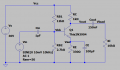
1666161563832.png

Without calculating gm (or any other small signal parameters, since you are past that), what does Vload look like?

Don't just throw it in a simulator and parrot the results, show your calculations.

Be sure to show that your calculations take a varying gm into account, since that is the big claim you are making about your approach.
 

LvW

Joined Jun 13, 2013
2,026
If you start from some bias point you have a particular gm. But that involves a fixed Beta because if you change the Beta the bias point must change, and that changes the collector current.
Sorry to say - but this is wrong.
That does NOT involve beta. The bias point (that means: Ic) is changed by modifying the voltage Vbe - because Ic depend on Vbe.
Remember: Even you are using the relation gm=Ic/VT.
And this relation is derived from the exponential voltage-control function Ic=f(Vbe).
For a fixed collector current Ic the transconductance gm has a certain value, which is determined by Vbe only - for B=100 or for B=200..(does not matter).
The only difference is in the signal input resistance rbe at the base - for a smaller B-value the base current Ib is larger and the resistance rbe is smaller (rbe=hie=VT/Ib).

Quote: " I dont see how this should be confusing"
My comment: Unfortunately, you didn't clear up the confusion - you did not give any answer to my questions in post#72.
 
Last edited:

MrAl

Joined Jun 17, 2014
13,704
But you DIDN'T eliminate the need to calculate gm for the bias point -- that need was never there! You invented the need in a contrived fashion just to then claim that you eliminated it.

But put your (virtual) money where your mouth is. You claim that you've come up with a way to eliminate calculating gm. Fine.

View attachment 278808

Without calculating gm (or any other small signal parameters, since you are past that), what does Vload look like?

Don't just throw it in a simulator and parrot the results, show your calculations.

Be sure to show that your calculations take a varying gm into account, since that is the big claim you are making about your approach.
Ok if i can get to that i will, but not exactly sure what you mean by what does Vload look like.
I was mainly concerned with the DC bias point for now, but you seem to say that gm does not matter for the DC bias point. To be clear though, i used 're' not 'gm', but i assumed that since they were simply related that it would not matter which i mentioned, but just to be clear i did use 're'. As you probably know, 're' is considered part of the transistor and it doesnt go away just because we are forming the bias of the network. It could be significant or less but in any case it does not just disappear, so i would think 'gm' also does not simply go away for the biasing part of the calculation. Am i wrong? I dont see how but if you think so tell me why. What i think is the reason someone might say that is because they dont use it for the biasing, they only use it for the AC again or something. I doubt you are alone in that too and i know there may be a good reason for that but that reason is probably to simplify the process of design certainly not for more accuracy even if just theoretical, and after all it's hard to get a super accurate calculation with the number of inaccessible factors that go into a circuit like this such as Vbe selection and as you know with the Beta variation we have to check at least a few different points.

In fact, i seem to remember a design procedure that calculated re during the biasing phase, then recalculated re after, then recalculated it another time (three times i think it was) in order to be sure the biasing point was correct.
Now i could see it if it was 0.1 Ohm and RE was 100 Ohms or maybe even 10 Ohms, but if it turned out to be 25 Ohms that would affect the bias point as well as the AC gain. Note i use the units of Ohms because that's the typical way to describe this 'resistor' when some would rather we say "volts per amp" or something like that.
 

MrAl

Joined Jun 17, 2014
13,704
Sorry to say - but this is wrong.
That does NOT involve beta. The bias point (that means: Ic) is changed by modifying the voltage Vbe - because Ic depend on Vbe.
Remember: Even you are using the relation gm=Ic/VT.
And this relation is derived from the exponential voltage-control function Ic=f(Vbe).
For a fixed collector current Ic the transconductance gm has a certain value - for B=100 or for B=200......
The only difference is in the signal input resistance rbe at the base - for a smaller B-value the base current Ib is larger and the resistance rbe is smaller (rbe=hie=VT/Ib).

Quote: " I dont see how this should be confusing"
My comment: Unfortunately, you didn't clear up the confusion - you did not give any answer to my questions in post#72.
What is wrong? Not sure i know what you mean here. If the circuit is sitting there in steady state and Beta changes, the collector current changes. How can that be wrong?

Vbe is part of what changes also because as the current increases Vbe increases, and that's because Vbe is measured externally not internally. This means the the drop across re is part of Vbe.

gm isnt really Ic/VT it is Ie/VT isnt it? But i use VT/Ie. Ic/VT is used as a matter of convenience because in most cases Ic is almost equal to Ie. But yes for a fixed collector current gm is constant because the emitter current is considered constant.

What i said was not confusing is that any function that is made part of another function results in just one function rather than two. THAT should be absolutely not confusing and if it is then i dont know what to tell you as this is done with a lot of things. Do you understand how one function can be made part of another function so that we then only have to deal with just one function? Dont worry about this particular case of the transistor right now for this question.
 

MrAl

Joined Jun 17, 2014
13,704
Hello again,

Here is what i think was one of the formulas that came out of this. I just have to figure out if i modified it later this was taken from older notes, but it looks right. This is for the direct calculation of re.

re=(2*Rc*B*VT)/(Vcc*(B+1))

where Rc is the collector resistance, VT the thermal voltage (i use 0.026), Vcc is the supply voltage, B is Beta.
One of the assumptions is that Vout is 1/2 of Vcc (DC bias point).
Not sure if this is relevant but the bias network is the voltage divider not the single resistor. It could be that it works with the single resistor too though as it doesnt seem to matter, but i didnt check that because nobody really does that.

Things to note:
Once that is incorporated into the network re no longer has to be calculated, even for the gain, because the gain has a similar simplification that since the above re is already in we dont need to calculate it again.
There is no RE (external emitter resistance) in the formula as it is not needed.
The total resistance at the ideal emitter (internally) would then be RE+re. That affects the gain of course.
I could be that re turns out to be a small percentage of RE on the order of 4 percent maybe even only 3 percent. If that is true it could mean the calculation is just in theory more than practical, although there are other practical aspects to look at.
 
Top