Increased current and a resistor

Thread Starter

Drmario5237

Joined Oct 14, 2018
65
Hello Let's say you have a current source that keeps on increasing in current and voltage and you have two outputs from that source one with a resistor and one leading to ground . Will the resistor limit the amount of current/voltage coming out of that output and cause the rest of the current/voltage go to ground without blowing the resistor or will equal amounts of current go to the resistor and ground eventually, because the current/voltage is increasing, blow up the resistor anyways. Thanks.
 

MaxHeadRoom

Joined Jul 18, 2013
30,654
Current source cannot continually increase in current, it is entirely due to the load placed on it and the voltage level.
Simple Ohms law.
What is the application?
Max..
 

crutschow

Joined Mar 14, 2008
38,503
I'm not clear on what you are asking.
Does this current source have 1 output or two separate outputs, each with the same current.
 

AnalogKid

Joined Aug 1, 2013
12,126
If the two current sources really are independent, then what you do to one will not affect the other.

If you have a constant current source connected directly to ground, then all of the power dissipation is in the current source circuit, probably in the output transistor.

For the output with the resistor, is the other end of the resistor connected to anything. You don't say anything about that in either post.

If none of this is helpful, that is because your question is not at all clear.

ak
 

Thread Starter

Drmario5237

Joined Oct 14, 2018
65
If the two current sources really are independent, then what you do to one will not affect the other.

If you have a constant current source connected directly to ground, then all of the power dissipation is in the current source circuit, probably in the output transistor.

For the output with the resistor, is the other end of the resistor connected to anything. You don't say anything about that in either post.

If none of this is helpful, that is because your question is not at all clear.

ak
My question is if you have parallel outputs from a current source . One leading to ground the other with a resistor leading to a load or to a inductor first, which line does the most current go to. The line with the resistor or the line with the ground and if it's ground will any current go to the line with the resistor.
 

BR-549

Joined Sep 22, 2013
4,931
Do you have a current source with parallel outputs?

Or are you connecting two outputs(one to ground and one to a resistor).....and calling that a parallel output?

It's going to be hard to answer your questions, because you think that you can filter our answers to your purpose.

But it doesn't work that way.......all the details matter......one detail changes everything.

It's physics....not nosiness or exploitation.
 

Thread Starter

Drmario5237

Joined Oct 14, 2018
65
Do you have a current source with parallel outputs?

Or are you connecting two outputs(one to ground and one to a resistor).....and calling that a parallel output?

It's going to be hard to answer your questions, because you think that you can filter our answers to your purpose.

But it doesn't work that way.......all the details matter......one detail changes everything.

It's physics....not nosiness or exploitation.
You have power source that has one wire going to ground and another wire from the same source going to a resistor. Does the current always go to the most negative -ground or does the power split equally into both wires
 

BR-549

Joined Sep 22, 2013
4,931
You come to a crossroads. Both paths equally lead to the destination. But one path is uphill all the way and the other path is downhill all the way.

What do you think.

Ground is zero potential. What potential would drive current thru that resistor?
 

Ya’akov

Joined Jan 27, 2019
10,235
"Current source" means something particular. You are using that term but it is entirely unclear you know what it means.

You have two choices: actually learn about circuits, Ohm's Law, Kirchoff's circuit laws, and the myriad other things that will make you competent to even ask this question—or tell us what you are doing.

Think for a moment about how it seems from our point of view: "give me free advice about something I think is so valuable that I won't even tell you about it". It if really is something novel, and the chances are actually pretty low, then hire a competent consultant under NDA.
 

kubeek

Joined Sep 20, 2005
5,796
You have power source that has one wire going to ground and another wire from the same source going to a resistor. Does the current always go to the most negative -ground or does the power split equally into both wires
I have no idea what you mean, can you at least draw a picture of what is connected where? From your description I get this, which makes no sense at all. Is the ground also connected to the other side of the power source? Where is the second leg of the resistor connected to?
upload_2019-4-25_11-24-59.png
 

AnalogKid

Joined Aug 1, 2013
12,126
You have power source that has one wire going to ground and another wire from the same source going to a resistor. Does the current always go to the most negative -ground or does the power split equally into both wires
That sounds more like a single-output power supply with two output wires or terminals, what we call the output and its return. What are the total number of wires or connections *out* of the power "source"? is it a voltage source or current source? If these seem like the same thing to you, then know that they are not. In the world of electronics, "voltage source" and "current source" are two very different things.

For two very different reasons, I don't think you will give away any valuable intellectual property if you post a simple sketch to illustrate what you are asking. Right now all we have are a bunch of words (that changed significantly) that sound technical but do not convey any useful information. You think you re-stated the same question, but it came across as a different question.

ak
 

BobTPH

Joined Jun 5, 2013
11,514
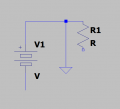
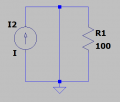
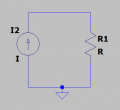
I am going to assume this is the circuit you are talking about:

upload_2019-4-25_8-11-21.png

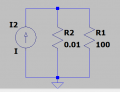
The connection to ground is a resistor, since no wire can have zero resistance.

So this is the real circuit:

upload_2019-4-25_8-13-46.png

So you have two parallel resistors. This is one of the first problems addressed (and solved) in any elementary text on electronics

Bob
 

Attachments

Tonyr1084

Joined Sep 24, 2015
9,744
OK, not trying to be a jerk here, but if I come off that way - my apologies up front.

First, (see the images below) I understand your reluctance to describe what you're attempting to do. I respect that. However, from what you describe, I've come up with the mental image that you may not fully understand what it is you are attempting to discuss. Like I said, I'm not trying to be a jerk, but the two outputs you speak of - I think they are the two connections on your PS (Power Supply). The term "Circuit" comes from the same Latin word "CIRCULUS" for "Circle". On a circle the point where it starts is the same point where it ends. Thus, it creates a circle. Same is true of a circuit. Take a battery and a lightbulb for instance. When power from one terminal of the battery circles around through the lightbulb back to the battery - you have a circuit. Break that circuit (circle) and you no longer have a circuit with a lit lightbulb.

You describe two outputs from your PS. One is needed to provide a source and the other is for a return, without which you can not have a circuit. You state one is connected directly to ground. Many here have said that an output tied directly to ground is a dead short.
Source to ground is a short circuit, you will burn the source or something else.
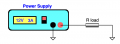
And that's correct. However, I don't think you're talking about a true "Output". More so you're talking about a terminal connection where you hook one of the wires. In my diagram the black terminal is shown directly connected to ground in keeping with what you describe and the other terminal shown in red is connected to your resistor (R load) as you describe. The arrow at the bottom of the two lines represents a circuit ground, which simply means a common connection without having to draw out all the wiring. Many complicated circuits will omit drawing the return path in favor of the understanding that common grounds are all tied together throughout the circuit.

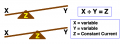
The second diagram shows two teeter totters. They illustrate that when one side goes up or down the other side has to respond in kind but opposite in order to maintain the "Constant Current" ( Z ) you want. This is how a CC (Constant Current) PS works. Let X represent the voltage and Y represent the load. As the load changes so must the voltage in order to maintain a set CC.

I hope this helps.

[edit] DRAWING CORRECTED.

Z CCPS.png
Z Teeter Totter.png
 
Last edited:
Top