How can the COP of a heat pump be increased? (theoretically)

Thread Starter

Motanache

Joined Mar 2, 2015
652
I am a hobbyist of electronic assemblies, I like to build, I am NOT a user who adjusts any heat pump!

I was fascinated by the mechanism of the heat pump!

I searched in the animal world for something similar to the heat pump!
I asked for free Artificial Intelligence, but nothing.

I would like to take the discussion in any direction you consider if it is possible for useful ideas to appear!

Can we draw the thermodynamic cycle in p-V coordinates of a heat pump?

Is the heat pump the same thing and has the same efficiency as an inverted Stirling engine? I mean, who is given mechanical energy and creates the temperature difference?

I am waiting for ideas on how we could create a small montage to test and improve COP..
 

wayneh

Joined Sep 9, 2010
18,089
In cooling mode where heat is being rejected to outdoors, evaporative cooling can increase system performance. There are many ways to implement this, ranging from misting the condenser coil directly to passing outdoor air through a swamp cooler before the condenser. This is all well known.
 

crutschow

Joined Mar 14, 2008
38,323
Your are rather limited by the thermodynamic cycle in getting higher efficiencies with the gas working fluid in a standard heat pump.

This Elastocalories approach using mechanical deformation of specific type of materials, apparently has the potential for higher efficiencies.
 

Ian0

Joined Aug 7, 2020
13,097
A lot of it is down to the choice of refrigerant, and there are other reasons than efficiency for the choice of refrigerant, such as how dangerous it is to the environment, and how flammable it is.
For the moment, we seem to have stopped worrying about flammability for the sake of efficiency, as most of the latest units use propane.
 

Thread Starter

Motanache

Joined Mar 2, 2015
652
If any of us knew the answer to that, we would patent it.
Not every inventor patents his invention!
The history of the radio, for example, Marconi in the USA was initially denied a patent radio because that's what Tesla had done before
And I was thinking, if we still waste so much time thinking about useless things like everyday stress.

Why don't we invest a little energy, certainly if it would make us happy, to study how to use energy more efficiently in today's energy crisis.
 

Thread Starter

Motanache

Joined Mar 2, 2015
652

I think it is the p-V Carnot diagram.

It's like compressing a gas adiabatically, that is, very quickly.
The gas, initially at low outside temperature, after rapid compression heats up quickly and ends up warmer than in the room. Thus it loses its heat in the room.

That's why I thought of the Carnot cycle, two isothermal and two adiabatic.
 

Thread Starter

Motanache

Joined Mar 2, 2015
652
I imagine that I take a cylinder that closes a gas with a piston.

1. We compress the gas suddenly, i.e. almost adiabatically, and the gas will heat up.
2. I take the cylinder to the imaginary room where it will release heat by heating the air, i.e. isovolumetric or isochoric.
3. I pull the piston outside, the gas expands and cools more than the outside air, so it will absorb the outside heat.
4. I take the imaginary cylinder out

This is the Stirling cycle, two adiabatic and two isochore
 

Thread Starter

Motanache

Joined Mar 2, 2015
652
I would have wanted all kinds of theoretical ideas including the strange ones,

I imagine complete or Brownian agitation. Molecules shake tirelessly.

How could we take part of their movement to create an external movement?
 

Thread Starter

Motanache

Joined Mar 2, 2015
652
The existence of pressure is not enough. There must be a pressure difference between the working gas and the external pressure, the atmospheric pressure.

Here I am trying to understand more deeply the processes in the heat pump.

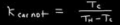
COP
1732303886237.png

Carnot engine efficiency
Efficiency = 1 - Tc/Th
Efficiency = (Th - Tc)/Th

Th, Tc hot temperature, cold temperature


I have not found a forum where someone wants to clarify these notions.

From the 2 equations above, the Carnot efficiency increases with the temperature difference, and the COP of the heat pump decreases with the increase in temperature difference.

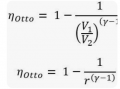
But the efficiency of the Otto engine seems to depend only on the compression ratio and not on the temperature difference....Am I wrong?
1732304912353.png
 

schmitt trigger

Joined Jul 12, 2010
2,027
Although most of us I am sure we saw the thermodynamic cycles during the physics courses in our undergraduate studies, I would say that it is safe to assume that no-one here is a thermodynamics expert (*). After all, this is an electronics forum.

We could perhaps suggest ways to improve the electrical to mechanical conversion efficiency, like replacing the induction motor driving the compressor with a variable speed BLDC one. But this idea is already in use.

(*) If my assumption is wrong, let me know.
 

Thread Starter

Motanache

Joined Mar 2, 2015
652
"he efficiency could just as well be stated in terms of temperature"
The efficiency of the gasoline engine is 30-35%, and that of the diesel engine is 40-45%
It is higher by 10 percentage points, i.e. higher by approximately 30%

diesel fuel is roughly 45.5 MJ/kg
petrol which is 45.8 MJ/kg
They differ by 5% with all different types.

You will say that the Diesel cycle is another formula for efficiency. But depending on the temperature difference, it is also expressed there.

" After all, this is an electronics forum. "
I also discuss as much as I will be allowed to discuss.
It would be possible for people to come forward and ask for the discussion to be closed.

Gasoline, the temperature when it burns 2000...2500 degrees Celsius
Diesel, the temperature when it burns 2000...2400 degrees Celsius
3632F.....4532F
3632F.....4352F

So to the heat provided by combustion, very close values for both.
At very close combustion temperatures.
For density and electrical resistance, refractivity very close values
However, the Diesel engine has a 1/3 higher efficiency than the gasoline engine.\

This is if, for both engines, we consider that we start from Carnot efficiency and the temperature difference between cold and hot is the most important factor that determines efficiency.

Where do I want to go?
How can we increase the efficiency of a heat engine or the "efficiency" of a heat pump?

Or is it not worth studying, because it would depend on an implacable law of physics? and efficiency cannot be increased.
Or we have to passively wait for the technology to evolve because we can't do anything.
 
Last edited:

schmitt trigger

Joined Jul 12, 2010
2,027
Don’t misread what I wrote. I AM NOT asking to close the thread. Nor am I disparaging you.
Ok?
I am only saying that this community’s area of expertise lies somewhere else than thermodynamics.
BTW, I am also extremely interested in A/C systems, because I live in a very hot and humid environment. My energy costs are dominated by A/C usage, and I have developed several strategies to reduce costs.
 

Thread Starter

Motanache

Joined Mar 2, 2015
652
The EDUCYPEDIA has a page on thermodynamics:
Bertus
I looked for discussion groups about engines or thermodynamics either on the forum or on Facebook.

I joined biology and physics groups.
They are different from electronics enthusiasts.

As an electronics hobbyist, I designed a schematic from another given schematic.
We were building and putting into practice.
Then we test for a long time in practice.

We listened to the audio amplifiers and loudspeakers we made.
Some of my colleagues were selling them.
I didn't sell, but I was asked why it sounded better than the commercial ones.

As a radio amateur, I tested and learned.

In the biology and physics groups, they only discuss theory.
A principle in teaching is the combination of theory and practice.

You can be proud that you are passionate about electronics.

For example, on physics groups I have seen many discussions about the quantum computer. But I haven't seen anything like that in practice and I don't think it's practical,

There are scientists who have practically studied the efficiency of the Stirling engine. But I don't think I will be able to ask them because they work at NASA.
https://www.hemmings.com/stories/found-nasas-stirling-engined-dodge-d-150/

The engine sketches were made public. But until I understand the logic, I don't think I can start practicing,
The theory discussed was to get an idea if the field is of the future and worth studying.

Ironically, on an electronics forum someone asked if it is possible to make a refrigerator with energy as solar heat, why couldn't an air conditioner be made with energy as solar heat?
https://en.wikipedia.org/wiki/Absorption_refrigerator

I'm not saying it's a good question or not. But someone tried to think more than the memorized theory.
 
Top