In a Micro-Drill: TIP127 and LM358

Thread Starter

Zohar

Joined Nov 19, 2015
70
Hi

I have a small Micro-Drill, it's like Dremel but thinner and weaker than it.

I disassembled it to see what's inside, and the 2 main components are:
- TIP127
- LM358

From googling them, both are amplifiers.
The first is a Transistor, and the second is a Dual Op-Amp.

My question:
Why both of them are needed?
Why not just 1 amplifier component?


Thank you
 

LesJones

Joined Jan 8, 2017
4,511
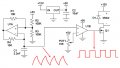
My guess would be that the LM358 is used to generate a PWM signal and the transistor provides enough current from the PWM signal to drive the motor. If you want more than a guess then trace out the schematic and post it here.

Les.
 

Thread Starter

Zohar

Joined Nov 19, 2015
70
My guess would be that the LM358 is used to generate a PWM signal
The PWM idea seems logic..
I forgot to add, that this micro-drill has a potentiometer for choosing the motor speed.

But, If LM358 is an Op-Amp, how does it produce a square PWM wave?
Isn't producing the PWM wave, a work of another component?

From what I understand, an amplifier does not produce a wave,
it gets it as an input, and then amplifies it..
 

ArakelTheDragon

Joined Nov 18, 2016
1,366
LM358 is normally a quad amplifier.

It can be the transistor is at the output of the opamp, which is the easiest way to control a motor. The OPAMP is providing the regulation, and the transistor is providing the amplification of the current:

Like in here:
https://www.electroschematics.com/4788/temperature-controlled-dc-fan/

EDIT: you can easily check by finding out the output pin from LM358 (should be 8 pins total) is connected to where. If the output pin is connected to the base of the transistor, than we have a winner.
 

Thread Starter

Zohar

Joined Nov 19, 2015
70
Thank you ArakelTheDragon

The transistor is indeed in the end of the circuit,
so what you say makes sense.

Regarding
>The OPAMP is providing the regulation
What is the kind of regulation that we have here, in a Micro-Drill?

There is the potentiometer as an input, by which the user chooses the speed he wants to get,
so what happens from there?
(and according to the datasheet, LM358 is a Dual Op-Amp - why a Dual op-amp is needed here and not a single op-amp?)
 

ArakelTheDragon

Joined Nov 18, 2016
1,366
Thank you ArakelTheDragon

The transistor is indeed in the end of the circuit,
so what you say makes sense.

Regarding
>The OPAMP is providing the regulation
What is the kind of regulation that we have here, in a Micro-Drill?

There is the potentiometer as an input, by which the user chooses the speed he wants to get,
so what happens from there?
(and according to the datasheet, LM358 is a Dual Op-Amp - why a Dual op-amp is needed here and not a single op-amp?)
Its the smallest chip possible, there are no chips with 1 OpAmp in them. Its not economically efficient.

There are a few options for the regulation. Normally a drill has to reduce the current through it when you press it to the wood/metal/other so it does not burn, because the rotation per minute decreases. When the wood starts being drilled, the rotation increase again which needs more current. Its only a mechanism to not burn the drill.

EDIT: Yes it really is a dual OpAmp, my mistake.
 

Thread Starter

Zohar

Joined Nov 19, 2015
70
There are a few options for the regulation. Normally a drill has to reduce the current through it when you press it to the wood/metal/other so it does not burn, because the rotation per minute decreases. When the wood starts being drilled, the rotation increase again which needs more current. Its only a mechanism to not burn the drill.
Wow,
I didn't think the regulation would be from that direction..

I thought it would be in relation to the potentiometer..

So what you say is that Drills (in general, and not just this micro-drill) reduce the current to the motor once friction is encountered?
And this is just regarding the Current, not the Voltage too?
 

ArakelTheDragon

Joined Nov 18, 2016
1,366
I don't remeber an LM358 single package?

Yes if the drill encounters friction, that needs to be accounted for, because if the rotor decreases its rotation speed, that decreases the "resistance" of it and increases the current through it and can burn it.

The motor in your case should be current controlled, but depending on the motor it can be voltage/PWM controlled also.

EDIT: The bolded word up should be voltage.
There is only 1 thing wrong in this statement, the bolded work should be "voltage": when the drill encounters friction, the back EMF voltage decreases, normally the voltage over the coil (rotor) is the forward EMF voltage minus the back EMF, but during the low rotation cycles per minute of the rotor the back EMF is very little so we have a high forward voltage over the rotor. The only thing limiting the current in this case is the resistance of the rotor itself, which is very little.
 
Last edited:

Thread Starter

Zohar

Joined Nov 19, 2015
70
Thank you both.


Yes if the drill encounters friction, that needs to be accounted for, because if the rotor decreases its rotation speed, that decreases the resistance of it and increases the current through it and can burn it.
Terrific explanation - simple and clear..

I see.

This also tells the user how to properly use an electric drill..
Not to press to hard, and instead to prefer a slower (yet with less friction) drilling.
 

ArakelTheDragon

Joined Nov 18, 2016
1,366
Thank you both.


Terrific explanation - simple and clear..

I see.

This also tells the user how to properly use an electric drill..
Not to press to hard, and instead to prefer a slower (yet with less friction) drilling.
Thats the reason why you receive these instructions from experienced drillers. Also this is why drills for metal/wood/walls exist.
 

shortbus

Joined Sep 30, 2009
10,050
There are a few options for the regulation. Normally a drill has to reduce the current through it when you press it to the wood/metal/other so it does not burn, because the rotation per minute decreases. When the wood starts being drilled, the rotation increase again which needs more current. Its only a mechanism to not burn the drill.
Again do read what you post? When a motor especially a DC motor starts to stall, it demands more current not less. You continue to mislead people.
 
For DC motors, this equation, can be used. V = Vm - Rm*Im
Rm is the motor winding resistance; Im, is the motor current

Which actually means that unloaded, or 0 current, V is proportional to RPM.
As you load it. there is a I*R drop across the motor, that slows it down.
This type of regulator has been used in cheap cassette decks.

Then it's important to know that current is proportional to torque. So, PWM gets you high torque at low average voltage.

Measuring speed is applied to other control systems.
 
Top