If low noise is priority, is it wise to use dedicated Voltage Regulators ?

Thread Starter

ch4z

Joined May 23, 2024
5
By dedicated voltage regulators i mean a voltage regulator per IC, even if they require the same voltage.

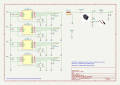
for example this is my circuit :
1717142824511.png

Here i use 3 voltage regulators to provide 3.3V reference to 3 different devices. my goal in mind being the isolation of noise that can find itself on the 3.3V power line.

Is this wise?

(pay no heed to the type of voltage regulator which may or may not be completely overkill for my design, though noise is of the utmost priority here)
 

DickCappels

Joined Aug 21, 2008
10,661
If you are only worried about the reference voltages and the reference inputs don’t draw much current then you can probably be ok using a single voltage reference. Separate filters for each input might be needed,
 

Thread Starter

ch4z

Joined May 23, 2024
5
If you are only worried about the reference voltages and the reference inputs don’t draw much current then you can probably be ok using a single voltage reference. Separate filters for each input might be needed,

sorry not reference voltages, they are supplying the Ic's with power
 

crutschow

Joined Mar 14, 2008
38,419
Why are you so concerned about noise on the 3.3V line?
Do you have devices that are particularly sensitive to power rail noise?
Normally, local capacitor decoupling near each device being powered is sufficient.
 

ronsimpson

Joined Oct 7, 2019
4,663
In the HP voltage meter/signal generator group, we took grate care to keep cross talk out of the system. Much of the art of low noise had to do with the PCB layout. In some cases, we had totally separate supplies and used opto-isolators to get data back to the CPU. It can be hard when mixing analog and digital. Most likely you are not chasing sub micro volts of noise.

Because we can't see what you are doing, we cannot say. I see you have FB1. I have used a CLC filter between sections.
I like to use several different sizes of capacitors. At each IC use a small ceramic cap. I usually add a large ceramic cap somewhere nearby. In each section I add a large cap that is no good at high frequencies.

I am going to say it again, the PCB layout is very important for noise.
 

MrChips

Joined Oct 2, 2009
34,700
Noise can mean ten different things. I would claim that it is rather unusual to use separate 3.3V supplies in a system.
If noise on the supply rail is the problem then there are passive filters one can use on the 3.3V input rail.

In mixed signal applications, it is common to use separate digital and analog supplies. For example, the MCU is powered by a 3.3V regulator while the analog circuitry is powered by a 5V regulator. This keeps the digital noise away from the analog section.

Board layout, separate ground planes, power supply decoupling capacitors, low power devices and SMD technology all play important roles in reducing noise levels.
 

sparky 1

Joined Nov 3, 2018
1,218
LT3045 ultra low noise has good specs. The package is sort of flat, pcb ground plane and shielding keep it from being an antenna.
A pre-regulator can help, it should be in series. Optimizing the series regulators one at a time individually with appropriate capacitors.
Minimizing excessive step-down voltage, running them cool. I see more sensitive instruments inside are mostly empty, the regulators distanced using
shielded power cables fastened down with connectors for faster less sloppy assembly.
 
Last edited:

JohnSan

Joined Sep 15, 2018
124
I think, with 4 power supplies, you have just created 4 times the number of connection issues. How will the 0v connections from each of those be made? That cct diagram shows only half the story.
Use one power supply and get the layout right.
 

ronsimpson

Joined Oct 7, 2019
4,663
In a recent project I spent big money for a reference voltage. I only put the ADC reference on it. The rest of the 3.3 supply was from a low-cost regulator. That product runs $1,000,000 and a $10 reference is nothing and I did not want anyone to question the readings. That was about accuracy not noise but I did spend some time thinking about noise.
 

MisterBill2

Joined Jan 23, 2018
27,325
I suggest one FIVE volt regulator and then bypass capacitors, with a separate dropping resistor for each op-amp, and separate electrolytic caps for each also. But no disc caps because some of them can be microphonic.
 

WBahn

Joined Mar 31, 2012
32,766
By dedicated voltage regulators i mean a voltage regulator per IC, even if they require the same voltage.

for example this is my circuit :

Here i use 3 voltage regulators to provide 3.3V reference to 3 different devices. my goal in mind being the isolation of noise that can find itself on the 3.3V power line.

Is this wise?

(pay no heed to the type of voltage regulator which may or may not be completely overkill for my design, though noise is of the utmost priority here)
If noise is of the utmost priority, the hopefully you can put some numbers to that -- what must the noise level be below in order to be acceptable? What is the spectral content of the acceptable noise content?

Have you even identified what parts of the circuit are sensitive to noise and what parts aren't?

If your circuit is so noise-sensitive that you are having to power individual ICs from their own regulators, then you almost certainly have LOTS of other contributors that need to be dealt with. Have you done the work do get all of those down to a point where they are contributing less than the residual power-supply rejection between the regulators?
 

Thread Starter

ch4z

Joined May 23, 2024
5
If noise is of the utmost priority, the hopefully you can put some numbers to that -- what must the noise level be below in order to be acceptable? What is the spectral content of the acceptable noise content?
When i talk about noise i mean phase noise, this device is supposed to generate or convert an external input into 2 different reference frequencies (10MHz & 40MHz) : as an example the 40MHz output needs to be at most -130dBc @ 1kHz, and sub -150dBc @ 100kHz

to do this my device will use an LTC6954 programmable divider, and a LMK1C1106 clock buffer to drive 6 10MHz outputs. these 2 devices plus the TCXO @ 160MHz all run on 3.3V.

What i understand now, is that I should use a single voltage regulator for supplying these devices? and make sure that the layout (which i may probably outsource) is optimised to reduce noise ?

PS : i have followed each devices application notes and applied decoupling capacitors accordingly, in the hopes of further reducing the possiblity of crosstalk or noise I wondered this question of providing each chip with it's own individual supply

PPS: when thinking of how to route the 0V reference, i know they should all converge in one point, making sure that each block is properly "isolated" until that point.
 

Thread Starter

ch4z

Joined May 23, 2024
5
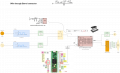
Thank you all for your replies ! in response to my likely badly worded original question, i am particularly looking at the phase noise of the outputs that the board will provide, here is the basic principle of my design.

"this device is supposed to generate or convert an external input into 2 different reference frequencies (10MHz & 40MHz) : as an example the 40MHz output needs to be at most -130dBc @ 1kHz, and sub -150dBc @ 100kHz "


FINALITY.png


Just to try and sum up what i have learnt from your replies : using multiple regulators for the same voltage level can complicate things or even worsen noise, which mostly comes from the layouting that i should pay extra attention to.

my question now is : Is this still true when talking about phase noise now? (i imagine for the layouting yes, but the original idea of using multiple 3.3V regluators. ) ?
 

MisterBill2

Joined Jan 23, 2018
27,325
Phase noise at those rather low amplitudes can be added by anything that changes anything in the circuit. The good news is that a lot of folks have done a lot of studying the issue and have learned quite a bit.
I am not one of those folks. I am aware of the problems, but not been involved because it does not impact me.
BUT there is a fair amount of published information on the topic.
 
Top