Noise Gate Questions

Thread Starter

Kim Sleep

Joined Nov 6, 2014
391
Ok, Im back after over a month in hospital, and a broken neck, and brain damage.
Im still on stuff that makes me a bit loopy, so please forgive me.
As well, Im not really good at audio stuff, so I need some help.

I need to make a line level input, Audio Noise Gate.
Ive come across a plethora of schematics online, but I need some help as far as which is best.

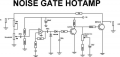
http://guitar-fx-layouts.238.s1.nabble.com/Hotamp-Noise-Gate-td15761.html
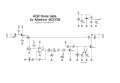
https://www.freestompboxes.org/viewtopic.php?t=32191
Schematic is posted at the very bottom of the page

Thanks on advance
 

Ian0

Joined Aug 7, 2020
13,097
A bipolar transistor does work for AC signals. Both Bipolar and MOSFET will clip any signal that exceeds 0.6V peak, so a line level signal at 775mV rms or 1.1V peak will get badly clipped.
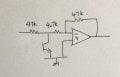
If you put it in an inverting amplifier circuit it works very well. IMG_2164.jpg
but you do need split power supplies to work the op-amp.
I haven't drawn the side chain, but @ronsimpson 's circuit is fine.
Alternatively, reverse the diodes, remove the 2nd transistor and replace the first transistor with a JFET, so that increasing input signal produce more negative gate voltage and turns the JFET off.
 

MisterBill2

Joined Jan 23, 2018
27,159
I am seriously wondering about the application of the "noise gate". The last time I heard one, it was being used to be a cheap replacement for an actual snare drum, and it (critical remark removed)
So while it would be a fair substitute for "bleeping" out words for a broadcast audio sound track, I am wondering what the intended application is. It is an interesting circuit, but for what???
 

ronsimpson

Joined Oct 7, 2019
4,645
wondering about the application of the "noise gate".
1) Some audio recordings have a background noise that needs to be removed. I can set the attack and delay time, and level so during a word the gain is up, but the gain dips down between words. Defiantly between sentences. When a person is talking or singing you can't hear the noise, but you can during silent spots unless you use a noise gate.

2) I some time us one when I have many microphones open on the stage. (more than I can handle) Lets say we have a high school play with 20 kids on stage and 25 microphones. If I turn on all microphones there will be feedback. Because the kids moved the microphone around, I lost track of which microphone is which. When a student picks up a microphone, I need to have his microphone volume up and all the rest are off. I us a noise gate on every input. When a microphone is picking up, the volume is turned on. As soon as someone stops talking the gain is turned off.

It is like a squelch on a radio. Talk loudly when you want to transmit and softly when you don't want the transmitter on.

The noise gate I use, I usually have set for a gain of 1 when there is audio and a gain of -20db when there is just noise. I find a gain of -80db causes a popping sound. (on/off effect) I set it to ramp up and down the gain not jump from one level to another. I set the attack time short and the release time long.
 

xox

Joined Sep 8, 2017
936
I wonder how doable it would be to address this with a microcontroller? Run an FFT over the signal and just drop amplitudes below a certain threshold (you could also do some lowpass/highpass/bandpass filtering while you're at it). I dunno tho....still might be some aliasing artifacts that would get through?
 

MisterBill2

Joined Jan 23, 2018
27,159
1) Some audio recordings have a background noise that needs to be removed. I can set the attack and delay time, and level so during a word the gain is up, but the gain dips down between words. Defiantly between sentences. When a person is talking or singing you can't hear the noise, but you can during silent spots unless you use a noise gate.

2) I some time us one when I have many microphones open on the stage. (more than I can handle) Lets say we have a high school play with 20 kids on stage and 25 microphones. If I turn on all microphones there will be feedback. Because the kids moved the microphone around, I lost track of which microphone is which. When a student picks up a microphone, I need to have his microphone volume up and all the rest are off. I us a noise gate on every input. When a microphone is picking up, the volume is turned on. As soon as someone stops talking the gain is turned off.

It is like a squelch on a radio. Talk loudly when you want to transmit and softly when you don't want the transmitter on.

The noise gate I use, I usually have set for a gain of 1 when there is audio and a gain of -20db when there is just noise. I find a gain of -80db causes a popping sound. (on/off effect) I set it to ramp up and down the gain not jump from one level to another. I set the attack time short and the release time long.
OK, that is totally different from the application that I was aware of, in every aspect. It makes good sense, indeed, but it is just the opposite of what noise gates were used for as a substitute for an actual drum-beat. Blocking noise instead of injecting it is a great concept.
Those productions did not last long on the broadcast radio stations.
 

Ian0

Joined Aug 7, 2020
13,097
I wonder how doable it would be to address this with a microcontroller? Run an FFT over the signal and just drop amplitudes below a certain threshold (you could also do some lowpass/highpass/bandpass filtering while you're at it). I dunno tho....still might be some aliasing artifacts that would get through?
Could you get it working in an hour? I could easily get the analogue version working in minutes.
 

xox

Joined Sep 8, 2017
936
Could you get it working in an hour? I could easily get the analogue version working in minutes.
Well I am a programmer by trade so the coding aspect at least would be fairly trivial. (I imagine the hardware setup wouldn't be that complicated either.) What really worries me is that the MCU might not be able to process the signal fast enough. I guess it just boils down to how low you could go with the sample rate without compromising output quality too much.
 

Ian0

Joined Aug 7, 2020
13,097
Well I am a programmer by trade so the coding aspect at least would be fairly trivial. (I imagine the hardware setup wouldn't be that complicated either.) What really worries me is that the MCU might not be able to process the signal fast enough. I guess it just boils down to how low you could go with the sample rate without compromising output quality too much.
Not below 48ksamples/second for professional audio.
 

ronsimpson

Joined Oct 7, 2019
4,645
I am a programmer by trade so the coding aspect at least would be fairly trivial.
I do mixed analog and digital work. There are many little 8 pin micros that could watch the audio at a slow rate. The CPU could detect sound, do the attack and decay time, level settings, etc. The little CPU probably could not process the audio.
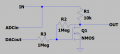
Audio enters (IN). R1 *& Q1 make a gain stage. Gain from 1 to 0.0001 as controlled by the DC voltage from the microcomputer.
1770495714442.png
In about 1975 +/- I was making audio processing gear using a MOSFET, or JFET, or (LED & Cad Cell) as gain stages.
Many of the PIC10 or PIC12 parts have OK ADC. (8 or 10 bit) and some have DAC that will set the gain. (or use PWM output)

You are right there some 32 bit ARMs in very small packages that can do it all and more.
 
Top