Facebook
 Google
 GitHub
 Linkedin

Hello everyone,
I am working on a project for an electronic variable load with a power MOSFET that can handle up to 10 A. To control the gate I need between 0-10 V, but since the ESP32 only outputs 3.3 V, I have set up a system with a DAC MCP4725 and a non-inverting operational amplifier with a gain of approximately 3. This way I can directly control the gate of the MOSFET without using a gate driver, since I am not looking for switching but rather to work in the linear region to perform Vgs sweeps and control the current.
The setup is as follows:
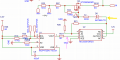
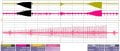
Since I added the diode at the gate, when looking at the oscilloscope there is noise on the signal before the diode (yellow trace in the capture). Then I checked the output of the DAC and I also see a rippled signal (pink trace). Interestingly, after the diode that noise does not appear, but the circuit does not work as expected, during the sweeps the Vgs is not very clean.
What could this noise be due to? Which components should I add or remove? I don’t understand what I am doing wrong in the setup.
I am working on a project for an electronic variable load with a power MOSFET that can handle up to 10 A. To control the gate I need between 0-10 V, but since the ESP32 only outputs 3.3 V, I have set up a system with a DAC MCP4725 and a non-inverting operational amplifier with a gain of approximately 3. This way I can directly control the gate of the MOSFET without using a gate driver, since I am not looking for switching but rather to work in the linear region to perform Vgs sweeps and control the current.
The setup is as follows:
Since I added the diode at the gate, when looking at the oscilloscope there is noise on the signal before the diode (yellow trace in the capture). Then I checked the output of the DAC and I also see a rippled signal (pink trace). Interestingly, after the diode that noise does not appear, but the circuit does not work as expected, during the sweeps the Vgs is not very clean.
What could this noise be due to? Which components should I add or remove? I don’t understand what I am doing wrong in the setup.