Identifying whether the getter compound in a valve tube is consumed?

Thread Starter

Rahulk70

Joined Dec 16, 2016
538
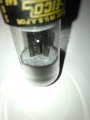
What I see in the picture appears to be the bottom Mica frame internal jig that holds everything in the correct position, there is one at the top as well. If that is not what you are referring too, take some pictures from different angles and highlight the areas.
Hi,
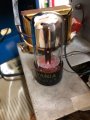
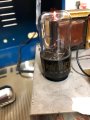
So I've attached pics of the original EICO 6X5 tube and the white substance that I had mentioned. Also I tried all the tubes today and it seems to fire up and the magic tube seemed to light up for all of them. Though I'm not 100% sure if some fault present could destroy the tube after a little while that may not be noticed immediately.
 

Attachments

recklessrog

Joined May 23, 2013
985
Hi,
So I've attached pics of the original EICO 6X5 tube and the white substance that I had mentioned. Also I tried all the tubes today and it seems to fire up and the magic tube seemed to light up for all of them. Though I'm not 100% sure if some fault present could destroy the tube after a little while that may not be noticed immediately.
I think you are worrying too much. The white appears to be de-lamination of the Mica frame jig and is not going to cause any problems. If you are really worried, why not put a fuse in the between the cathode of the 6X5 and the ht capacitors? It is likely your mains transformer has a centre tapped secondary, and you could put the fuse in the lead from the centre tap to chassis. (there are several reasons why fusing the output from the cathode is preferable) Just check that the anodes are fed from two separate leads from the transformer for full wave rectification, or, possibly, the anodes are linked together and the transformer only has the single ht winding giving half wave rectification.
 

Thread Starter

Rahulk70

Joined Dec 16, 2016
538
I think you are worrying too much. The white appears to be de-lamination of the Mica frame jig and is not going to cause any problems. If you are really worried, why not put a fuse in the between the cathode of the 6X5 and the ht capacitors? It is likely your mains transformer has a centre tapped secondary, and you could put the fuse in the lead from the centre tap to chassis. (there are several reasons why fusing the output from the cathode is preferable) Just check that the anodes are fed from two separate leads from the transformer for full wave rectification, or, possibly, the anodes are linked together and the transformer only has the single ht winding giving half wave rectification.
You are right. I'm overthinking and worrying too much as you said. I primary reason was I read some members in vintage electronics forums telling people who were trying to restore the EICO tester that should check out for the 6X5 as it had the habit of killing the transformer as the tube went bad. A bad transformer means buying another unit again. So, that kinda scared me seeing that white stuff in the tube.:rolleyes:
 

recklessrog

Joined May 23, 2013
985
You are right. I'm overthinking and worrying too much as you said. I primary reason was I read some members in vintage electronics forums telling people who were trying to restore the EICO tester that should check out for the 6X5 as it had the habit of killing the transformer as the tube went bad. A bad transformer means buying another unit again. So, that kinda scared me seeing that white stuff in the tube.:rolleyes:
The 6X5 has a maximum current limit of around 70 milliamps. To protect the transformer use a low value fuse of around 100 milliamps as I posted earlier. Then should a short develop, the fuse will blow.
 

MisterBill2

Joined Jan 23, 2018
28,077
You are right. I'm overthinking and worrying too much as you said. I primary reason was I read some members in vintage electronics forums telling people who were trying to restore the EICO tester that should check out for the 6X5 as it had the habit of killing the transformer as the tube went bad. A bad transformer means buying another unit again. So, that kinda scared me seeing that white stuff in the tube.:rolleyes:
Replacing the tube with two diodes will eliminate forever the chance of an internal short circuit in the tube damaging the transformer. AND the change is easy to remove if you want the tester as a classic antique for show purposes.
 
Top