Someone on here altered it for me but I can't remember who. Would making darlington pairs with tip increase their gain? I'll probably tinker around. If they aren't suitable for audio amplification I'm sure I can do something else with them.
Someone on here altered it for me but I can't remember who. Would making darlington pairs with tip increase their gain? I'll probably tinker around. If they aren't suitable for audio amplification I'm sure I can do something else with them.
Honestly I bought them for the price point/amount. Thinking about it I could likely salvage better ones. I did manage to salvage a couple of opamps that I didn't know I had and I'll just buy some decent ones. I want a good audio amp so I'll have to pay for good parts.
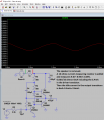
My simulation shows an idle current of the entire amplifier of 6mA and only 2.6mA for the output transistors which is why there is a little crossover distortion.
Current gain yes, voltage gain no. But a pair of darlingtons have twice the voltage loss as compound transistors so use compound transistors instead.
The input transistor of a Darlington or compound transistor conducts only a medium current so a power transistor like a TIP is not needed.
A 2N4401 and 2N4403 little transistor would be fine to drive the TIP output transistors.
My simulation shows an idle current of the entire amplifier of 6mA and only 2.6mA for the output transistors which is why there is a little crossover distortion.
What do you use to simulate with? If I had something like that it would help me alot. Getting to see results before wasting hours building one that won't work seems pretty enticing.
Current gain yes, voltage gain no. But a pair of darlingtons have twice the voltage loss as compound transistors so use compound transistors instead.
The input transistor of a Darlington or compound transistor conducts only a medium current so a power transistor like a TIP is not needed.
A 2N4401 and 2N4403 little transistor would be fine to drive the TIP output transistors.
So they can work. TIP's are fine if driven by a different transistor. A guess but tip's in an AB class need a better driver in the schematic I posted? Or does it need a little more complexity than just 3 transistors(which is just fine with me)?
What do you use to simulate with? If I had something like that it would help me alot. Getting to see results before wasting hours building one that won't work seems pretty enticing.
My simulation shows an idle current of the entire amplifier of 6mA and only 2.6mA for the output transistors which is why there is a little crossover distortion
Sometimes those simulations don't agree with the real thing. There's always some variation in the components used. All I tell you is what I measured. I'll double check the circuit again.
SG
The sim program did not produce the expected smoke and didn't even give a warning when those weak low current transistors were very overloaded.
The sim program uses "typical" transistor spec's but it is a pain to change the spec's to minimum or maximum which is what you buy.
I don't think a sim program knows that a reverse-biased emitter-base junction has avalanche breakdown like a zener diode if it gets more than 5V to 8V.
I did try one very similar to ltspice but you only get to test one circuit once then it's a monthly subscription. They do exist but the only ones that work I can't afford.
Sometimes those simulations don't agree with the real thing. There's always some variation in the components used. All I tell you is what I measured. I'll double check the circuit again.
SG
I'm not upset about it. I'll just buy ics meant for what I'm aiming for then I'll experiment with bjts until I make something comparable to what I want. Just to learn more. I am learning more and more but I think it's my components are the problem so I'm not getting results I'm being told I should or that I'm expecting.
Not talking about you using the wrong transistors in the "altered ab amp":
1) Do you understand that its first transistor was biased wrong causing the top of the waveform to be severely clipped.
2) Do you understand that the resistor that turns on the NPN output transistor had such a high value that the output could not go above 5V even though the supply was 9V?
3) Do you understand that the output with bootstrapping goes higher than any resistor can do it by itself?
4) Do you understand that the emitter resistor on the first transistor reduces amplifier voltage gain so if the input signal level is not very high then the output level is very low and faint?
5) Do you understand that the signal source (phone or MP3 player) output impedance is part of the calculation of this very simple amplifier's voltage gain?
Then of course, do you understand that a power transistor has a low current gain so it needs a very high AC and DC base current compared to a little low current transistor that has a very high current gain when it is not overloaded?

 Facebook
 Google
 GitHub
 Linkedin