I need help with an audio amplifier.

MisterBill2

Joined Jan 23, 2018
27,607
Those complete amplifier IC devices can certainly be very useful, but because they have a lot of gain and also quite high frequency response there is a potential for instability if the circuit layout is not right. Any excess resistance or inductance in the "grounds" part of the circuit can result in coupling that leads to instability. So if the maker shows a PC layout for the device you should consider copying it, or at least understanding what it implies.
The 2N4401 and 2N4403 are indeed better choices, also because they are lower noise devices. So in circuits where noise matters they are worth the extra cost. For DC and digital control work the 2N3904 and 2N3906 are fine. I use them frequently.
 

Audioguru

Joined Dec 20, 2007
11,248
If you bought TDA2030 or TDA2050 ICs then they must be badly designed Chinese copies because ST Micro who made them say they are obsolete. Digikey has none in stock.
TI (Texas Instruments) never made them. Like any single (not bridged) audio amplifier, they need a fairly high supply voltage (>28V) to make 10W into 8 ohms or a 21V supply to make 10W into 4 ohms.
 
Last edited:

Thread Starter

ConstructionK88

Joined Jul 25, 2018
282
Those complete amplifier IC devices can certainly be very useful, but because they have a lot of gain and also quite high frequency response there is a potential for instability if the circuit layout is not right. Any excess resistance or inductance in the "grounds" part of the circuit can result in coupling that leads to instability. So if the maker shows a PC layout for the device you should consider copying it, or at least understanding what it implies.
The 2N4401 and 2N4403 are indeed better choices, also because they are lower noise devices. So in circuits where noise matters they are worth the extra cost. For DC and digital control work the 2N3904 and 2N3906 are fine. I use them frequently.
I've been toying with them for a couple weeks now and so far I'm pleased but I know they can do better. Alas I am using 12volts of battery input for testing but I tried 18 and it sounds the same to me. I did buy proto boards to solder permanent circuits so I'm certain that will improve it further
 

Thread Starter

ConstructionK88

Joined Jul 25, 2018
282
If you bought TDA2030 or TDA2050 ICs then they must be badly designed Chinese copies because ST Micro who made them say they are obsolete. Digikey has none in stock.
TI (Texas Instruments) never made them. Like any single (not bridged) audio amplifier, they need a fairly high supply voltage (>28V) to make 10W into 8 ohms or a 21V supply to make 10W into 4 ohms.
I agree they are copies. Yet I'm not displeased by them. I'd guess 5-8 watts on 12 volts considering how loud they are and the sound is fairly clear to me. I've tried burning a few up to see how rugged they are and so far I'm pleased. Most I've managed was to break a pinout. So far they work as the originals, even the thermal shutdown protection is impressive considering a copy. I've yet to destroy one from pushing it to hard without any heatsinks. It merely gets quieter for a minute or so then booms away again. Might I ask....is there a way to bridge them using a single supply such as 2 batteries or must they have split supply. Haven't found any diagrams for that application.
 

MisterBill2

Joined Jan 23, 2018
27,607
Certainly it is possible to run them in a bridge configuration from a single supply. BUT neither speaker lead can be grounded, destruction of an IC if you do ground one speaker lead. TI application notes for those and similar devices show how to make the bridge circuit. And be sure to do adequate heat sinking when you do.
 

Audioguru

Joined Dec 20, 2007
11,248
I agree they are copies. Yet I'm not displeased by them. I'd guess 5-8 watts on 12 volts considering how loud they are and the sound is fairly clear to me. Might I ask....is there a way to bridge them using a single supply such as 2 batteries or must they have split supply. Haven't found any diagrams for that application.
The datasheet for the TDA2030A and the TDA2050 show one opamp having a single supply with its (+) input biased at half the supply voltage. So simply bias the (+) input of both bridged opamps at half the supply voltage.

The datasheet for the TDA2030A shows a minimum supply of 12V but all its spec's are with 24V or more. With a 12V supply its output power into a 4 or 8 ohm speaker is almost nothing.
The minimum supply for the TDA2050 is shown as 9V and with 12V its output power into 4 or 8 ohms is shown as almost nothing.

You do not gain much additional power by bridging them because they do not produce enough output current.
 

Thread Starter

ConstructionK88

Joined Jul 25, 2018
282
The datasheet for the TDA2030A and the TDA2050 show one opamp having a single supply with its (+) input biased at half the supply voltage. So simply bias the (+) input of both bridged opamps at half the supply voltage.

The datasheet for the TDA2030A shows a minimum supply of 12V but all its spec's are with 24V or more. With a 12V supply its output power into a 4 or 8 ohm speaker is almost nothing.
The minimum supply for the TDA2050 is shown as 9V and with 12V its output power into 4 or 8 ohms is shown as almost nothing.

You do not gain much additional power by bridging them because they do not produce enough output current.
I was actually and um oops i didn't clarify my intentions. .. I meant to say. Would it improve on the sound quality and possibly lower thermals to bridge them? I did use 2 of my 6v 7ah(series for 12v) and it sounded loud and nice through a 4ohm 10watt computer speaker. The output is certainly what I wanted but I had to add resistance to the input so I couldn't increase it to clipping levels. Yet I'm curious shouldn't paralleling 2 8ohm or 2 6ohm give 4 and 3 ohm impedance? Sounded awful btw. But anything I add with my computer speaker sounds amazing if it's parallel or series with any ohm speaker. Why is that? Why is my computer speaker the basis of improvement??
 

Thread Starter

ConstructionK88

Joined Jul 25, 2018
282
Certainly it is possible to run them in a bridge configuration from a single supply. BUT neither speaker lead can be grounded, destruction of an IC if you do ground one speaker lead. TI application notes for those and similar devices show how to make the bridge circuit. And be sure to do adequate heat sinking when you do.
That's my issue. I can't find a schematic for that. Should I just move ground like in a split supply to negative as in a single supply? It's only important if it gives just a fuzz more power or clarity. If it doesn't really improve then it's not important. I'm already happy with what they do. I'm only confused with the great quality of my computer speaker vs every other kind possible I have tried.
 

MisterBill2

Joined Jan 23, 2018
27,607
The connections for bridged operation need to have the plus input of one amplifier driven and the inverting input of the Iother amplifier driven. The output power is than greater because the effective voltage swing is doubled. TI makes a number of audio amplifier IC devices, and their website has application notes that show bridge operation with two of them. Several other semiconductor makers also have application notes showing bridge operation. The pin numbers are different but the connection principles are the same. Also, you can go to the "schematicsforfree" website and look at what they have to find examples of similar circuits.
 

Audioguru

Joined Dec 20, 2007
11,248
If the output transistors in the amplifier can produce the increased currents then bridging two amplifiers increases the output power 3.5 times when the speaker impedance and supply voltage are the same.
Since the output current and power are much higher then the heating in each amplifier are also much higher.

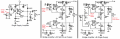
The datasheet of the TDA2030A shows it with a single supply and shows a bridged amplifier with a split supply. I combined them to show a bridged amplifier with a split supply:
 

Attachments

Thread Starter

ConstructionK88

Joined Jul 25, 2018
282
The connections for bridged operation need to have the plus input of one amplifier driven and the inverting input of the Iother amplifier driven. The output power is than greater because the effective voltage swing is doubled. TI makes a number of audio amplifier IC devices, and their website has application notes that show bridge operation with two of them. Several other semiconductor makers also have application notes showing bridge operation. The pin numbers are different but the connection principles are the same. Also, you can go to the "schematicsforfree" website and look at what they have to find examples of similar circuits.
Thanks I'll do that
 

Thread Starter

ConstructionK88

Joined Jul 25, 2018
282
If the output transistors in the amplifier can produce the increased currents then bridging two amplifiers increases the output power 3.5 times when the speaker impedance and supply voltage are the same.
Since the output current and power are much higher then the heating in each amplifier are also much higher.

The datasheet of the TDA2030A shows it with a single supply and shows a bridged amplifier with a split supply. I combined them to show a bridged amplifier with a split supply:
Thanks for the schematic! I only intend on bridging the 2030s because I have so many of them vs the 2050s. I just didn't know if a single supply would work in bridging.
 
You seem to be saying that your circuit sounds good through your "computer speaker" but not through your other speakers. Your computer speaker is surely in an enclosure--are the others? Plain, unmounted speakers always sound bad because the front and back waves interfere with each other. If this is the case, make a simple enclosure (almost surely open at the back unless you read up on speaker enclosures) and mount your speaker in it.
 

MisterBill2

Joined Jan 23, 2018
27,607
Mostly, computer external speakers are low power devices, often having both a higher impedance and a higher resistance because of the #26 connection wires. And seldom can they handle even one watt. So that may have a lot to do with sounding different.
 

Thread Starter

ConstructionK88

Joined Jul 25, 2018
282
You seem to be saying that your circuit sounds good through your "computer speaker" but not through your other speakers. Your computer speaker is surely in an enclosure--are the others? Plain, unmounted speakers always sound bad because the front and back waves interfere with each other. If this is the case, make a simple enclosure (almost surely open at the back unless you read up on speaker enclosures) and mount your speaker in it.
I haven't tried that with all of them. I have a couple. I did remove the CS from its box to check and while it's noticeably quieter it's still clean. The others are either really quiet for the 8 ohm (yes I know less watts) or sound like a cat locked in a beebox(6ohm). I did try them all in parallel or series to lower or uo the ohms but for some reason anything I tie to the CS in parallel or series it sounds great. Not that I'm complaing it's just I don't understand why changing the impedance with the CS and any other speaker sounds good yet no other way does. It's way cheaper and easier to get computer speakers where I'm from so it's fine. Flea markets and yard sales abound.
 

Thread Starter

ConstructionK88

Joined Jul 25, 2018
282
Mostly, computer external speakers are low power devices, often having both a higher impedance and a higher resistance because of the #26 connection wires. And seldom can they handle even one watt. So that may have a lot to do with sounding different.
The 4 I have are 4ohm 10watt rated computer speakers. It's their small size is why I wanted to use car speakers not because they are weak. It's for aesthetics and just to use all the car speakers I got laying around I suppose. Besides 10 watts is really all I need but if higher I must go to push those pesky car speaks then I shall.
 
I think I must be misunderstanding what your wrote. Are you saying that if you parallel your computer speaker and another speaker the sound is good and if you series the computer speaker with another speaker the sound is good but, without the computer speaker the other speakers sound bad?

If that is really the case, does good clean sound come out of the speaker in parallel or series speaker or is the sound from the computer speaker so loud you can't tell?

I push this because you seem to be having problems that are not connected to your amplifier.
 

MisterBill2

Joined Jan 23, 2018
27,607
Here is a crazy thought, based on my first-hand experience. Have you verified recently that the car speakers are OK? I had a few pairs that sat on a shelf for quite a few years. They were fine when I last used them many years back, but now they rattle and scratch. It seems that speakers do not all age gracefully. That might possibly be the problem.
 
Top