I need help with an audio amplifier.

Audioguru

Joined Dec 20, 2007
11,248
There is a review of the Vivitar "Infinite" tiny Bluetooth stereo speaker on YouTube. It costs $3.50US to $10.00US and most reviews say it is junk that does not last. The audio on the video sounds like a cheap little clock radio with screeching mid-highs and no bass.

Old school radios played AM radio middle audio frequencies with no lows and no highs. Maybe you like that.
I like hearing very low 20Hz up to very high 20kHz audio with no distortion.
 

Thread Starter

ConstructionK88

Joined Jul 25, 2018
282
Mine doesn't sound terribly bad. I think it mostly has to do with the speaker and case assembly. But I only intend on using it as a source, not for the output. Adding a full amp after to clear up any distortions and to amplify it past its rated 3w. Essentially using it as a wireless controller so I don't have to use my aux port.
 

Audioguru

Joined Dec 20, 2007
11,248
Since the cheap Vivitar Bluetooth amplified speaker has tiny little speakers that produce no bass and limited highs, then the line output from it to feed a much better amplifier and speakers will probably be missing the parts needed for deep bass and good highs.

I have a Name Brand clock radio that I bought for $1.75 at a clearance store that sounded awful. I disconnected its little 3" speaker and tried a good woofer/tweeter speaker system that also sounded awful. I needed to increase the value of some coupling capacitors for its little amplifier to produce good bass and I changed the value of some other capacitors for it to produce good highs and now it sounds fantastic when it plays through the woofer/tweeter speaker system. Its output power is still the original 0.5W which is fine for my bedroom.
 
If your first post had said that you wanted guidance on making a good looking, wooden enclosed, blue tooth connected amp for phones which you could sell, you would have gotten very different sets of advice.

We thought you wanted to use parts you had to cobble together a plug into the phone amplifier and spent a lot of time giving you advice you did not need or want.
 

Thread Starter

ConstructionK88

Joined Jul 25, 2018
282
Since the cheap Vivitar Bluetooth amplified speaker has tiny little speakers that produce no bass and limited highs, then the line output from it to feed a much better amplifier and speakers will probably be missing the parts needed for deep bass and good highs.

I have a Name Brand clock radio that I bought for $1.75 at a clearance store that sounded awful. I disconnected its little 3" speaker and tried a good woofer/tweeter speaker system that also sounded awful. I needed to increase the value of some coupling capacitors for its little amplifier to produce good bass and I changed the value of some other capacitors for it to produce good highs and now it sounds fantastic when it plays through the woofer/tweeter speaker system. Its output power is still the original 0.5W which is fine for my bedroom.
I have made a simple single transistor that sounds fine at low levels and works fine inside for loudness. But overall pretty wimpy and the tip41c gets really hot at mid levels and unrecognizable at high. Is there a way to fix that.
 

Thread Starter

ConstructionK88

Joined Jul 25, 2018
282
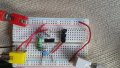
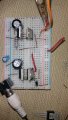
Single tip41c audio amp. Nevermind the 3 c1815's (let's me swap out the tip41 without disruption and surprisingly prevents thermal runaway). White block is input. Yellow is out and red is power. This is literally the only setup that I've got to work somewhat correctly. Is there something I can add to improve it? As a way to slowly build up my knowlege. Also how is a tip considered capable of final power amp when it gets hot so easily on only 4.5v at 600mA power input? Already burned up 2.
 

Attachments

Audioguru

Joined Dec 20, 2007
11,248
A single transistor in an audio amplifier operated in class-A (look it up) basically is a heater. It gets very hot even when not playing.
The datasheet for a TIP41 shows that it is very hot when it dissipates only 1.22W but with your 4.5V x 600mA it is dissipating 2.4W.
The datasheet for a TIP41 shows that if a heatsink is attached then it can dissipate up to about 50W.
Most audio amplifiers operate two output transistors in class-AB (look it up) and get only slightly warm when not playing.
 

Thread Starter

ConstructionK88

Joined Jul 25, 2018
282
A single transistor in an audio amplifier operated in class-A (look it up) basically is a heater. It gets very hot even when not playing.
The datasheet for a TIP41 shows that it is very hot when it dissipates only 1.22W but with your 4.5V x 600mA it is dissipating 2.4W.
The datasheet for a TIP41 shows that if a heatsink is attached then it can dissipate up to about 50W.
Most audio amplifiers operate two output transistors in class-AB (look it up) and get only slightly warm when not playing.
I just built a popularly posted ab amp perfectly as described. It barely made a sound. This is what frustrates me. When I build what others say are great but it barely works for me. And trust me I swapped up components for the last 3 hours. It got no better. Though efficiency isn't that important to me it's merely quality and loud enough to hear through my not very large house. Like I mentioned I did prevent thermal runaway by placing my transistors in parallel. I think for me I'll have to figure it out myself but everyone has been helpful.
 

Audioguru

Joined Dec 20, 2007
11,248
Please post the schematic and parts list for the "popularly posted AB amp" and I will analyse why it "barely made a sound?".
Maybe you connected the pins of the transistors backwards? Maybe the transistors are cheap and defective from "over there"?
 

Thread Starter

ConstructionK88

Joined Jul 25, 2018
282
Please post the schematic and parts list for the "popularly posted AB amp" and I will analyse why it "barely made a sound?".
Maybe you connected the pins of the transistors backwards? Maybe the transistors are cheap and defective from "over there"?
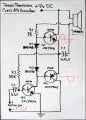
This one. I've seen it all over AAC as well. I made sure to swap up components just to be sure. Though it is a preamp I believe so it may be that I misunderstood it's purpose.
 

Attachments

Thread Starter

ConstructionK88

Joined Jul 25, 2018
282
If your first post had said that you wanted guidance on making a good looking, wooden enclosed, blue tooth connected amp for phones which you could sell, you would have gotten very different sets of advice.

We thought you wanted to use parts you had to cobble together a plug into the phone amplifier and spent a lot of time giving you advice you did not need or want.
I may have mistyped what I meant. No I can easily build a beautiful enclosure. What my problem is building a beautiful sounding amp circuit with what I have. What I've read class a is essentially the best in linearity(efficiency isn't really important) but no matter my class a setup there is still a lot of distortion and clipping at just moderate input levels. It's the making it loud enough to validate building an enclosure for it is the issue i have.
 

Audioguru

Joined Dec 20, 2007
11,248
You found a little power amplifier (it is not a preamp) that was designed wrong. Its output should be almost 4V peak into an 8 ohm speaker which is a current of 4V/8= 500mA.
1) The little output transistors have an absolute maximum allowed current of only 200mA and they work poorly above 100mA.
2) The first transistor was biased wrongly.
3) The value of R3 was too high.
4) The speaker was connected to the positive supply which is odd. One extra resistor and capacitor fixes that.

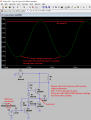
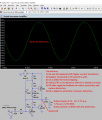
Here is a simulation of the original circuit with a distorted output of only 0.26W and my fixed version with a low distortion output of 0.93W.
 

Attachments

Thread Starter

ConstructionK88

Joined Jul 25, 2018
282
You found a little power amplifier (it is not a preamp) that was designed wrong. Its output should be almost 4V peak into an 8 ohm speaker which is a current of 4V/8= 500mA.
1) The little output transistors have an absolute maximum allowed current of only 200mA and they work poorly above 100mA.
2) The first transistor was biased wrongly.
3) The value of R3 was too high.
4) The speaker was connected to the positive supply which is odd. One extra resistor and capacitor fixes that.

Here is a simulation of the original circuit with a distorted output of only 0.26W and my fixed version with a low distortion output of 0.93W.
That is one problem that's most maddening. I can't simulate any circuit I come up with for clarity before spending an hour building it and failing. It's also nearly impossible to find a purely transistor based amp with a clean output. Seems to always have that pinch of secret ingredient/component I'm not spending more money on for it. Surely there must be an amp that's in the 5-10w range that can use just tip41c/42c and still sound decent throughout my house.
 

Audioguru

Joined Dec 20, 2007
11,248
10W into an 8 ohm speaker is 1.12A RMS which is 1.6A peak. The minimum current gain of a TIP41/42 is about 20 so it needs a peak input that is 1.12A/20= 60mA which can be supplied by an amplifier made with 3 or 4 transistors. Today an inexpensive IC power amplifier would be used.
 

Thread Starter

ConstructionK88

Joined Jul 25, 2018
282
10W into an 8 ohm speaker is 1.12A RMS which is 1.6A peak. The minimum current gain of a TIP41/42 is about 20 so it needs a peak input that is 1.12A/20= 60mA which can be supplied by an amplifier made with 3 or 4 transistors. Today an inexpensive IC power amplifier would be used.
So it is possible to make a fully functional amp from tip41/42 alone? Again I have made one from a single 41 but it's not quite loud enough. Is it possible to darlington them or use a single to power an in parallel 41 class a amp or parallel class ab? Parallel Strictly to control thermals. I've tried multiple circuits but none match the watt output the circuit claims (judging by ear)
 

Thread Starter

ConstructionK88

Joined Jul 25, 2018
282
So it is possible to make a fully functional amp from tip41/42 alone? Again I have made one from a single 41 but it's not quite loud enough. Is it possible to darlington them or use a single to power an in parallel 41 class a amp or parallel class ab? Parallel Strictly to control thermals. I've tried multiple circuits but none match the watt output the circuit claims (judging by ear)
meant single class a to power the parallels for a string class a or ab
 

sghioto

Joined Dec 31, 2017
8,634
Just got through testing some LM386-4 chips for fun. Interesting results. Using a 12 volt power supply I could get just about .9 watts into a 10 ohm load with a max dissipation of .7 watts on the chip. Bridging the chips only produced 1.5 watts output into the same 10 ohm load but the dissipation on the chips was almost 1.5 watts each.
I'm leaning more toward the idea in post #11 by "whitehaired/novice". Build 4 or 5 single chip amps each driving it's own speaker.
SG
 

Audioguru

Joined Dec 20, 2007
11,248
You could make a 3-transistor amplifier like I fixed today with a TIP41 at the input and a TIP41 and TIP42 at the output.
With a 24V supply it could produce 6W into 8 ohms or 10W into 4 ohms.
Its input resistance would be fairly low but fine for a headset signal to feed it.

Thermal runaway is fixed in class-B amps with the two diodes at the bases of the output transistor or a little transistor can replace the two diodes. Mount the diodes or little transistor on the heatsink for the output transistors and when the output transistors get hot and begin conducting more current then the diodes or little transistor also get hot and conduct more current between the inputs which reduces the current in the output transistors.
 

Thread Starter

ConstructionK88

Joined Jul 25, 2018
282
Just got through testing some LM386-4 chips for fun. Interesting results. Using a 12 volt power supply I could get just about .9 watts into a 10 ohm load with a max dissipation of .7 watts on the chip. Bridging the chips only produced 1.5 watts output into the same 10 ohm load but the dissipation on the chips was almost 1.5 watts each.
I'm leaning more toward the idea in post #11 by "whitehaired/novice". Build 4 or 5 single chip amps each driving it's own speaker.
SG
That's the issue really. No matter how many speakers you drive if it's 1 watt then it's 1 watt. You're just basically making 1 watt surround sound like that. But it shouldn't technically be louder. Just perceived as louder. Don't get me wrong I got ideas for my 386s but as an audio amp I doubt they are worth the effort. I am hoping my TIP's will prove themselves soon. So far experimenting has yielded that reversing the polarity I can make a pnp do the same thing as a npn lol. Forgive me yall but in electronic's I'm full retard.
 

Thread Starter

ConstructionK88

Joined Jul 25, 2018
282
Neverminding the audio jack side, white plug (npn, single, yes 2 for heat issues). The other is pnp for confirmation of theory it would work. Throwing it out there that one from each side can be removed and either will work. Both are obviously not tied together. How can I bridge them together to work as an ab or b class? Thought I was being clever by making each power one output wire to the speaker. Horrible distortion. Most likely oscillating af.
 

Attachments

Top