I need help with an audio amplifier.

MrChips

Joined Oct 2, 2009
34,829
You cannot create a high-fidelity audio amplifier by throwing components together at random. At the very least, you need to know how a basic NPN BJT amplifier works. Next, you need to know how a basic PNP BJT amplifier works. Then you need to know the difference between common emitter and common collector configuration.

Did you try the circuit I showed in post #34?
 

Audioguru

Joined Dec 20, 2007
11,248
I read schematics, not a photo of tangles of parts and wires.
It sounded like you are trying to make a bridged class-A heater, not an audio amplifier. Your heater is probably also heating the speaker and driving its coil and cone to one side all the time.

A single transistor operates in class-A and conducts the full current all the time.
Two complimentary transistors operate in class-AB and conduct a tiny current when there is no audio and at the crossover times when the audio changes from from one transistor that pushes up the output then switching to the other transistor that pulls down the output (push pull).
 

Audioguru

Joined Dec 20, 2007
11,248
Did you try the circuit I showed in post #34?
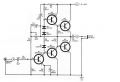
I analysed the amplifier circuit in my post #15 since it is the same circuit as in post #14. It has such high losses that its output when barely clipping is only 0.42W which is less than the 0.66W power of an LM386 by itself. Since the LM386 is driving a complimentary emitter-follower then it stays cool, instead of almost frying at 0.82W of heating.
 

sghioto

Joined Dec 31, 2017
8,634
Well the only way to get any decent output is to raise the supply voltage. Here's a throw-back circuit from the late sixties I've used many times. The "Lil Tiger" from Southwest Technical Products. 22 watts at 45 volts or about 5 watts at 24 volts dc, 8 ohm load.
SG
Lil Tiger amp.png
 

Audioguru

Joined Dec 20, 2007
11,248
Well the only way to get any decent output is to raise the supply voltage.
Car radios use a bridged amplifier (one amplifier for each of the two speaker wires), then the voltage swing and current swing are almost doubled resulting in about 3.5 times the output power of one amplifier.
 

Thread Starter

ConstructionK88

Joined Jul 25, 2018
282
You cannot create a high-fidelity audio amplifier by throwing components together at random. At the very least, you need to know how a basic NPN BJT amplifier works. Next, you need to know a basic PNP amplifier works.

Did you try the circuit I showed in post #34?
I did good sir. Exactly as shown. The only issue I had was with the diodes. I had to try multiple types. I couldn't read the lettering on the ones I had( hunreds) so I couldn't find the ones shown in the schematic though no matter the combination it sounded horribly distorted. That may be inherent to the TIP41/42S themselves. My experiment's so far tell me they can't handle much. Imy guessing my output is only around 2 watts. I just ordered an oscilloscope so I can at least view the waveform and see how to fix the distortion. I'm almost certain it's from clipping.
 

MrChips

Joined Oct 2, 2009
34,829
I did good sir. Exactly as shown. The only issue I had was with the diodes. I had to try multiple types. I couldn't read the lettering on the ones I had( hunreds) so I couldn't find the ones shown in the schematic though no matter the combination it sounded horribly distorted. That may be inherent to the TIP41/42S themselves. My experiment's so far tell me they can't handle much. Imy guessing my output is only around 2 watts. I just ordered an oscilloscope so I can at least view the waveform and see how to fix the distortion. I'm almost certain it's from clipping.
The distortion is from clipping. The output transistors are configured as emitter followers. You do not get any voltage gain. The LM386 is clipping with 12V supply. If you need more power you have to increase the supply voltage.

Read post #64 and post #65.
 

Thread Starter

ConstructionK88

Joined Jul 25, 2018
282
The distortion is from clipping. The output transistors are configured as emitter followers. You do not get any voltage gain. The LM386 is clipping with 12V supply. If you need more power you have to increase the supply voltage.

Read post #64 and post #65.
No offense but is it really as simple as increasing supply voltage? Am I wrong to assume the values of capacitors and resistors need to be recalculated as well?
 

MrChips

Joined Oct 2, 2009
34,829
No offense but is it really as simple as increasing supply voltage? Am I wrong to assume the values of capacitors and resistors need to be recalculated as well?
Increasing the supply voltage would be the first step.
Do the math. With a supply voltage of 12V, the maximum output signal is 4Vrms.
Maximum power into 8Ω speaker is 4 x 4 / 8 = 2W.

Capacitance values remain the same. Just make sure the voltage rating of the capacitors can handle the higher voltages.
Resistances have to be adjusted for increased bias currents needed.

Try it first as is with higher supply voltages, 24V for example. If you do not increase the supply voltage on the LM386 you will have to have an additional driver stage to raise the bias voltage to the output transistors. Remember that the voltage gain at the output stage is less than unity.
 

Audioguru

Joined Dec 20, 2007
11,248
The datasheet of the TIP41 and TIP42 shows that they can conduct 6A continuously. Then they can be used in an audio amplifier that produces 6A peak into 4 ohms which can be done with (Voltage= 6A x 4 ohms)= 24V peak. A power supply of about 54VDC can do it. The power in 4 ohm speaker will be 72W. The TIP41 and TIP42 will each heat with about 30W so they will need pretty large heatsinks that are not enclosed.
But the minimum current gain of a TIP41 or TIP42 is almost nothing at 6A so forget it.

The minimum current gain is 15 at 3A so change the max peak current to 3A then a power supply can be about 28VDC and the power in the 4 ohm speaker will be 18W and each output transistor will heat with 7.5W.

Do the calculations again using an 8 ohm speaker and 2A peak in it.

The amplifier in post #34 has A LOT of voltage and current losses. If you increase its supply voltage then it might get so hot it melts.
 

Thread Starter

ConstructionK88

Joined Jul 25, 2018
282
No offense but is it really as simple as increasing supply voltage? Am I wrong to assume the values of capacitors and resistors need to be recalculated as well?
50v power supply. Didn't get louder but it certainly sounded clearer. Also chicken fried my finger checking the transistors which are now space heaters.
 

Audioguru

Joined Dec 20, 2007
11,248
If you increase the supply voltage then all the resistors will also have increased current which causes the transistors and speaker to have increased current. The amplifier will work fine if nothing is overloaded.
I took the "corrected" amplifier in my post #52 and increased its supply voltage from its designed 9V to 18VDC. It performed perfectly without changing any resistor values and had an output of 3.7W instead of 0.93W since the input level also needed to be doubled. The doubled supply voltage doubles the speaker voltage swing and also doubled the speaker current swing. Of course the little transistors I used would blow up due to their current being higher than their max allowed current.
 

Thread Starter

ConstructionK88

Joined Jul 25, 2018
282
Increasing the supply voltage would be the first step.
Do the math. With a supply voltage of 12V, the maximum output signal is 4Vrms.
Maximum power into 8Ω speaker is 4 x 4 / 8 = 2W.

Capacitance values remain the same. Just make sure the voltage rating of the capacitors can handle the higher voltages.
Resistances have to be adjusted for increased bias currents needed.

Try it first as is with higher supply voltages, 24V for example. If you do not increase the supply voltage on the LM386 you will have to have an additional driver stage to raise the bias voltage to the output transistors. Remember that the voltage gain at the output stage is less than unity.
All capacitors are rated above 100v. And thank you for the math. At the moment I am only using tips for the circuit. The lm386 will come in later. Currently I'm trying to make a decent circuit with just transistors I have. The 386 I'll use as a circuit controller.
 

Audioguru

Joined Dec 20, 2007
11,248
The maximum allowed supply voltage for a little LM386 is 15V or 22V depending on the version. It must be replaced if a higher supply voltage is used because the TIP transistors are used as emitter-followers with no voltage gain.
 

Thread Starter

ConstructionK88

Joined Jul 25, 2018
282
If you increase the supply voltage then all the resistors will also have increased current which causes the transistors and speaker to have increased current. The amplifier will work fine if nothing is overloaded.
I took the "corrected" amplifier in my post #52 and increased its supply voltage from its designed 9V to 18VDC. It performed perfectly without changing any resistor values and had an output of 3.7W instead of 0.93W since the input level also needed to be doubled. The doubled supply voltage doubles the speaker voltage swing and also doubled the speaker current swing. Of course the little transistors I used would blow up due to their current being higher than their max allowed current.
I speced my tips and the adapter I just used is rated 48v at 0.38A. The Tip41C is rated higher. Why did they get so hot it made the sun jealous?
 

MrChips

Joined Oct 2, 2009
34,829
You can adjust the current through the TIP41/42 by adjusting the quiescent current (idle current) or Q-point (bias point)of the transistor. In effect what you are doing is changing the class of the amplifier, from class A to AB to B. You are inviting higher cross-over distortion as you go from class A to AB to B while improving power efficiency.

In any case, you still need to put heat sinks on the TIP41/42 for higher power output.

If you wanted a straight transistor design and not use the LM386 then you can go with a four-transistor design consisting of a pre-amp, driver, and push-pull output. If that is what you want with the TIP41/42 as output I can come up with a design but not today.

I am not a audio amplifier design expert but I can slap together a simple four-transistor circuit that will work. I rarely do simulations but prefer to work with a real circuit and see how well it performs.
 

MrChips

Joined Oct 2, 2009
34,829
50v power supply. Didn't get louder but it certainly sounded clearer. Also chicken fried my finger checking the transistors which are now space heaters.
Of course it would not sound louder. By increasing the supply voltage to 50V you have given the amplifier more headroom so that it no longer clips. In order to sound louder you have to increase the input signal without introducing clipping.
 
Top