I need help with an audio amplifier.

Thread Starter

ConstructionK88

Joined Jul 25, 2018
282
You can adjust the current through the TIP41/42 by adjusting the quiescent current (idle current) or Q-point (bias point)of the transistor. In effect what you are doing is changing the class of the amplifier, from class A to AB to B. You are inviting higher cross-over distortion as you go from class A to AB to B while improving power efficiency.

In any case, you still need to put heat sinks on the TIP41/42 for higher power output.

If you wanted a straight transistor design and not use the LM386 then you can go with a four-transistor design consisting of a pre-amp, driver, and push-pull output. If that is what you want with the TIP41/42 as output I can come up with a design but not today.

I am not a audio amplifier design expert but I can slap together a simple four-transistor circuit that will work. I rarely do simulations but prefer to work with a real circuit and see how well it performs.
I'm currently doing just that. Just trying to find two 1n4148s. If this ab circuit works then I plan on using to to drive transistor banks. Hopefully it'll give me at least another 5 watts. Not shooting for the moon when I can see it from earth. I figure when my oscilloscope gets here I'll be able to do more with what I have knowing how it's working. This ab I tried last night and didn't work but I already know I didn't have the right diodes.

Of course it would not sound louder. By increasing the supply voltage to 50V you have given the amplifier more headroom so that it no longer clips. In order to sound louder you have to increase the input signal without introducing clipping.
Would creating a preamp accomplish that? Say a well build class a?

because the very simple circuit has nothing to adjust for the correct amount of current in the output transistors. The diodes and emitter resistors work when the supply voltage is low.
Makes sense. I'm working on a class ab right now with transistor banks to share the load as a slightly higher power pretty amp for a power amp I'll try to build later. At the moment it's just a proof of concept circuit.
 
Last edited by a moderator:
MrChips

Joined Oct 2, 2009
34,830
I'm currently doing just that. Just trying to find two 1n4148s. If this ab circuit works then I plan on using to to drive transistor banks. Hopefully it'll give me at least another 5 watts. Not shooting for the moon when I can see it from earth. I figure when my oscilloscope gets here I'll be able to do more with what I have knowing how it's working. This ab I tried last night and didn't work but I already know I didn't have the right diodes.
What kind of diodes make the right diodes? How you know you have the right diodes?

You need some tutorials on audio amplifier designs. I am willing to provide this if you are willing to pay attention.
 

Audioguru

Joined Dec 20, 2007
11,248
Guess what? When the output transistors get hot then they draw more current which makes them hotter which makes them draw more current which makes them hotter which... It is called Thermal Runaway. But the diodes also draw more current when they get hot which causes the output transistors to stop getting hotter when they are clamped to the heatsink for the output transistors.
Amplifiers usually use a transistor that is adjusted with a trimpot to simulate the diodes and this transistor is clamped to the heatsink of the output transistors to regulate the heating. The trimpot is adjusted for a small current in the output transistors with no signal or a low level signal to eliminate crossover distortion (look it up) but produce not much heating.

A preamp probably cannot provide enough current to drive your TIP41 and TIP42 output transistors. You need the front part of an audio power amplifier designed for the job. A preamp is deigned to provide the small current needed to drive the front part of a power amplifier.

Why are you using banks of (output?) transistors? You just need a heatsink for one pair of TIP41 and TIP42 transistors for an output up to about 25W. Your banks of output transistors will need a pretty big heatsink.
 

Thread Starter

ConstructionK88

Joined Jul 25, 2018
282
What kind of diodes make the right diodes? How you know you have the right diodes?

You need some tutorials on audio amplifier designs. I am willing to provide this if you are willing to pay attention.
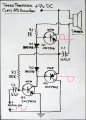
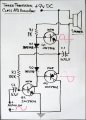
I would appreciate that very much. I'll post the schematic I tried. It doesn't work. I build it exactly as shown but nothing. Tested all connections. And 1n4148 is what I was missing. Found them, put them in. Not even a hum. Things like this makes me afraid to try most schematics.
 

Attachments

Thread Starter

ConstructionK88

Joined Jul 25, 2018
282
Guess what? When the output transistors get hot then they draw more current which makes them hotter which makes them draw more current which makes them hotter which... It is called Thermal Runaway. But the diodes also draw more current when they get hot which causes the output transistors to stop getting hotter when they are clamped to the heatsink for the output transistors.
Amplifiers usually use a transistor that is adjusted with a trimpot to simulate the diodes and this transistor is clamped to the heatsink of the output transistors to regulate the heating. The trimpot is adjusted for a small current in the output transistors with no signal or a low level signal to eliminate crossover distortion (look it up) but produce not much heating.

A preamp probably cannot provide enough current to drive your TIP41 and TIP42 output transistors. You need the front part of an audio power amplifier designed for the job. A preamp is deigned to provide the small current needed to drive the front part of a power amplifier.

Why are you using banks of (output?) transistors? You just need a heatsink for one pair of TIP41 and TIP42 transistors for an output up to about 25W. Your banks of output transistors will need a pretty big heatsink.
The only reason I'm using parallel banks is for the thermal runaway. At full input one gets far to hot to touch. Using just two it's no more than ambient temperature. I only do it for testing my circuit. Heatsinks I will add later. Also it sounds better when I bank them. That part I don't understand as to why. I assume less heating.
 

MrChips

Joined Oct 2, 2009
34,830
Firstly, a caveat. I will present the design of a basic four-transistor audio amplifier.
I will not be discussing in detail except when necessary to explain certain features:
  • linearity
  • total harmonic distortion
  • frequency and phase response
  • power efficiency
For an audio amplifier exceeding 1Wrms output, be prepared to put heat sinks on the output transistors.
I am going to assume that you are going to use TIP41 and TIP42 for the output stage though TIP31 and TIP32 will work as well.
 

MrChips

Joined Oct 2, 2009
34,830
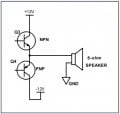
We begin with consideration of the output stage.
AudioAmp01.jpg
This is called a push-pull output. Why?

When turned on, Q3 pushes current to the loudspeaker.
When Q3 is turned off and Q4 is turned on, Q4 will pull current through the loudspeaker.
For best power efficiency, we never want both Q3 and Q4 to be turned on at the same time otherwise it becomes a short circuit across the power supply rails. With both Q3 and Q4 turned off, the quiescent (or idle) current is zero, i.e. zero power consumed and no heat generated by the transistors. This would be a Class-B amplifier.

To be useful as an audio amplifier, we want to be able to control Q3 and Q4 in a "soft" manner, i.e. to be able to slowly turn on Q3 or Q4 in a linear fashion.

What are some important considerations with this type of circuit?
  1. You need a dual supply.
  2. You must balance Q3 and Q4 perfectly so that the current through the speaker is zero when no signal is present.

What is the maximum power output from this stage?
The maximum voltage is 24V peak-to-peak.
The maximum amplitude is 12V.
For a 12V sine-wave signal, the rms voltage is 12 x 0.7 = 8.4V
The maximum power into an 8Ω load = 8.4 x 8.4 / 8 = 8.8Wrms
 

Thread Starter

ConstructionK88

Joined Jul 25, 2018
282
Firstly, a caveat. I will present the design of a basic four-transistor audio amplifier.
I will not be discussing:
  • linearity
  • total harmonic distortion
  • frequency and phase response
  • power efficiency
For an audio amplifier exceeding 1Wrms output, be prepared to put heat sinks on the output transistors.
I am going to assume that you are going to use TIP41 and TIP42 for the output stage though TIP31 and TIP32 will work as well.
I appreciate that. Any distortion, I will piddle with the design myself until I reduce it if it's an issue. I do believe no matter it's output I can find a way to increase it if I need. Also if you don't mind good sir could you explain why the circuit below doesn't work? I did build it exactly to specs using tip41c/42c and I don't get anything. Not even a hum from the speaker. It was simple so I decided to try it. Seems popular as well.
 

Attachments

MrChips

Joined Oct 2, 2009
34,830
I appreciate that. Any distortion, I will piddle with the design myself until I reduce it if it's an issue. I do believe no matter it's output I can find a way to increase it if I need. Also if you don't mind good sir could you explain why the circuit below doesn't work? I did build it exactly to specs using tip41c/42c and I don't get anything. Not even a hum from the speaker. It was simple so I decided to try it. Seems popular as well.
My first guess is that you made an error in wiring.
 

Thread Starter

ConstructionK88

Joined Jul 25, 2018
282
We begin with consideration of the output stage.
View attachment 157604
This is called a push-pull output. Why?

When turned on, Q3 pushes current to the loudspeaker.
When Q3 is turned off and Q4 is turned on, Q4 will pull current through the loudspeaker.
For best power efficiency, we never want both Q3 and Q4 to be turned on at the same time otherwise it becomes a short circuit across the power supply rails. With both Q3 and Q4 turned off, the quiescent (or idle) current is zero, i.e. zero power consumed and no heat generated by the transistors. This would be a Class-B amplifier.

To be useful as an audio amplifier, we want to be able to control Q3 and Q4 in a "soft" manner, i.e. to be able to slowly turn on Q3 or Q4 in a linear fashion.

What are some important considerations with this type of circuit?
  1. You need a dual supply.
  2. You must balance Q3 and Q4 perfectly so that the current through the speaker is zero when no signal is present.

What is the maximum power output from this stage?
The maximum voltage is 24V peak-to-peak.
The maximum amplitude is 12V.
For a 12V sine-wave signal, the rms voltage is 12 x 0.7 = 8.4V
The maximum power into an 8Ω load = 8.4 x 8.4 / 8 = 8.8Wrms
Thank you, please continue.

My first guess is that you made an error in wiring.
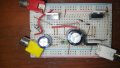
I looked the wiring over and over. Then again and again. Absolutely nothing is done wrong. All of the values are correct except 12v power instead of 9. The voltage rating on the capacitors are higher than needed but the uf values are exact. Diodes are correct. Using tip41c/42c but I don't see that as an issue. I took my time (2hours) wiring it to be sure it was right. Even checked continuity between connections. All checks out. And certainly swapped up components in case one was bad. Still nothing. I'll show you a picture. Though many jumpers, it does follow the schematic perfectly. White: input. Red: power. Yellow: audio out. Also you may continue with your tutorial sir.
 

Attachments

Last edited by a moderator:

MrChips

Joined Oct 2, 2009
34,830
This configuration overcomes the first two issues, but introduces other ones.

AudioAmp02.jpg

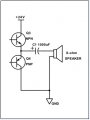
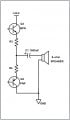
By inserting a capacitor C1 before the loudspeaker, this allows us to go with a single polarity power supply. The loudspeaker is now AC coupled to the output of the amplifier. No DC current flows through the capacitor C1.

This means that Q3 and Q4 do not have to be perfectly balanced. However, we still want Q3 and Q4 to be reasonably balanced so that the junction at the emitters of Q3 and Q4 is close to halfway between the power supply rails. In other words, we want this junction to be at +12V when using a single +24V supply.

Two new issues are introduced.
1) When you turn on the power, you will hear a "thump" as C1 charges up to +12V. Similarly, when you turn the power off, you might hear another "thump".

2) Of greater consequence, C1 in series with the loudspeaker now constitute a high-pass filter. High frequencies signal will pass without being attenuated. Low frequencies will suffer. If you want good low-frequency response you have to increase the value of C1. 1000-4700μF is not uncommon.

Capacitor C1 must be rated to handle 24V. For example, 35V, 50V or 63V capacitors would be ok.

PS - later I will move my posts to a blog so as to tidy up your main thread.
 
I hope you have those transistors on heat sinks, but your comments make me think you don't. Imagine touching a 40 watt light bulb while it was on. They will burn out without fairly large sinks.
 

Thread Starter

ConstructionK88

Joined Jul 25, 2018
282
This configuration overcomes the first two issues, but introduces other ones.

View attachment 157605

By inserting a capacitor C1 before the loudspeaker, this allows us to go with a single polarity power supply. The loudspeaker is now AC coupled to the output of the amplifier. No DC current flows through the capacitor C1.

This means that Q3 and Q4 do not have to be perfectly balanced. However, we still want Q3 and Q4 to be reasonably balanced so that the junction at the emitters of Q3 and Q4 is close to halfway between the power supply rails. In other words, we want this junction to be at +12V when using a single +24V supply.

Two new issues are introduced.
1) When you turn on the power, you will hear a "thump" as C1 charges up to +12V. Similarly, when you turn the power off, you might hear another "thump".

2) Of greater consequence, C1 in series with the loudspeaker now constitute a high-pass filter. High frequencies signal will pass without being attenuated. Low frequencies will suffer. If you want good low-frequency response you have to increase the value of C1. 1000-4700μF is not uncommon.

Capacitor C1 must be rated to handle 24V. For example, 35V, 50V or 63V capacitors would be ok.

PS - later I will move my posts to a blog so as to tidy up your main thread.
Thank you. Leave a link if you would please. Please go on.

I hope you have those transistors on heat sinks, but your comments make me think you don't. Imagine touching a 40 watt light bulb while it was on. They will burn out without fairly large sinks.
I plan on it. I don't run it for very long. Just long enough to get a feel for the sound. I'm working my way up to a permanent version that shouldn't require heatsinks. I dont know to much of shi+ about electronics but I am adept at woodworking, construction, metal smithing, chemistry, brewing, gardening, and as for the heatsinks: running a mineral oil cooling bath around the circuitry with custom radiators and very efficient pumps.
 
Last edited by a moderator:

MrChips

Joined Oct 2, 2009
34,830
In this next development, we have added two very important resistors R3 and R4 in the emitter legs of the NPN and PNP output transistors.

Why are these resistors important?

Without these resistors, we are in danger of blowing out the two transistors, R3 and R4, in the event that both transistors are ever turned on at the same time. Remember, R3 and R4 are across the power supply rails. If both R3 and R4 are turned on, this represents a short-circuit across the power supply rails. A large current will flow, potentially destroying both R3 and R4.

The total sum of R3 and R4 will set a maximum limit on the short-circuit current. For example, if R3 and R4 are 1Ω each, the maximum short-circuit current would be 24V / 2Ω = 12A.

Of course, there is always a downside and what is it?
R3 and R4 are now passive loads that steal power from going to the speaker. We have to sacrifice some of the potential output power. We lose power in the form of heat dissipated in R3 and R4.

That sacrifice is well worth it for another important reason. @Audioguru mentions Thermal Runaway in post #87.

What is thermal runaway?
Thermal runaway is a positive feedback mechanism that makes a bad thing get worse. As a transistor passes current, it heats up (the temperature rises). If this causes the transistor to pass more current, "Houston, we have a problem!". We have positive feedback and thermal runaway, resulting in a meltdown.

How do we prevent thermal runaway? Easy. We apply negative feedback. We need a mechanism to oppose the positive feedback that is causing the problem in the first place. Putting a resistor in the emitter leg of the BJT (bipolar junction transistor) amplifier provides negative feedback. I will not go into the details as to how this works.


AudioAmp03.jpg

This type of BJT amplifier configuration is called an emitter follower. There are important characteristics of the emitter follower amplifier. Most importantly, in provides current amplification but no voltage amplification (close to unity).

How do we choose the value of R3 and R4?
If we make the resistance too high, we lose power.
If we make it too low, we do not get the desired benefit.
The result has to be a compromise.

Values from 0.1 to 2Ω are typical. One has to calculate the power dissipated in order to install resistors with acceptable power rating.
 

Audioguru

Joined Dec 20, 2007
11,248
I appreciate that. could you explain why the circuit below doesn't work? I did build it exactly to specs using tip41c/42c and I don't get anything.
You used the spec's for the 2N3904 that has a typical current gain of 200 at 10mA, not the current gain of only 40 for the TIP41. So the value of R2 is way too high (the original 100k is too low for a 2N3904).
The value of R1 is also way too high to use a TIP41 instead of a 2N3904.
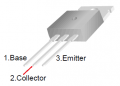
But your circuit should produce some very distorted sound and it doesn't maybe because you have the pins on the TIP41 and TIP42 mixed up.
Here are the pins shown on the datasheet:
 

Attachments

Thread Starter

ConstructionK88

Joined Jul 25, 2018
282
In this next development, we have added two very important resistors R3 and R4 in the emitter legs of the NPN and PNP output transistors.

Why are these resistors important?

Without these resistors, we are in danger of blowing out the two transistors, R3 and R4, in the event that both transistors are ever turned on at the same time. Remember, R3 and R4 are across the power supply rails. If both R3 and R4 are turned on, this represents a short-circuit across the power supply rails. A large current will flow, potentially destroying both R3 and R4.

The total sum of R3 and R4 will set a maximum limit on the short-circuit current. For example, if R3 and R4 are 1Ω each, the maximum short-circuit current would be 24V / 2Ω = 12A.

Of course, there is always a downside and what is it?
R3 and R4 are now passive loads that steal power from going to the speaker. We have to sacrifice some of the potential output power. We lose power in the form of heat dissipated in R3 and R4.

That sacrifice is well worth it for another important reason. @Audioguru mentions Thermal Runaway in post #87.

What is thermal runaway?
Thermal runaway is a positive feedback mechanism that makes a bad thing get worse. As a transistor passes current, it heats up (the temperature rises). If this causes the transistor to pass more current, "Houston, we have a problem!". We have positive feedback and thermal runaway, resulting in a meltdown.

How do we prevent thermal runaway? Easy. We apply negative feedback. We need a mechanism to oppose the positive feedback that is causing the problem in the first place. Putting a resistor in the emitter leg of the BJT (bipolar junction transistor) amplifier provides negative feedback. I will not go into the details as to how this works.


View attachment 157607

This type of BJT amplifier configuration is called an emitter follower. There are important characteristics of the emitter follower amplifier. Most importantly, in provides current amplification but no voltage amplification (close to unity).

How do we choose the value of R3 and R4?
If we make the resistance too high, we lose power.
If we make it too low, we do not get the desired benefit.
The result has to be a compromise.

Values from 0.1 to 2Ω are typical. One has to calculate the power dissipated in order to install resistors with acceptable power rating.
That I understand. So the next stage is voltage amplification?
 

Audioguru

Joined Dec 20, 2007
11,248
Since this 3 transistor amplifier is extremely simple then it is missing a 4th input transistor to isolate the negative feedback of R2 at its input from the gain being changed by the source impedance. You and I do not know the impedance of your signal source.
 

MrChips

Joined Oct 2, 2009
34,830
That I understand. So the next stage is voltage amplification?
Nope.
The first part was the easy part. The next part is critical - biasing the base of the two transistors. This will determine the class of the amplifier, class A, AB or B and how much power is wasted when idle.
 

sghioto

Joined Dec 31, 2017
8,634
Construction/K88, here's your circuit modified to work at 9 volts. Actually sounds good using a 6 ohm speaker, not much output but enough to hear clearly. Has a voltage gain of about 10, idle current 6ma with no crossover distortion.:)
Sg
EEE 3 Transistor AB Amp.png
 
Last edited:
Top