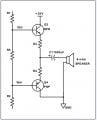
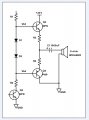
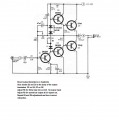
I need help with an audio amplifier.

Thread Starter

ConstructionK88

Joined Jul 25, 2018
282
You used the spec's for the 2N3904 that has a typical current gain of 200 at 10mA, not the current gain of only 40 for the TIP41. So the value of R2 is way too high (the original 100k is too low for a 2N3904).
The value of R1 is also way too high to use a TIP41 instead of a 2N3904.
But your circuit should produce some very distorted sound and it doesn't maybe because you have the pins on the TIP41 and TIP42 mixed up.
Here are the pins shown on the datasheet:
The pins are correct. I use the Before Christ Everything for my tips. It's not at all distorted, just very, very quiet. I'd post more pictures but I know you gentleman don't like that. What got me is substituting my tip for every single transistor class a and it work. Even kept the values of capacitors and resistors the same as shown. I didn't understand why it didnt work with tips for that ab schematic. So should I change my resistors then? Or capacitors?

Since this 3 transistor amplifier is extremely simple then it is missing a 4th input transistor to isolate the negative feedback of R2 at its input from the gain being changed by the source impedance. You and I do not know the impedance of your signal source.
That I don't know either. It is a galaxy note 4 and I tried to look that up. Clearly it's a cold war secret. Just guessing here... connecting to my test speakers(4ohm&32ohm) the watt output is likely around .1-.3 judging by volume. The impedance I can't fathom. Although it does push the 4 ohm better. Noticeably!

Nope.
The first part was the easy part. The next part is critical - biasing the base of the two transistors. This will determine the class of the amplifier, class A, AB or B and how much power is wasted when idle.
Suppose idle waste isn't terribly important. For a decent Class A. Or even moderately for a decent class AB. I think ab is what I need. Battery will be the source. Two 6 volt 7amp hour, SLA batteries. 12 volts in series. Do not need 4063 hours of play time. 8 to 10 is more than adequate at mid, one room, volume levels. Class a is easy. Class ab I cannot seem to make work as advertised.

Construction/K88, here's your circuit modified to work at 9 volts. Actually sounds good using a 6 ohm speaker, not much output but enough to hear clearly. Has a voltage gain of about 10, idle current 6ma with no crossover distortion.:)
Sg
View attachment 157612
Thank you and it's certainly not my schematic. I'm especially perplexed by why it isn't working as I expected it to. I will try your idea. I only have 4ohm speakers at the moment. I'm sure it'll still play through. Also I don't have a 9volt supply. I test using 6v and 12volt supplies since I have rechargeable batteries to match.
 
Last edited by a moderator:

Audioguru

Joined Dec 20, 2007
11,248
Nearly ALL audio amplifiers are class-AB, hardly any are class-A heaters.
Class-A amplifiers produce even-harmonics distortion that is difficult to remove but electric guitar "fuzz" likes it.

You cannot get much power from an amplifier powered from only 12V.

Your amplifier was very, very quiet because its gain is too low. its gain depends on the impedance of the signal source, use a speaker output and the gain will be very high.
 

Thread Starter

ConstructionK88

Joined Jul 25, 2018
282
Nearly ALL audio amplifiers are class-AB, hardly any are class-A heaters.
Class-A amplifiers produce even-harmonics distortion that is difficult to remove but electric guitar "fuzz" likes it.

You cannot get much power from an amplifier powered from only 12V.

Your amplifier was very, very quiet because its gain is too low. its gain depends on the impedance of the signal source, use a speaker output and the gain will be very high.
The output is a 4ohm speaker. So I the question is how to increase the gain? Also do I need to change the resistors/ capacitors to reflect the tip pairing?
 

MrChips

Joined Oct 2, 2009
34,829
The previous discussion was easy. Now comes the critical part - biasing the base of Q3 and Q4. This will establish the class of the amplifier, Class A, AB or B and how much power is wasted.

We know where we want to go. How we get there is another story. For every next audio amplifier designer, there is new design idea.
We have come up with some partial specs for Q3 and Q4. Q3 and Q4 must withstand 24V and 12A if we choose 1Ω resistors for R3 and R4. (This is actually overkill but we will go with this for now.)

AudioAmp04.jpg

We know that we want the voltage at the output junction to be at +12V.
We also know that the BJT will start to conduct when the base-emitter voltage is at about 0.6V.
If we were to ignore the voltage drop across R3 and R4, we want the voltage at the base of Q3, Vb3 to be 12 + 0.6 = +12.6V
Similarly, the voltage at the base of Q4, Vb4 needs to be 12 - 0.6 = +11.4V

If we set the voltage difference between Vb3 and Vb4 too low, we are into Class-B and will suffer from severe cross-over distortion. If Vb3-Vb4 is too high, we are into Class-A and we waste power. Again, we seek a compromise in order to bias the amplifier into class AB.

How much voltage gain do we need?
Since there is unity voltage gain, the base of Q3 and Q4 has to swing the full supply rail, from 0 to 24V (or close to that).

How much current do we need? This is where you need to consult the datasheet to find the current gain of Q3 and Q4 as @Audioguru alluded to in post #100.

If we are to take as an example a current gain of 40 at Ic = 10A, we need a base current of 10A/40 = 0.25A or 250mA.

Again, there are many ways to get to our goal as you have obviously discovered by examining various audio amplifier designs.

In the next step, we will examine a simple and common design.
 

Audioguru

Joined Dec 20, 2007
11,248
Gain is determined by the amount of negative feedback. The negative feedback resistor in your extremely simple amplifier is connected directly to the input so the impedance of the signal source determines the gain.

I do not know why and how you will be tip pairing.
 

Thread Starter

ConstructionK88

Joined Jul 25, 2018
282
The output is a 4ohm speaker. So I the question is how to increase the gain? Also do I need to change the resistors/ capacitors to reflect the tip pairing?
Power power isn't important. At most 20 watts. I'd prefer 5 to 10 though. This is for around the house listening. I don't want a f-load of power. The reason for this is simple. I've seen many Bluetooth and aux jack speakers that run on less than 12volts but are loud and clear enough to hurt. I do understand they are class d or digital, maybe even ab. But how can they be so loud and clear on so little voltage and amp input? How is that old radios sound off loud and clear with only transistors? That is my paradox. How can they but I can't but they do and I can but cant.

Gain is determined by the amount of negative feedback. The negative feedback resistor in your extremely simple amplifier is connected directly to the input so the impedance of the signal source determines the gain.

I do not know why and how you will be tip pairing.
They are paired via voltmeter diode testing. Tip41c and tip42c.

The previous discussion was easy. Now comes the critical part - biasing the base of Q3 and Q4. This will establish the class of the amplifier, Class A, AB or B and how much power is wasted.

We know where we want to go. How we get there is another story. For every next audio amplifier designer, there is new design idea.
We have come up with some partial specs for Q3 and Q4. Q3 and Q4 must withstand 24V and 12A if we choose 1Ω resistors for R3 and R4. (This is actually overkill but we will go with this for now.)

View attachment 157615

We know that we want the voltage at the output junction to be at +12V.
We also know that the BJT will start to conduct when the base-emitter voltage is at about 0.6V.
If we were to ignore the voltage drop across R3 and R4, we want the voltage at the base of Q3, Vb3 to be 12 + 0.6 = +12.6V
Similarly, the voltage at the base of Q4, Vb4 needs to be 12 - 0.6 = +11.4V

If we set the voltage difference between Vb3 and Vb4 too low, we are into Class-B and will suffer from severe cross-over distortion. If Vb3-Vb4 is too high, we are into Class-A and we waste power. Again, we seek a compromise in order to bias the amplifier into class AB.

How voltage gain do we need?
Since there is unity voltage gain, the base of Q3 and Q4 has to swing the full supply rail, from 0 to 24V (or close to that).

How much current do we need? This is where you need to consult the datasheet to find the current gain of Q3 and Q4 as @Audioguru alluded to in post #100.

If we are to take as an example a current gain of 40 at Ic = 10A, we need a base current of 10A/40 = 0.25A or 250mA.

Again, there are many ways to get to our goal as you have obviously discovered by examining various audio amplifier designs.

In the next step, we will examine a simple and common design.
Thank you! This will help. I have been copying circuits with my components. Not taking into account mine are different and require different complementary components.
 
Last edited by a moderator:
as for the heatsinks: running a mineral oil cooling bath around the circuitry with custom radiators and very efficient pumps.[/QUOTE said:
I thought you were intending to get the source from a blue tooth phone. The quality of sound you are starting with does not justify anything like the cooling system you are contemplating. You are letting the skills you have force you into bad decisions in the skills you are learning.
 

Audioguru

Joined Dec 20, 2007
11,248
Your "pairing" is actually matching the diode voltages of the complementary transistors which is useless because you need to match the currents, not the voltages. Two transistors will have the same base-emitter voltages but one might have a much higher current gain than the other so the audio they produce will be lop-sided with maybe a lot of distortion.

A class-A output transistor usually is common emitter and has voltage gain. A class-AB output is usually common collector (emitter-follower) and has no voltage gain.
 

MrChips

Joined Oct 2, 2009
34,829
Now we come to the design of the driver stage.

Have you noticed how we start at the output and work backwards to the input? This is because we need to set our goals and then choose how we are going to get there. We are designing a modest 8Wrms audio amplifier. If we wanted to design a 25W amplifier, everything would have to change.

We need our driver to deliver 250mA with a voltage swing of 0 to 24V, i.e. 2Wrms.
The simplest and most common way to provide Vb3 - Vb4 = 1.2V is with two signal diodes.

AudioAmp05.jpg

Why two diodes?
Two diodes because the voltage drop across two silicon rectifier diodes is similar to the that of two BJT base-emitter junctions, i.e. two times 0.6V.
If we wish to turn on the output stage harder than Class-AB we could choose three diodes instead. Or we can substitute the third diode with a resistor. Hence we do have some control on the amount of cross-over distortion.

Designing the driver stage is somewhat more difficult because of the 2W requirement. You will often find a separate driver for each of the two output transistors, Q3 and Q4.

Of course, the intent of this design is to keep it simple, right? Hence we will commit our design to a one-transistor driver.

The choice of the diodes is not critical as long as they can handle the desired current of 250mA. Common signal diodes such as 1N914 and 1N4148 or 1N4001 rectifier diodes will do.
 

Thread Starter

ConstructionK88

Joined Jul 25, 2018
282
Very true. That was just my end goal. Certainly not in a rush to do so. I plan on learning circuitry and perfecting them well before I build that. The reason liquid cooling is my aim is for efficiency. Got many fans but most are less efficient and I don't want holes in my box for air flow. My intention is to keep it hidden inside out of sight. But learning circuit's is my full intention here.

Your "pairing" is actually matching the diode voltages of the complementary transistors which is useless because you need to match the currents, not the voltages. Two transistors will have the same base-emitter voltages but one might have a much higher current gain than the other so the audio they produce will be lop-sided with maybe a lot of distortion.

A class-A output transistor usually is common emitter and has voltage gain. A class-AB output is usually common collector (emitter-follower) and has no voltage gain.
So might I ask, how do I increase the voltage gain on my ab amp? The schematic I showed clearly works but it's no louder than my phone powering the speaker directly. Also I didn't have the time last night to switch out the resistors. As mentioned before they are likely valued to high for my circuit.
 
Last edited by a moderator:

Audioguru

Joined Dec 20, 2007
11,248
Many new audio products use class-D switching amplifiers. They use Pulse-Width-Modulation at a high frequency and the output transistors switch completely on and completely off which produces a very little amount of heat.
But many of these new ICs are tiny and difficult or impossible to hand solder.
 

MrChips

Joined Oct 2, 2009
34,829
Let us review our primary objective and that is to design an audio amplifier with low distortion.

Distortion can creep into our design in three places:
  1. Cross-over distortion at the push-pull output stage for a Class-B amplifier.
  2. Clipping if we over drive the amplifier and hit the limits of the supply rail.
  3. Non-linearity if the bias points of each transistor are not properly chosen.
Here it must be emphasized why the proper bias point is critical. For this reason, one cannot go changing circuit components willy-nilly and hope to reach our primary objective of low distortion. The bias point must be carefully chosen from both current and voltage perspectives in order to reach our goal. Of course, we will try to correct all three points above as best as we can within the limits and compromises we have to make.

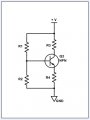
Before looking at how to bias the driver stage, it would be instructive to look at the classic BJT amplifier circuit.

AudioAmp06.jpg

This is the classic way to bias a BJT amplifier with four resistors, R1, R2, R3, and R4 as shown. R1 and R2 create a voltage divider that establishes the proper bias at the base of the transistor. We can make the bias voltage as "stiff" as we want by making the values of R1 and R2 low. Or we can make the bias "loose" by choosing higher values for R1 and R2. Our choice will determine the amount of current available to the critical base-emitter junction and also determines the input impedance of this stage of the amplifier.

How much base current do we need? Again, a visit to the transistor datasheet will provide us with typical current gain ratios. (I say typical because gains will vary from transistor to transistor and will also vary with operating conditions of the circuit.)

The BJT circuit configuration as shown can be either a common-emitter amplifier (where R3 is the load) or a common-collector amplifier (or emitter follower) where R4 is the load.

For this driver stage, we want to create a Class-A common-emitter amplifier. R3 is the load resistor. R4 will provide us with negative feedback which we know is a beneficial stabilizing mechanism.
 

Audioguru

Joined Dec 20, 2007
11,248
A class-A transistor (the driver or the output) that is loaded and biased properly produces massive distortion if it does not have plenty of negative feedback and its output voltage swing is high (but is not clipping).
A simple amplifier circuit like the ones in this thread cannot provide enough negative feedback to reduce the distortion below the level that can be heard.
 

Attachments

MrChips

Joined Oct 2, 2009
34,829
A class-A transistor (the driver or the output) that is loaded and biased properly produces massive distortion if it does not have plenty of negative feedback and its output voltage swing is high (but is not clipping).
A simple amplifier circuit like the ones in this thread cannot provide enough negative feedback to reduce the distortion below the level that can be heard.
Plenty of negative feedback. That's coming.:)
 

Audioguru

Joined Dec 20, 2007
11,248
Most good audio amplifiers use an audio opamp or are built like one. The open-loop gain of an audio opamp (OPA134 for example) is about
one million so it can provide "plenty" of negative feedback to reduce distortion.
 

MrChips

Joined Oct 2, 2009
34,829
Most good audio amplifiers use an audio opamp or are built like one. The open-loop gain of an audio opamp (OPA134 for example) is about
one million so it can provide "plenty" of negative feedback to reduce distortion.
TS wants to do this without an opamp.
 

Thread Starter

ConstructionK88

Joined Jul 25, 2018
282
Many new audio products use class-D switching amplifiers. They use Pulse-Width-Modulation at a high frequency and the output transistors switch completely on and completely off which produces a very little amount of heat.
But many of these new ICs are tiny and difficult or impossible to hand solder.
Indeed I have noticed. Even a car radio from the mid 90s I stripped down was class D. I was disappointed to say the least. Personally I'm fixated on transistors far more than ic's. They are generally much cheaper and more easily replaced from what I've seen.

TS wants to do this without an opamp.
Well I don't mind using an opamp. I'm quite open to it. I was just trying to get the jist of basic transistor only amp circuits before I jumped into using opamps.

Plenty of negative feedback. That's coming.:)
Is an lm386 capable of providing enough negative feedback or am I to upgrade my opamp?

I don't understand how your external radiator will be any less obtrusive than a heat sink.
My apologies it will be mounted on the bottom most likely. Or if it is pretty enough probably visible. I prefer it over a fans noise since I don't plan on having to many or large holes to allow air to pass through for heatsinks. Only enough hole for the speakers to function without blowing a case apart
 
Last edited by a moderator:

Top