HV Supply using an Ignition Coil

Thread Starter

JulesP

Joined Dec 7, 2018
458
Put it in series with a 15V Zener with it's anode towards the gate. If the gate is not clamped within the gate to source voltage parameters gate to drain capacitance of only a few pf will drive gate to source voltage too far during switching. Found the info on a page about gate driving circuit designs and issues.
Ok I’ll draw it up and post it tomorrow to check I have it right. When you say ‘it’ you mean a 10V Zener in series with a 15V one or do you mean the Gate by ‘it’?
 

Thread Starter

JulesP

Joined Dec 7, 2018
458
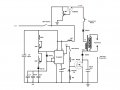
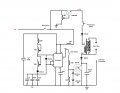
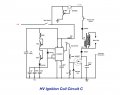
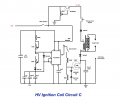
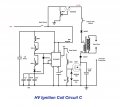
I attach the latest circuit with the suggested 15V Zener included but I'm not sure if you meant to have a 10v and a 15V Zener in series as I'm not clear what the 'it' in your last post referred to.

I have also added a diode in the primary coil circuit to offer some protection to the Primary Coil Switch from a back EMF spike in the primary but it may be unnecessary.

Ignition Coil Circuit C.jpeg
 
The diode needs to be parallel to the resistor and a 15V zener back to back with the 10V zener. The 10V zener can be as low as 5V if that is what you have. Rise times when mosfet switches off are in the low nanosecond range, and can be hard to see even with a 100mhz scope. However they do vary greatly with coil quality and construction.
 
Gate to source as it is gate which is fragile and needs protected. Spec sheets show relatively low maximum gate voltages and these must be rigidly controlled. Fast rising signals combined with relatively small gate to drain capacitance will quickly exceed those voltages and fail the device as I experienced mocking up a couple different ignition systems on my bench. Also be very careful of dwell time as these coils typically saturate in 2ms or less while your circuit should need only about 1/4 saturated coil to function. I would try driving with a monostable allowing easier control of rise time and start with about 0.5us.
 
Yes, except the zeners reversed. The point is to limit gate to +15 and -10volts. This applies to mosfets, IGBT's and especially SICFET's as switching speeds are very high and transients far higher. Zeners must be sized to hold Vgs well within specified limits. Lead inductance and zener turn on times can become significant factors in discrete component designs.
 

Ian0

Joined Aug 7, 2020
13,132
The diode needs to be parallel to the resistor and a 15V zener back to back with the 10V zener. The 10V zener can be as low as 5V if that is what you have. Rise times when mosfet switches off are in the low nanosecond range, and can be hard to see even with a 100mhz scope. However they do vary greatly with coil quality and construction.
Perhaps not with 300nF across drain and source?
What are the merits of the cap, now that the mechanical points are gone?
At first glance it appears to be superfluous, but is the intention to make it ring, or to give a ”square” pulse out?
 
I failed both mosfets and IGBT's with the cap across either the drain-source or the coil + and - terminals. I am just suggesting the simplest way I have found to minimize the problem. I should also have stated that smaller wattage rating zeners work better due to less internal capacitance and faster turn on.
 

Thread Starter

JulesP

Joined Dec 7, 2018
458
Yes, except the zeners reversed. The point is to limit gate to +15 and -10volts. This applies to mosfets, IGBT's and especially SICFET's as switching speeds are very high and transients far higher. Zeners must be sized to hold Vgs well within specified limits. Lead inductance and zener turn on times can become significant factors in discrete component designs.
So switch the Zeners but keep their polarity wrt the Gate?
 

Thread Starter

JulesP

Joined Dec 7, 2018
458
I failed both mosfets and IGBT's with the cap across either the drain-source or the coil + and - terminals. I am just suggesting the simplest way I have found to minimize the problem. I should also have stated that smaller wattage rating zeners work better due to less internal capacitance and faster turn on.
I’m not sure of the effect of the condenser yet but in principal it will be to mop up some energy in the event that the spark does not occur during a pulse such as when the spark gap is too large or the insulation or dielectric in the distilled water cell does not let it discharge. As an experiment time will tell
 
The condenser increases voltage rise time and improves spark energy delivered. In a points ignition it is crucial to improving point life. The circuit you are using with 2ms dwell time has the potential of over 1" open circuit sparks. My coil of choice is an Echlin IC676 which many of us use in the old cars. 1" sparks occur when a plug wire falls off almost immediately damaging the distributor cap with an arc over. Hint, grind out and repair with 3M potting epoxy.
 
Zeners should be arranged to allow +15V and -10V Vgs. When driving gate using a mosfet you can use just the 15V zener but when using IGBT's or SICFET's the -10V zener is needed to ensure rapid turn off of device.
 

Thread Starter

JulesP

Joined Dec 7, 2018
458
Zeners should be arranged to allow +15V and -10V Vgs. When driving gate using a mosfet you can use just the 15V zener but when using IGBT's or SICFET's the -10V zener is needed to ensure rapid turn off of device.
So like these two arrangements:

Ignition Coil with MOSFET.jpegIgnition Coil with IGBT.jpeg
 
I wasn't clear enough, reverse their polarity. Personally I would dispense with the coil primary voltage control and simply set output via coil saturation (mosfet turned on) time.
 
Control output waveform of 555 on time. Look up 555 PWM circuits and use a pot to set gate on time. Try not to exceed about 40% on time or no benefit will be seen. Most ignition coils will work best between .1 and 2.5ms dwell but check coil current waveform to be sure, a 0.1 ohm resistor in the source to ground will work.
 

Thread Starter

JulesP

Joined Dec 7, 2018
458
Control output waveform of 555 on time. Look up 555 PWM circuits and use a pot to set gate on time. Try not to exceed about 40% on time or no benefit will be seen. Most ignition coils will work best between .1 and 2.5ms dwell but check coil current waveform to be sure, a 0.1 ohm resistor in the source to ground will work.
Oh I see what you mean. Yes I have PWM control of both frequency and duty cycle via the two pots (100k and 500k) shown in the circuit. The primary voltage control gives me more flexibility to match the needs of the plasmolysis cell being tested.
 
Top