I knew someone would catch me! But yeah, I assumed in the TS's scenario that the inductor is ideal (no resistance) so that even a DC current causes no average voltage across the inductor.
I knew someone would catch me! But yeah, I assumed in the TS's scenario that the inductor is ideal (no resistance) so that even a DC current causes no average voltage across the inductor.
That's essentially it. The point I was getting at is that it is neither a net energy source nor a net energy sink.
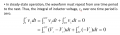
But I don't think that really does it in either case, though. That only means that the average power into the (ideal) inductor must be zero over one cycle when in steady state. The average energy flow is not necessarily related to average voltage. The resistor is a prime example -- even with a nice AC voltage across it that averages to zero, it still has net power. I think you could create a periodic waveform that, in steady state, has no net power into or out of the inductor but yet has a non-zero time-average voltage. It would simply have to have a large voltage when there was little current flowing and small voltage at other times, plus you get to play with the sign of things to some degree. However, I need to actually play with the math to see whether or not this is actually true given the tie between voltage and the time-rate of change of current.
I knew someone would catch me! But yeah, I assumed in the TS's scenario that the inductor is ideal (no resistance) so that even a DC current causes no average voltage across the inductor.
I think you could create a periodic waveform that, in steady state, has no net power into or out of the inductor but yet has a non-zero time-average voltage.
Faraday's law provides that the inductor flux is proportional to the integral of the voltage across the inductor. If there is a non-zero time-average voltage, then there is a steadily increasing flux in the steady state, and that means there is a steadily increasing energy in the magnetic field, which is a net power flow into the field.
Faraday's law provides that the inductor flux is proportional to the integral of the voltage across the inductor. If there is a non-zero time-average voltage, then there is a steadily increasing flux in the steady state, and that means there is a steadily increasing energy in the magnetic field, which is a net power flow into the field.
I buy that. I hadn't gotten around to playing with it yet. I don't know how easy I would have come to that conclusion or how long it would have taken me to go back to Maxwell's equations.

 Facebook
 Google
 GitHub
 Linkedin