A "differential switch " is what others of us call a Ground Fault Interrupter or a Ground Fault Circuit Interrupter . The purpose is to switch off the power if more current flows in one line of a circuit than the other line, with the concept that somebody touching one line is getting a shock. But it will also trigger if the electrical heating tape on your outside water pipes has a bit of leakage, or if the defrost heater on your (grounded) freezer has a bit of leakage current.
In the event of an overload the differential (GFCI) breakers that I have seen will trip in a manner similar to regular circuit breakers. But in the event of a short circuit overload, every GFCI device that I have seen tripped for a short circuit has been damaged and is no longer functional, neither as a breaker nor as a GFCI. Because one major function of a circuit breaker is to protect against short circuit damage and fires, that is a reason to not have a combined function device. In the event of a short circuit overload the combined function device would fail like a fuse, and no rest would be possible.
Also known as a RCD or RCBO in the UK. (Residual Current Device & Residual Current Breaker Over-Current)
Some decades ago, they were made mandatory there in replacing the main disconnect device at the panel, in installations where the traditional methods of earth grounding had been changed, for different materials, PVC's in place of copper/galvanized water pipes etc..
This was where the original practice was to use the metallic water pipe for earth,
They are more likely to be seen in 15a socket outlets in N.A.
Or in the breaker panel for localized installations such as Pools etc.
Also known as a RCD or RCBO in the UK. (Residual Current Device & Residual Current Breaker Over-Current)
Some decades ago, they were made mandatory there in replacing the main disconnect device at the panel, in installations where the traditional methods of earth grounding had been changed, for different materials, PVC's in place of copper/galvanized water pipes etc..
This was where the original practice was to use the metallic water pipe for earth,
They are more likely to be seen in 15a socket outlets in N.A.
Or in the breaker panel for localized installations such as Pools etc.
Just imagine the excitement when a damaged appliance cord trips the GFCI and the whole house is switched off. And how about a slightly damaged outdoor extension cord that gets rained on during the night. The lights and everything else switch off and the house is dark and nobody has a clue as to why.
So the GFCI in the mains is a rather poorly thought out way to go. The fact that quite a few people are so terribly afraid of the electrical shocks that they never experienced is what has lead to such really goofy mandates. Of course, the lack of considering the secondary results of the decisions is what makes them so poorly made.
Just imagine the excitement when a damaged appliance cord trips the GFCI and the whole house is switched off. And how about a slightly damaged outdoor extension cord that gets rained on during the night. The lights and everything else switch off and the house is dark and nobody has a clue as to why.
Nothing strange,! UK, Circa 50,s 60's , your watching TV, listening to the radio, reading, having a birthday party,, all the power goes off, OK Who has a shilling for the (Under stairs) meter.?
Most/many households had pay-as-you-go !
Regular occurrence !
Nothing strange,! UK, Circa 50,s 60's , your watching TV, listening to the radio, reading, having a birthday party,, all the power goes off, OK Who has a shilling for the (Under stairs) meter.?
Most/many households had pay-as-you-go !
Regular occurrence !
Not here in the USA , at least not since 1950. I am talking current times, not when you were a teenager!
And at least folks knew exactly what the problem was and exactly how to fix it. Currently I sometimes come across folks who do not even know where their breaker panel is located, or how to reset a tripped breaker.
Nothing strange,! UK, Circa 50,s 60's , your watching TV, listening to the radio, reading, having a birthday party,, all the power goes off, OK Who has a shilling for the (Under stairs) meter.?
Most/many households had pay-as-you-go !
Regular occurrence !
Not sure how this evolved into GFCIs or for those across the pond from me a RCD I can tell you what not to do. A few years back I added a large garage. Good thing it was pre COVID when a $3.00 2x4 stud went to $9.00. Anyway I ran power to the building and installed a sub breaker panel. In my not so infinite wisdom, not thinking it through I ran some really great AWG 6 armored cable I had through a buried 2" pipe to the new building. I decided to buy a two pole GFCI to feed my mains to the garage. Not a good idea, actually a bad idea. So I now have 240 VAC (L1 & L2). Well a two pole GFCI looks for a delta current between L1 & L2. So now I have split phase running out to my sub panel in the garage. As soon as anything 120 VAC came online the GFCI trips. Have any idea what a good brand name 50 Amp 2 pole GFCI cost? Expensive lesson all because I failed miserably to just think things through. By NEC everything garage needs to be GFCI so I started by using GFCI outlets and daisy chaining a few standard outlets on each GFCI which meets code but little by little I am adding GFCI breakers into the new sub panel. Lesson learned is using an expensive two pole GFCI to feed a sub panel is not a good idea. Not here in the US anyway.
ChatGPT is a particular version of the GPT3 AI. It is targeting accurate answers to general questions, and it is really very good. But it can only provide general answers and can’t really understand too much about attempts to get more information.
But it does produce cogent and lucid replies. It is in beta right now and you can sign up and try it free, it’s very impressive.
However, this is definitely off-topic so if there is interest starting another thread is in order.
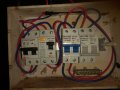
So this is the first breaker box that I have installed myself. Its for a house that didn't have its own box, all the electricity enters in from the next door house through an extension cable crazily enough. The electrical outlet that the extension cable was plugged into melted, so Ive decided to go all out and wire everything. So I ran new 12 guage wire from the main breaker box to this new breaker box, so now the house has its own connection. The person who originally wired the house used really thin wire, so its gonna cost a bit to replace it all with 12 and 14 guage wire.
Multiple outlets have overheated and melted already, so I see its a matter of urgency to get all this wired properly. Im thinking I need to replace these outlets with more expensive ones because the cheap ones are don't endure.
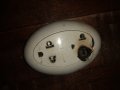
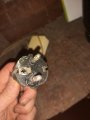
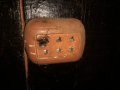
Heres some outlets that have burned and melted (before I started rewiring the building). The first one had a kettle plugged into it. The second one an extension cord. They were both pretty old outlets, but I didnt think outlets suddenly become a fire hazard like this after a few years. How can I make sure nothing like this ever happens again?
OK, I see that the wiring in that electrical installation is to a standard that I am not familiar with, which is reasonable indeed.
For electrical system safety it is vital that all circuits be operated within their current limitation. Not only the wire, but also the electrical outlets, as the TS has mentioned. Overloaded outlets do overheat and either melt or burn, with burning outlets tending to start fires, which is a "bad show" indeed.
To avoid meltdowns like these the very first thing is to use connectors and connections that are correctly rated and are adequate for the actual load. After that, being careful to properly connect the correct size wire to the outlet correctly, so that there is not a connection with excessive resistance. With the correct size of wire properly connected to adequate outlets there should not be any overheating problems.
Heres some outlets that have burned and melted (before I started rewiring the building). The first one had a kettle plugged into it. The second one an extension cord. They were both pretty old outlets, but I didnt think outlets suddenly become a fire hazard like this after a few years. How can I make sure nothing like this ever happens again?
Well a good start of preventative maintenance begins with placing regular sockets and plugs on a regular maintenance schedule for periodic inspection. Actually start by making sure all current carrying conductor are rated for the loads they will see, such as the wire sizes ro outlets. Plugs and sockets need to be kept clean and a plug into a socket should offer some physical resistance going in and removing. They make tension testers for this purpose The longer a plug and socket remain connected wear happens and once any arcing begins it's a downhill slide to a fire. The more heat the worse the connections like a snowball rolling down a hill. Finally you have a fire.

 Facebook
 Google
 GitHub
 Linkedin