Should I remove the ground plane under AC traces in my PCB?

Thread Starter

EveraldoM

Joined Nov 3, 2022
3
Attached below are images of a 2-layer PCB layout I am currently designing. I have always had the habit of removing the ground plane underneath AC signals, but a more experienced PCB designer advised me that the removal of the ground plane should only be done near the connectors and high-power AC traces.

In this PCB, there are three isolated secondary windings from the same transformer providing the following voltages:

  1. 24VAC: Rectified using a full-bridge rectifier to power a DC motor that consumes approximately 90W.
  2. 14VAC: Used directly to power an AC lamp.
  3. 12VAC: Rectified and regulated to supply the digital circuits with 3.3V.
My question is:
From an EMI perspective, would the return paths for the currents be negatively affected if I remove the ground plane under all AC traces and connectors across the board?

Alternatively, should I only cut the ground plane in the region where the AC connectors and traces are located? Or would it be better to leave a continuous ground plane underneath the entire system?

1- PCB with continuos ground plane. PS: I added some silkscreens to make it easier for you to identify what is what
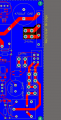
PCB with continuou ground plane.PNG


2- PCB after cutting the ground plane. PS: this is a preliminary cut for purposes of demonstration
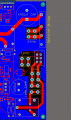
PCB after cut.PNG
 

nsaspook

Joined Aug 27, 2009
16,249
Simply from the point of electromagnetics the EM energy of the circuit travels in the dielectric. The ground plane acts as shield to confine that energy near the trace conductors like a waveguide. Unless there is some voltage isolation requirement, I would leave it there not knowing what's on the rest of the PCB that might have greater a EMI possiblity than a AC power trace.
 

Thread Starter

EveraldoM

Joined Nov 3, 2022
3
Which safety regulations does this design have to meet, and what does it say about spacing between Line, Neutral, and Ground?
The connection of the line and neutral in the transformer is made externally, what goes to the PCB are only the secondaries, the PCB it does not come into contact with the electrical network.
 

Thread Starter

EveraldoM

Joined Nov 3, 2022
3
Simply from the point of electromagnetics the EM energy of the circuit travels in the dielectric. The ground plane acts as shield to confine that energy near the trace conductors like a waveguide. Unless there is some voltage isolation requirement, I would leave it there not knowing what's on the rest of the PCB that might have greater a EMI possiblity than a AC power trace.
I understood and agree your points, especially regading the propagation of EM energy through the dielectric and how the ground plane serves as a shield to confine that eneryg near the trace conductors. In this specific case, I’m inclined to folliw your advice and keep the ground plane intact under the 14VAC and 12VAC traces. These voltages are lower power and either directly power a lamp (14VAC) or are rectified and regulated to supply the digital circuitry (12VAC at 3.3V).

But..., I’m still deliberating on the 24VAC, which is rectified using a full-bridge rectifier to supply a DC motor. The motor in question is a gear-reduced motor, trading speed for torque, and is controlled in a very simple manner using an H- bridge made of relays there’s no PWM involved. Given that it’s a relatively simple setup, I wonder if it would be prudent to remove the ground plane under the 24VAC traces and connector only to avoid any potential issues with coupling or noise from higher currents in this part of the board.

Given thath, would you recommend this localized removal in this case, or would you suggest maintaining the continuous ground plane even for the 24VAC motor supply?
 

Lo_volt

Joined Apr 3, 2014
370
If you were using line voltages it would be a concern. There is the potential for arcing at line voltages so most countries have minimum clearances between the two incoming AC leads and between either lead and ground.

Since you are bringing in 24 volts, there's far less concern over arcing.

As far as EMI, you want the two incoming traces short and close to each other. You've done nicely with that. The current path from the connector to the bridge and back forms a loop. The larger that loop is the lower frequency EM fields that can be emitted from the loop or affect the loop. That loop is small so 50 or 60 Hz won't emit in any significant strength and only very high MHz or higher frequencies will affect it.

As far as ground plane, I don't think it will matter much whether you cut it away under the 24 VAC traces or not. 24 volts is not likely to arc to ground under normal circumstances.
 

crutschow

Joined Mar 14, 2008
38,316
If both traces of the AC are close to each other, then there is only a small capacitive AC current in the ground plane between the two traces.
The only noise into the plane would be from any common-mode noise on the two traces, which seems unlikely for this configuration.
Note that any break in the ground plane reduces its effectiveness in providing a low-noise ground reference.
 

MisterBill2

Joined Jan 23, 2018
27,164
With circuits like what is shown, and the lower AC voltages but probably higher currents, a bigger concern would be short circuits and creep leakage distances.
 

DickCappels

Joined Aug 21, 2008
10,661
Given that these are low voltages (up to 24 VAC), if the circuit is grounded, then as long as appropriate cregpage distance is maintained, then you should not have any difficulty as far as safety is concerned.
 

MisterBill2

Joined Jan 23, 2018
27,164
The only reason to remove the ground plane would be if there was noise on the AC conductors that would couple into the ground plane and cause problems with other circuits on the board. And even there it is a decision that requires understanding what else is on that Board.
 
Top