How to impose 2nd order approximation?

Thread Starter

woodmark75

Joined Dec 11, 2014
36
Plot the root locus of the system as a function of K1. By imposing the 2nd order system approximation, estimate; settling time, rise time & peak time with 20% overshoot.
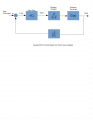
Here's the system:
https://app.box.com/s/unjk9dm1goaftgititwq
(image wouldn't work)

G(s)=-0.125(s+0.452)/(s+1.25)(s^2+0.234s+0.0163)
  • The closed loop tf I get is 4th order
  • How do I then impose 2nd order approx?
 

Papabravo

Joined Feb 24, 2006
22,058
You always start a root locus problem by plotting all of the poles and all of the zeros. You then locate the branches. From this you would estimate the significance of the various poles and zeros and if possible hypothesize a 2nd order approximation that behaved similarly. So what does the initial pole zero plot look like? Don't forget the poles and zeros at infinity.
 

Thread Starter

woodmark75

Joined Dec 11, 2014
36
If I plot 'Root Locus' should I use 1 transfer function to represent entire system i.e. G(s)_closed loop?
  • Gcl(s)= k1.(2/s+2).G(s)/1+k1(2/s+2)G(s)
 

Papabravo

Joined Feb 24, 2006
22,058
That doesn't look right. Ask yourself what happens when K1 = 0, where are you. Then ask what happens as K1 goes to ∞, where do you end up?
On the real axis the branches start at a pole and end at a zero, possibly a zero at infinity. Each branch of the root locus has an odd number of poles to the right

Another hint. How do you bring the parameter K1 inside the loop? Don't you have to modify the transfer function of the feedback path?
 
Last edited:

Thread Starter

woodmark75

Joined Dec 11, 2014
36
I'm a real novice at this. I'm looking at old notes, should my transfer function for the root locus have the 'K1' as the numerator? If this is the case, how do I derive the denominator?
 

Papabravo

Joined Feb 24, 2006
22,058
It actually needs to be in two places. IIRC you need to bring K1 inside the loop. To do this you need to modify the transfer function of the feedback path so that the result is identical to the original system.

In the original system you have:
\(E(s)=-K1*C_P(s)-P(s)\)
where E(s) is the error signal to the elevator actuator,Cp(s) is the Pitch Command, and P(s) is the Pitch output.
With a -K1 gain block in the forward path on the other side of the summing junction, what gain do you need in the feedback path so that E(s) to the elevator actuator is equal to E(s) from the original system.

How about:
\(\frac{-1}{K1}\)
Then
\(E_1(s)=C_P(s) - \frac{-1}{K1}*P(s)\)
and
\(E_2(s) = -K1*E_1(s)= -K1*C_P(s)-P(s)\)
which matches the original input to the elevator control.

Now you can use standard techniques to get the closed loop transfer function.
 
Last edited:

Papabravo

Joined Feb 24, 2006
22,058
So for the new system:
https://app.box.com/s/w97s8mpbkgjwuv78klv5
  • When I try to find the 'closed loop' tf of this it equates to my post in #3 above?
  • G(s) closed loop = -K1*Cp(s)*G(s)/1+ -K1*Cp(s)*G(s)
  • Isn't this how you derive 'closed loop' tf's?
Sorry that is wrong. I told you that you can't just move the Gain constant inside the loop without modifying the feedback path. You should verify this result. That the system transfer function is unchaged between the original drawing and the revised drawing.

Aside: I guess I should figure out how to crop images from .png files

PitchControl.png PitchControl.png
 

Thread Starter

woodmark75

Joined Dec 11, 2014
36
When I now calculate my 'closed loop' transfer function;
  • would this now be, numerator= -k1*2/(s+2)*G(s), denomenator=1+(-k1*2/(s+2)*G(s))*-1/k1
  • would this not cancel out the 'k1'?
  • As I haven't got a value for 'k1', only a sign '-ve', if k1 is cancelled in the denomenator this will only remove the effect of its sign?
 

Papabravo

Joined Feb 24, 2006
22,058
I should have initially posted the original system, which is;https://app.box.com/s/lb7djxnuiwzer1he59rb
The actual given question is: https://app.box.com/s/n01akln83up0szlwqhbl
  • I would post pics but they don't seem to work.
  • I think if I can get the transfer function that represents the system (specified in attached question), I can plot root locus & proceed from there.
  • Thanks for your help...
Yeah..that kinda changes everything. I was puzzling about the fact that in your original statement K1 has no effect on the denominator and thaus has no effect on the pole locations.
This should be an object lesson to other posters. If you want accurate guidance, please, please, please, post the original problem instead of your interpretation.
 

Thread Starter

woodmark75

Joined Dec 11, 2014
36
My appologies, I thought I was being smart jumping ahead to what I 'assumed' was the new configuration. My grasp of 'control' is so bad I should never make assumptions!
  • with these new specs how should I go about plotting root locus
  • & by imposing 2nd order approx, find settling time, rise time , peak time (PO=20)
 
Last edited:

Papabravo

Joined Feb 24, 2006
22,058
I already gave you the prescription in my earlier post.
  1. You derive the closed loop transfer function
  2. For the open loop transfer function, which should match the closed loop transfer function for K=0, you locate the finite poles and zeros
  3. Also for the open loop transfer function, locate any complex conjugate pairs. Complex poles may head for the real axis, spilt, and go towards a real zero or a zero at infinity. They may also depart directly for the zeros at infinity.
  4. You locate the branches on the real axis. A branch begins on a pole and ends on a zero, and there is always an odd number of poles to the right of a branch.

To do a 2nd order approximation you look at the sketch and determine if a single pair of poles can be imagined that has the same behavior.
Do that much and then show me what you get.
 
Last edited:

Papabravo

Joined Feb 24, 2006
22,058
The rules are:
  1. The number of branches of the root locus equals the number of closed loop poles.
  2. The root locus is symmetrical about the real axis.
  3. On the real axis for K > 0 the root locus exists to the left of an odd number of real-axis, finite open-loop poles and/or finite open-loop zeros
  4. The root locus begins at the finite and infinite poles of G(s)H(s) and ends at the finite and infinite zeros of G(s)H(s).
  5. The root locus approaches straight lines as asymptotes as the locus approaches infinity. Further the equation of the asymptotes is given by the real axis intercept, \( \sigma_a\) and angle, \(\theta_a\)
\(\sigma_a=\frac{\sum \text{finite poles}-\sum \text{finite zeros}}{\text{\sharp finite poles}-\text{\sharp finite zeros}}\)

\(\theta_a=\frac{(2k+1)\pi}{\text{\sharp finite poles}-\text{\sharp finite zeros}}\)​
 
Last edited:

Papabravo

Joined Feb 24, 2006
22,058

Thread Starter

woodmark75

Joined Dec 11, 2014
36
  • poles taken from denomenator of F(s)
  • zero taken fron numerator of F(s)
  • complex conjugate pair taken from solution to quadratic (s^2+0.234s+0.0163=0)
  • one pole at s=-2
  • one pole at s=-1.25
  • one zero at s=-0.452
  • complex conjugate pair at: -0.177 +/- 0.051j
  • 2nd order approx:
 

Thread Starter

woodmark75

Joined Dec 11, 2014
36
If anyone can help with determining the '2nd order system approximation' it would be really appreciated, as I'm totally stuck....
 

MrAl

Joined Jun 17, 2014
13,667
Hi,

Try doing a search on this forum for that 2nd order approximation as i gave an idea how to go about doing this in another thread. There are a couple different ways though so if this is an assignment the instructor might want you to do it a certain way and allow certain assumptions.
If you cant find it i'll have to try to find it again :)
 
Top