How to convert momentary switch to on for a second when powered

Thread Starter

John Correia

Joined Aug 22, 2016
8
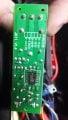
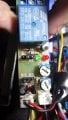
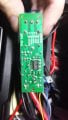
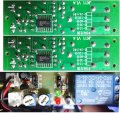
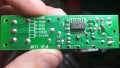
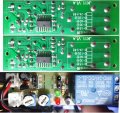
Hello, I have a small 24v DC timer module that has a momentary switch. I need the device to be powered on when powered up. So its just on when powered instead of having to push a button to start the timer cycles.

If there was a simple compact way of bypassing the momentary switching I would greatly appreciate any info how to do that. Thanks!

Ill try to link/attach a picture of the module
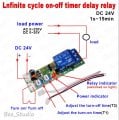
Screenshot_2016-08-22-09-03-26.jpg


Mods Note:
You used the wrong file type, the png is using for simple and similar as vertical and horizontal line, the file already converted to jpg and the file size from about 700Kb to 130Kb.
 

Alec_t

Joined Sep 17, 2013
15,121
Welcome to AAC!
You might be able to do this by putting a fat capacitor (with a bleed resistor in parallel) across the two contacts of the momentary switch. Since this would be an electrolytic type you would need to get the polarity right. You could check with a voltmeter to determine the polarity of any voltage on those contacts, before connecting the capacitor.
 

ScottWang

Joined Aug 23, 2012
7,501
The parts are not so much, so you can draw the circuit for the left side of PCB, then it is more easy to give you a right suggestion.
 

Thread Starter

John Correia

Joined Aug 22, 2016
8
Thank you very much! I'm extremely novice but I'll research what you posted. I'm not sure what a fat capacitor is or even what type I'd require. I'm not even sure what a bleeder resistor is or what type Id require for this application. Although I do know how to determine the polarity.

To run the timer, I'm converting 24V AC into 24V DC. I think the momentary switch might be using 5V DC. It just needs maybe 1 second of power to turn on.
 

ScottWang

Joined Aug 23, 2012
7,501
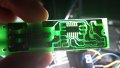
You could take two clear photos, the one is from the top view for the left components side of the PCB and the the top view for the left tin side of the PCB, and then they can be draw to the circuit.
 

AnalogKid

Joined Aug 1, 2013
12,143
The description says there is a uC doing the timing work. Still, if we can trace out the switch input parts, that should be enough.

ak
 

ErnieM

Joined Apr 24, 2011
8,415
Hello, I have a small 24v DC timer module that has a momentary switch. I need the device to be powered on when powered up. So its just on when powered instead of having to push a button to start the timer cycles.
OK, what is the power and what is the powered?
24V does what? Power the timer?
Your load uses something between zero to 30 or 250 volts AC?

If so, toss your timer circuit away, or just salvage the relay out of it. Use the 24V and a resistor to drop the voltage down to 12V to drive that relay.

Or just get a 24V relay and be done.
 

Thread Starter

John Correia

Joined Aug 22, 2016
8
OK, what is the power and what is the powered?
24V does what? Power the timer?
Your load uses something between zero to 30 or 250 volts AC?

If so, toss your timer circuit away, or just salvage the relay out of it. Use the 24V and a resistor to drop the voltage down to 12V to drive that relay.

Or just get a 24V relay and be done.
I just need the momentary switch to turn on the timer when power is applied with no human intervention. The timers turn on and off sprinklers that run on 24v AC. but if the power goes out for a second the module needs to be manually turned on. What sucks is Im running several timers but need to keep an eye open because power may go out for a second when I'm away and then nothing gets watered and dies.
 

AnalogKid

Joined Aug 1, 2013
12,143
If the timer is running *all* the time, and you never need the pushbutton, then it sounds like what you're really after is a simple, slow oscillator and a relay. If so,
What are the on and off times?
Do they really need to be independently adjustable?

ak
 

Thread Starter

John Correia

Joined Aug 22, 2016
8
If the timer is running *all* the time, and you never need the pushbutton, then it sounds like what you're really after is a simple, slow oscillator and a relay. If so,
What are the on and off times?
Do they really need to be independently adjustable?

ak
They do need to be adjustable depending on plant size. I don't want to over water or under water. But I would gladly love to learn more about making a few fixed timmed timmers. Maybe 2min on 2min off or 3min on 3min off. I'm very novice but I like puzzles and technology. I read about using a 555 timer chip but got confused. If there's a way to accomplish this with simplier and more compact size at short intervals I am totally intrested. Thanks for all the help.
 

AnalogKid

Joined Aug 1, 2013
12,143
"2min on 2min off or 3min on 3min off" and "they do run 24/7"
That's 12 hours of watering every day; seems like a *lot* of water.

The 555 is a resistor-capacitor (R-C) timer circuit. For multi-minute timing it needs a relatively large capacitor, and this leads to inaccurate times that drift with time and temperature. For example, for 3 min on/off a 555 would need a 160K resistor and a 1000 uF capacitor.

For long periods, I prefer a higher frequency oscillator followed by a multi-stage divider. This gives more accurate times with much smaller capacitors. The CD4060 is a good part for this. It doesn't have the 555's high current output stage, but that is easy to work around. For the same 3 min on/off, R = 20K and C = 1.0 uF.

24 Vac > LM317 12 Vdc regulator circuit > CD4060 oscillator > sN7000 relay driver transistor > relay with 12 Vdc coil > output

ak
 

Thread Starter

John Correia

Joined Aug 22, 2016
8
That's 12 hours of watering every day; seems like a *lot* of water.

The 555 is a resistor-capacitor (R-C) timer circuit. For multi-minute timing it needs a relatively large capacitor, and this leads to inaccurate times that drift with time and temperature. For example, for 3 min on/off a 555 would need a 160K resistor and a 1000 uF capacitor.

For long periods, I prefer a higher frequency oscillator followed by a multi-stage divider. This gives more accurate times with much smaller capacitors. The CD4060 is a good part for this. It doesn't have the 555's high current output stage, but that is easy to work around. For the same 3 min on/off, R = 20K and C = 1.0 uF.

24 Vac > LM317 12 Vdc regulator circuit > CD4060 oscillator > sN7000 relay driver transistor > relay with 12 Vdc coil > output

ak
I'm going to definitely check this out thanks so much!
 
Top