How to Calculate Impedance

Thread Starter

royaaron

Joined Feb 19, 2024
110
Depends on what you are trying to do and your expectations of quality sound and output levels.
LM386 might be ok for quiet mediocre listening. They make lousy hifidelity amplifiers.
yeah, so i've heard. and it's a relatively ancient piece. what would you recommend for a low wattage hi-fi output?
 

LesJones

Joined Jan 8, 2017
4,511
Re post #76. From the start of the thead I had assumed that source of the sound input was from a device (TV radio etc.) whose out put audio amplifier was a PAM8403. and so you had no option other than convering the balanced speaker outputs to a single ended signal with respect to ground. Now it seems that for some reason YOU have chosen to use a class D amplifier (The PAM8403) Using a normal class AB amplifier would remove the problem. Even better (As MisterBill2 suggests in post#75) do the mixing of one channel with the inverted other channel to attempt to cancel out the voice (Which you assume is added in phase to both channels.) using op amps (EG MC33171) and then use any power amplifier stage JUST to drive the speaker anf headphones.

Les.
 

MisterBill2

Joined Jan 23, 2018
27,631
Really, the summing and difference generation between the two stereo channels can best be done prior to any power amplifier stages that add noise and distortion. In addition, every bit of that RC circuitry alters the phase relationship some.
So my suggestion is: first, a unity gain buffer in each channel, then the ability to feed each channel into either the inverting or the non-inverting input of a second stage. If the signal level is too low initially, make the buffer stages have a moderate gain, like 10X, which should not cause overloads. AND use the outputs of that class "D" amplifier only for driving speaker or headphones. Use a separate LINEAR IC amplifier to provide the processed audio for other applications.
 

Thread Starter

royaaron

Joined Feb 19, 2024
110
I have not read through your thread. What are you trying to do?
The purpose of the project is to take a stereo input and:
1. output the difference between the left and right input channels
2. output what is common to the left and right channels
3. output a mono combination of the left and right inputs
4. via a rotary selector, to drive a speaker (and headphones) with an 8 ohm output with each of 1-3
and
5. using the "8 ohm-to-line" conversion, output a line-level output to an RCA jack as well as a mini phone jack of the three options.
(I also just copy the inputs to a pair of RCA jacks.)

I had been including a PAM8403 but now realize it's not what I want. I need a small amp to drive a small speaker. And I'd also want to (slightly) boost the signal from the differential and center channel portions to output line level, say 0.5V.
 

Thread Starter

royaaron

Joined Feb 19, 2024
110
Really, the summing and difference generation between the two stereo channels can best be done prior to any power amplifier stages that add noise and distortion. In addition, every bit of that RC circuitry alters the phase relationship some.
So my suggestion is: first, a unity gain buffer in each channel, then the ability to feed each channel into either the inverting or the non-inverting input of a second stage. If the signal level is too low initially, make the buffer stages have a moderate gain, like 10X, which should not cause overloads. AND use the outputs of that class "D" amplifier only for driving speaker or headphones. Use a separate LINEAR IC amplifier to provide the processed audio for other applications.
what would a unity gain do if i'm only then feeding into the differential amp? i thought they're for impedance matching.
say i didn't worry about attenuation in the circuitry leading up to the inversion step, could i just use something like a OPA820 to drive a line-level output and something else to drive the speaker?
 

MrChips

Joined Oct 2, 2009
34,855
The purpose of the project is to take a stereo input and:
1. output the difference between the left and right input channels
2. output what is common to the left and right channels
3. output a mono combination of the left and right inputs
I would use an op amp such as TL074 to firstly buffer the Left and Right line level signals.
Then take the difference and sum for (1) and (3) respectively.
You cannot obtain (2).

You have three variables but only two equations. You cannot solve for all variables.
 

MrChips

Joined Oct 2, 2009
34,855
If you are trying to create a surround sound effect, there are some schemes you can try.

Take the sum signal and feed it into a low-pass filter with a cut-off frequency at 200 Hz. You can feed this into a center-channel sub-woofer.

You can take this filtered signal and subtract it from the original Left and Right channels. This will hopefully remove the common signals below 200 Hz. These can be used to drive frontal left and right amplifier/speaker.

The problem with filter circuits is that they will introduce phase distortion.
 

Thread Starter

royaaron

Joined Feb 19, 2024
110
If you are trying to create a surround sound effect, there are some schemes you can try.

Take the sum signal and feed it into a low-pass filter with a cut-off frequency at 200 Hz. You can feed this into a center-channel sub-woofer.

You can take this filtered signal and subtract it from the original Left and Right channels. This will hopefully remove the common signals below 200 Hz. These can be used to drive frontal left and right amplifier/speaker.

The problem with filter circuits is that they will introduce phase distortion.
thank you but that's not what i'm trying to do.
 

MisterBill2

Joined Jan 23, 2018
27,631
The purpose of the input buffers is to provide a very constant impedance for the adding and subtracting processes to work from. That will make the controls repeatable each time it is used. AND the purpose of using each channel of the amplifier is to avoid needing to switch the low impedance amplified audio signal. Selection is more easily done at the input side of the amplifier, where the input is not a balanced pair.
AND, when you connect that balanced power amplifier output to a recorder you will learn why others have told you it is not a good choice.
 

Thread Starter

royaaron

Joined Feb 19, 2024
110
The purpose of the input buffers is to provide a very constant impedance for the adding and subtracting processes to work from. That will make the controls repeatable each time it is used. AND the purpose of using each channel of the amplifier is to avoid needing to switch the low impedance amplified audio signal. Selection is more easily done at the input side of the amplifier, where the input is not a balanced pair.
AND, when you connect that balanced power amplifier output to a recorder you will learn why others have told you it is not a good choice.
got it . . . thank you . . . by " balanced power amplifier" you mean the PAM8403? If so, I can tell you now that it is gone. I'll be using either a TL072 or NE5532.
Can you say more about input buffers? Actually, could you offer a design?
 

Thread Starter

royaaron

Joined Feb 19, 2024
110
I'm re-thinking what I posted earlier about the workings of #71, R15. Separate from that:

I don't see that. The signal inputs are direct connections to the inverting inputs of opamps. That is a virtual GND with approx. 0 ohm impedance. This means that the input impedance of the circuit is whatever resistor you place in series with the input. The datasheet suggests 18K as a minimum value. The larger the resistor value, the lower the gain. A lower value will increase the circuit gain to the point that the output might clip.

Your circuit has three optional inputs, and all of them are incorrect. Sorry about that, but the PAM is *not* a typical audio device.

Also, are you familiar with basic opamp concepts: non-inverting and inverting inputs, the "virtual ground" at the inverting input, input and output voltage ranges, etc?

ak
for the most part I am not.
 

MisterBill2

Joined Jan 23, 2018
27,631
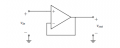
OK, Mister C. has provided it. It is also possible to add some resistance to that feedback connection and provide a bit of gain. As is apparent Rf=Ri and so the gain is one (unity). And the output impedance is quite low. In addition, the input impedance is rather high. So you have a stable source for whatever networks you attach.
 

MisterBill2

Joined Jan 23, 2018
27,631
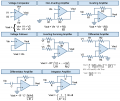
The differential amplifier in post #96 shows why a buffer stage preceding matters. It assures that the gain from each input will be the same, because the source resistance is in series with the intentional resistor (R1 and R3 in this instance).
 

Thread Starter

royaaron

Joined Feb 19, 2024
110
for the most part I am not.
Regarding the schematic in your post #12: I plan to use an OPA2134 instead of a PAM8403. The open-loop output impedance is stated as 10 ohms which sounds right enough to drive an 8 ohm speaker. But as I still want to produce a "line level" output how would I alter that post #12 diagram now that I don't have to isolate one of the sides from ground? Would it look like what I've attached?
 

Attachments

BobTPH

Joined Jun 5, 2013
11,553
The open-loop output impedance is stated as 10 ohms which sounds right enough to drive an 8 ohm speaker.
No. It can output only 40mA. That is 9 mW RMS into an 8 Ohm speaker.

Please erase the idea of impedance matching for audio. The best output impedance for driving speakers is zero. Good power amps are well under an Ohm.

Also, open loop output impedance is the wrong figure to use since you cannot use it open loop. The output impedance with negative feedback will depend on the gain but be much much lower. Like thousands of times lower typically.
 
Top