Can You Calculate The Input Impedance?

Thread Starter

MrAl

Joined Jun 17, 2014
13,667
Hello there,

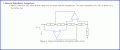
(See attachment)
Here is a little challenge. The idea is to simply calculate the input impedance looking into Z1.
This is with all the impedances (Z1, Z2, etc.) made into a pure resistance with value equal to the subscript.
So Z1=1 Ohm, Z2=2 Ohms, Z3=3 Ohms, Z4=4 Ohms, Z5=5 Ohms.

Hint:
Zin (which is actually Rin with all resistors) is either equal to 8/15 Ohms or 15/8 Ohms. Or am i wrong?
Warning: This might be more difficult than it looks like at first glance.
 

Attachments

Tesla23

Joined May 10, 2009
558
Hello there,

(See attachment)
Here is a little challenge. The idea is to simply calculate the input impedance looking into Z1.
This is with all the impedances (Z1, Z2, etc.) made into a pure resistance with value equal to the subscript.
So Z1=1 Ohm, Z2=2 Ohms, Z3=3 Ohms, Z4=4 Ohms, Z5=5 Ohms.

Hint:
Zin (which is actually Rin with all resistors) is either equal to 8/15 Ohms or 15/8 Ohms. Or am i wrong?
Warning: This might be more difficult than it looks like at first glance.
Assuming that the op-amps stay linear (so V+ - V- = 0 for both):
denoting the input voltage as V, then the voltage at the middle node must be V as must the voltage across Z5. So the current through Z5 is V/Z5, which is the current through Z4, so the current through Z3 must be -Z4*V/(Z3*Z5), this is the current through Z2, so the current through Z1 is Z2*Z4*V/(Z1*Z3*Z5). This is also the input current, so divide it into V to get the given input impedance.
 

WBahn

Joined Mar 31, 2012
32,702
Hello there,

(See attachment)
Here is a little challenge. The idea is to simply calculate the input impedance looking into Z1.
This is with all the impedances (Z1, Z2, etc.) made into a pure resistance with value equal to the subscript.
So Z1=1 Ohm, Z2=2 Ohms, Z3=3 Ohms, Z4=4 Ohms, Z5=5 Ohms.

Hint:
Zin (which is actually Rin with all resistors) is either equal to 8/15 Ohms or 15/8 Ohms. Or am i wrong?
Warning: This might be more difficult than it looks like at first glance.
At first glance it seems pretty simple -- but looks certainly can be deceiving. So let's give it a go.

Assuming the opamps are operating in their linear region, we know that the voltage at each input of each amp is Vin. So that's the voltage at {Vin, P23, P45} (I'm assuming people can figure out my nomenclature for the nodes -- if not, P23 is the node that connects Z2 and Z3.

The voltage across Z5 is therefore Vin and the current in it is

I5 = Vin/Z5.

This current must flow in Z4, from which we can find the voltage at P34 (which I'll call V34).

V34 = V45 + I5·Z4
V34 = Vin + (Vin/Z5)·Z4
V34 = Vin·( 1 + (Z4/Z5))

This results in a current (flowing to the left) through Z3 of

I3 = (V34 - V23)/Z3
I3 = (Vin·( 1 + (Z4/Z5)) - Vin)/Z3
I3 = Vin·[Z4/(Z3Z5)]

Since this same current has to flow into Z2, this results in a voltage at P12 of

V12 = V23 - I3·Z2
V12 = Vin - Vin·[Z4/(Z3Z5)]·Z2
V12 = Vin[1 - (Z2Z4)/(Z3Z5)]

The current flowing (to the right) in Z1 is therefore

Iin = (Vin - V12)/Z1
Iin = {Vin - Vin[1 - (Z2Z4)/(Z3Z5)]}/Z1
Iin = Vin·[(Z2Z4)/Z1Z3Z5)]

The input impedance is therefore

Zin = Vin/In = (Z1·Z3·Z5)/(Z2·Z4)

If the resistance is equal to the subscript (in ohms), the Zin is

Zin = Vin/In = (1 Ω · 3 Ω · 5 Ω)/(2 Ω · 4 Ω) = (15/8) Ω

An answer of (8/15) Ω is not possible, since it would be (8/15) siemens. Track your units instead of just tacking them onto the end!
 

WBahn

Joined Mar 31, 2012
32,702
Hi,

Ok, yes, great guys :)

Nice to see two different approaches too.
It's the same approach, I was just more explicit on the expressions and descriptions while Tesla23 left out intermediate steps leaving it up to the reader to fill in the gaps. Each approach has pros and cons. Leaving out steps forces the reader to think more deeply to fill in those gaps, which aids in learning and understanding more so than the spoonfeeding approach I took. But it also takes more time and many readers won't make the effort to fill in the gaps or will fill them in incorrectly because they didn't think about things deeply enough. For instance, it would be easy for someone to conclude from Tesla23's description that all of the resistors have the same current flowing in them, even though nothing along those lines was actually claimed. But since a common mistake people make when working with opamps is to assume that NONE of the inputs have nonnegligible current flow, many people would be primed to make that inference and not go any further.
 

Thread Starter

MrAl

Joined Jun 17, 2014
13,667
It's the same approach, I was just more explicit on the expressions and descriptions while Tesla23 left out intermediate steps leaving it up to the reader to fill in the gaps. Each approach has pros and cons. Leaving out steps forces the reader to think more deeply to fill in those gaps, which aids in learning and understanding more so than the spoonfeeding approach I took. But it also takes more time and many readers won't make the effort to fill in the gaps or will fill them in incorrectly because they didn't think about things deeply enough. For instance, it would be easy for someone to conclude from Tesla23's description that all of the resistors have the same current flowing in them, even though nothing along those lines was actually claimed. But since a common mistake people make when working with opamps is to assume that NONE of the inputs have nonnegligible current flow, many people would be primed to make that inference and not go any further.
Hi,

Ok great. I just threw nodal at it and then calculated the difference voltage across R1 and then the current, then the input resistance.
Yeah some of the voltage came out the same, such as vR5=Vin.
 

LvW

Joined Jun 13, 2013
1,994
Here is my approach for calculating the input impedance.
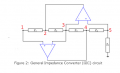
When we remember how the circuit was developped (see the attached jpg file) it is very simple to find the input impedance.
The "first" GIC was a simple series connection of two different NIC blocks (one input "short circuit stable" and the other one "open circuit stable" )

* The input resistance of the first NIC (the second NIC replacedby Z6) is ZA=-Z1*Z6/Z2
* The input resistance of the second NIC is ZB=-Z3*Z5/Z4

When we now connect the second NIC instead of Z6 to the first NIC we must replace Z6 by the input resistance ZB.
The resulting input resistance now is positiv:
ZA=Z1*Z3*Z5/Z2*Z4

This is already the desired expression - and it will remain unchanged if we introduce the modification of the circuit as proposed by A. Antoniou in 1969. Assuming ideal opamps, the diff. voltage between the opamp input terminals will be zero - and the potential of the non-inv.inputs of both opamps will be the same. Hence, we are allowed to interchange both non-inv. nodes.
If we now redraw the whole circuit, we have the classical GIC (in Antoniou topology) as shown in the task description.

Comment: The two-NIC circuit as shown in the attached jpg file works as a GIC - however, the Antoniou-structure has better properties with respect to real world conditions: The non-ideal opamp properties (finite and frequency-dependen open-loop gain) cancel each other up to a certain degree. This is the result of "cross-coupling" between both output nodes.
This effect works best if we make the choice Z2=R2 and Z3=R3 with R2=R3.
 

Attachments

Last edited:

Thread Starter

MrAl

Joined Jun 17, 2014
13,667
Here is my approach for calculating the input impedance.
When we remember how the circuit was developped (see the attached jpg file) it is very simple to find the input impedance.
The "first" GIC was a simple series connection of two different NIC blocks (one input "short circuit stable" and the other one "open circuit stable" )

* The input resistance of the first NIC (the second NIC replacedby Z6) is ZA=-Z1*Z6/Z2
* The input resistance of the second NIC is ZB=-Z3*Z5/Z4

When we now connect the second NIC instead of Z6 to the first NIC we must replace Z6 by the input resistance ZB.
The resulting input resistance now is positiv:
ZA=Z1*Z3*Z5/Z2*Z4

This is already the desired expression - and it will remain unchanged if we introduce the modification of the circuit as proposed by A. Antoniou in 1969. Assuming ideal opamps, the diff. voltage between the opamp input terminals will be zero - and the potential of the non-inv.inputs of both opamps will be the same. Hence, we are allowed to interchange both non-inv. nodes.
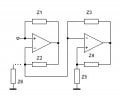
If we now redraw the whole circuit, we have the classical GIC (in Antoniou topology) as shown in the task description.

Comment: The two-NIC circuit as shown in the attached jpg file works as a GIC - however, the Antoniou-structure has better properties with respect to real world conditions: The non-ideal opamp properties (finite and frequency-dependen open-loop gain) cancel each other up to a certain degree. This is the result of "cross-coupling" between both output nodes.
This effect works best if we make the choice Z2=R2 and Z3=R3 with R2=R3.
Hi,

I didnt go through the math but that does look like an interesting way to do it too.
 

The Electrician

Joined Oct 9, 2007
2,986
Assuming the opamps are ideal-- infinite gain, zero input current, and zero output impedance, and given that Z1=1 Ohm, Z2=2 Ohms, Z3=3 Ohms, Z4=4 Ohms, Z5=5 Ohms, what is the impedance at node 3 and at node 5?

GIC-02.png
 

Thread Starter

MrAl

Joined Jun 17, 2014
13,667
Assuming the opamps are ideal-- infinite gain, zero input current, and zero output impedance, and given that Z1=1 Ohm, Z2=2 Ohms, Z3=3 Ohms, Z4=4 Ohms, Z5=5 Ohms, what is the impedance at node 3 and at node 5?

View attachment 166153
Hi,

You mean the impedance looking into node 3 assuming ground reference and looking into node 5 assuming ground reference, or do you mean across nodes 3 and 5?
 

Thread Starter

MrAl

Joined Jun 17, 2014
13,667
I meant with respect to ground, but between the two nodes would be fun too.
Hi,

Oh yes, that too, right.

I'll take a quick guess, are they both zero (ground reference)?
I say this because a quick analysis shows that the voltages are independent of any 'extra' current injected into those nodes. If i did it right :)

If they are then that might tell us something about the impedance across the two.
 
Last edited:
Nodes 2 and 4 are zero ohms because they are driven by the (ideal) opamp outputs. If nodes 3 and 5 were also zero ohms with respect to ground, the whole thing wouldn't work, it seems to me.
 

LvW

Joined Jun 13, 2013
1,994
Without any calculation, it is very easy to give the input impedance (vs. ground) at node 5:

The input impedance at node 1 is known and given as Zin1=Z1Z3Z5/Z2Z4.
As we can see, the grounded load impedance Z5 appears in the numerator

The whole circuit is symmetric and we can now write down the input impedance as seen from the right (into node 5).
However, because there is no load impedance connected to node 1 (which would appear in the numerator) this missing load has to be considered with an infinite value. Hence, this makes the input impedance as seen from node 5 into the GIC also infinite - and the remaining impedance (parallel to infinite) is Z5.

Therefore: Zin5=Z5.
 
It seems to me that the circuit is only symmetric in a limited sense, namely that if Z5 is removed, the impedance at node 5 is infinite with no load at node 1, and the impedance at node 1 is infinite with no load at node 5, and if the opamp gains are infinite. Otherwise, it would only be symmetric if Z2 = Z3 and Z1 = Z4, which is not the case.
 

Thread Starter

MrAl

Joined Jun 17, 2014
13,667
Nodes 2 and 4 are zero ohms because they are driven by the (ideal) opamp outputs. If nodes 3 and 5 were also zero ohms with respect to ground, the whole thing wouldn't work, it seems to me.
Hello again,

Well i would almost agree, except that if we recall circuits with feedback can be used to alter impedances.
Here, we are talking about an impedance or two that are viewed with ground references. So part of the problem involves how a node responds to an outside excitation.
I'll go over this again though because i went a little fast on that last reply.

[LATER]
Ok i have to reiterate my original guess, that both impedances to ground are zero. That is of course if we assume that the op amps are completely ideal which means at least the following:
1. Infinite internal gain.
2. Zero output impedance.
3. No limit to the output voltage plus and minus swing (other than infinity maybe).
4. Infinite input impedance, zero input offset.
So when i say ideal i mean in the most ideal way possible :)
which is a voltage controlled voltage source with infinite gain factor.

I could be wrong so please continue to hash this out.
 
Last edited:

Thread Starter

MrAl

Joined Jun 17, 2014
13,667
Without any calculation, it is very easy to give the input impedance (vs. ground) at node 5:

The input impedance at node 1 is known and given as Zin1=Z1Z3Z5/Z2Z4.
As we can see, the grounded load impedance Z5 appears in the numerator

The whole circuit is symmetric and we can now write down the input impedance as seen from the right (into node 5).
However, because there is no load impedance connected to node 1 (which would appear in the numerator) this missing load has to be considered with an infinite value. Hence, this makes the input impedance as seen from node 5 into the GIC also infinite - and the remaining impedance (parallel to infinite) is Z5.

Therefore: Zin5=Z5.

Hi there,

Are you completely sure?
Well now maybe it is time to think outside the box again :)
Can you design an experiment to prove your thesis?
 
Last edited:

LvW

Joined Jun 13, 2013
1,994
Hi there,

Are you completely sure?
Well now maybe it is time to think outside the box again :)
Can you design an experiment to prove your thesis?
An "experiment"?
Of course, I am sure.
My experiment was "calculation" (I trust mathematics).
 

LvW

Joined Jun 13, 2013
1,994
It seems to me that the circuit is only symmetric in a limited sense, namely that if Z5 is removed, the impedance at node 5 is infinite with no load at node 1, and the impedance at node 1 is infinite with no load at node 5, and if the opamp gains are infinite. Otherwise, it would only be symmetric if Z2 = Z3 and Z1 = Z4, which is not the case.
OK - I agree.
When I say "symmetric" I mean: As far as the symbolic expression for Zin is concerned - independent on parts values. But that is sufficient for our purpose.
 

Thread Starter

MrAl

Joined Jun 17, 2014
13,667
An "experiment"?
Of course, I am sure.
My experiment was "calculation" (I trust mathematics).
Hi,

Ok no problem, i thought you were guessing.
In that case i agree.
See i told ya we'd agree on something at another time :)
 
Top