How to Calculate Impedance

Thread Starter

royaaron

Joined Feb 19, 2024
110
What you have with the capacitors instead of the transformer is a pseudo balanced (the speaker outputs are differential in most modern audio amps) to unbalanced (single ended line input) connection. Common mode signals like hum and noise still have a cable conductor energy circuit path to the line J1 input pin so these types of connections are hit and miss for ground loop noise and hum.

https://www.ranecommercial.com/legacy/note110.html
thank you very much for this discussion.
 

MisterBill2

Joined Jan 23, 2018
27,615
OK, what I have not seen is a statement of how precise the "line level" signal must be controlled, and what sort of output configuration the driving amplifier has. Also missing, or possibly I missed it, is how perfectly linear the translation needs to be.
That is, to ask: Is this for an "audiophile", or for recording?? or to relay a program/speech, to a crowd outside?? The very cheapest LOW LEVEL isolation transformer is one of the higher resistance and low current BIFILAR CHOKES that get used in some devices to keep external electrical noise out. If you do not demand super HiFi you are all set for less than $5 USD.
 

Thread Starter

royaaron

Joined Feb 19, 2024
110
OK, what I have not seen is a statement of how precise the "line level" signal must be controlled, and what sort of output configuration the driving amplifier has. Also missing, or possibly I missed it, is how perfectly linear the translation needs to be.
That is, to ask: Is this for an "audiophile", or for recording?? or to relay a program/speech, to a crowd outside?? The very cheapest LOW LEVEL isolation transformer is one of the higher resistance and low current BIFILAR CHOKES that get used in some devices to keep external electrical noise out. If you do not demand super HiFi you are all set for less than $5 USD.
i am connecting the output of a PAM8403 to an IC that expects an input impedance of around 2K.
It's all within a DiY circuit. That is, none of these sepcific parts are external.
 

nsaspook

Joined Aug 27, 2009
16,333
i am connecting the output of a PAM8403 to an IC that expects an input impedance of around 2K.
It's all within a DiY circuit. That is, none of these sepcific parts are external.
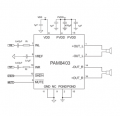
The speaker outputs are as expected for a class D amp, 'floating".
1738890775911.png

So, why can't you just use the INL and INR signals source for the 'IC' that expects an input impedance of around 2K?
 

Thread Starter

royaaron

Joined Feb 19, 2024
110
Finally, in your 13th post, some actual information. This should have been in post #1.

What is the part number the IC you are connecting to? (Again, missing from post #1)

ak
i didn't think it needed to be so involved so i limited my question to just the speaker-to-line particulars.
The IC is a MC33171N.
 

nsaspook

Joined Aug 27, 2009
16,333
i didn't think it needed to be so involved so i limited my question to just the speaker-to-line particulars.
The IC is a MC33171N.
Don't do that. If you need to ask questions they you don't know what is relevant to your question. Always include as much information as possible.

So, why can't you just use the INL and INR signals source for the MC33171N instead?
 

MisterBill2

Joined Jan 23, 2018
27,615
In audio SIGNAL circuits I have not noticed the impedance matching to be critical, except for speakers and amplifiers where a lot of power is to delivered to a load. And in "line level"circuits the voltage is often about 0.7 volts at the maximum level. So mostly it is the VOLTAGE level that matters. In addition, most audio system designers and setup folks try to avoid connecting amplifier output to anything except speakers, because that is usually where the distortion and noise are greatest. AND, speakers also make reasonable microphones to some extent.
 

BobTPH

Joined Jun 5, 2013
11,548
i am connecting the output of a PAM8403 to an IC that expects an input impedance of around 2K.
It's all within a DiY circuit. That is, none of these sepcific parts are external.
I think you are confusing input and output impedance. An input has an input impedance. An output has (surprise) an output impedance. For audio frequencies, the output impedance should generally be much lower than the input impedance.
 

Thread Starter

royaaron

Joined Feb 19, 2024
110
Make that *really* expensive. Anything on that list with a low frequency range below 100 Hz is $$$.

Instead of a transformer you could use two capacitors (in addition to the resistive divider). 4 x 47 uF, configured as two pairs of back-to-back 23 uF caps. With the resistive divider balanced and scaled for a 1 K load, that yields a 14 Hz corner frequency. Note that the GND of the downstream device is not connected directly to either the GND or any output of the source device.

ak


View attachment 342086
This super.
I take it the balancing was effected by inserting the 470 ohm resistors in series and the 100 ohm resistor in parallel.
How would one compute that?
 

AnalogKid

Joined Aug 1, 2013
12,147
When that schematic was created, we had no useful information about the downstream load on the circuit. I might do something different now. Apart from that . . .

NOTE that the PAM8403 output signal is not an analog voltage output, it is a 260 kHz PWM digital signal that ASSUMES that it is driving a low impedance loudspeaker. It relies on the speaker inductance and mass to lowpass filter the PWM signal down to audio, which is why the part description says "filterless". We have zero information about the opamp circuit that this signal is driving, but it probably does not have a 2-pole lowpass filter at its input. Whatever is downstream sees a constant 10 V peak-to-peak signal. With an attenuating coupler circuit that drops to 1 Vp-p, but that 1 V is constant no matter what the audio volume level is.

https://en.wikipedia.org/wiki/Pulse-width_modulation

Not all of this article applies to your application. Also, the first waveform image is incorrect for you.

ak
 
Last edited:

Thread Starter

royaaron

Joined Feb 19, 2024
110
When that schematic was created, we had no useful information about the downstream load on the circuit. I might do something different now. Apart from that . . .

NOTE that the PAM8403 output signal is not an analog voltage output, it is a 260 kHz PWM digital signal that ASSUMES that it is driving a low impedance loudspeaker. It relies on the speaker inductance and mass to lowpass filter the PWM signal down to audio, which is why the part description says "filterless". We have zero information about the opamp circuit that this signal is driving, but it probably does not have a 2-pole lowpass filter at its input. Whatever is downstream sees a constant 10 V peak-to-peak signal. With an attenuating coupler circuit that drops to 1 Vp-p, but that 1 V is constant no matter what the audio volume level is.

https://en.wikipedia.org/wiki/Pulse-width_modulation

Not all of this article applies to your application. Also, the first waveform image is incorrect for you.

ak
Am I screwed? I've uploaded my latest cut of the project. Its purpose is to:
1. output the difference between the left and right input channels
2. using the mono combination of the left and right inputs to then output what is common to the left and right channels.
3. via a rotary selector, to drive a speaker (and headphones) with an 8 ohm output
and
4. using the "8 ohm-to-line" conversion, output a line-level output to an RCA jack as well as a mini phone jack.
(I also just copy the inputs to a pair of RCA jacks.)
 

Attachments

nsaspook

Joined Aug 27, 2009
16,333
My question still stands. Why can't you use the signal (with a buffer amp or a simple resistor network if needed) from L on the speaker amplifier module and send that to J6?
 

Thread Starter

royaaron

Joined Feb 19, 2024
110
My question still stands. Why can't you use the signal (with a buffer amp or a simple resistor network if needed) from L on the speaker amplifier module and send that to J6?
J6 (as well as J5 and the two other outputs) are fed based on the rotary selector which has three possible outputs.
 

nsaspook

Joined Aug 27, 2009
16,333
J6 (as well as J5 and the two other outputs) are fed based on the rotary selector which has three possible outputs.
So is the speaker amplifier Left input pin. Pin L on the amp module is based on the rotary selector which has three possible outputs. Simply tap Pin L.
 
Top