How to Calculate Impedance

Thread Starter

royaaron

Joined Feb 19, 2024
110
With an AC input, maybe. BUT in this case, common-grounding the input and output reduces the bridge to a single series diode. The 15 V input is more than enough headroom to cover that voltage drop.


In this area, I think you're fine. Reduce C13 to 10 uF, add a 0.1 uF ceramic cap, and make sure they are located as close as possible to the 8403 power pins.

ak
i take it the 0.1 uF cap parallels the 10uF electrolytic, yes? If so, why do I need both?
 

MisterBill2

Joined Jan 23, 2018
27,615
Since there is already a PCB or vector board for the two opamps, the extra hardware is not an issue. And depending on the load current it might not need a heat sink. AND, is the TS working in one of those "sterile" environments where there is not even a single #4 lock washer on hand??? I have not investigated that module and so it is not clear what it contains.
Many experimenters do not reside in such an unfortunate existence.
 

Thread Starter

royaaron

Joined Feb 19, 2024
110
Have to disagree. With the bare IC you have to purchase a heatsink, at least two capacitors, perf board, and connectors. And then assemble and test everything.

All of that for 95 cents - ? Even with shipping (ebay is cheaper), not even close.

ak
quite so . . . that's why i got a 15VDC supply from Avion Studios as well as the 5VDC module. i'm mostly in the dark here already which should be painfully obvious by now. but thank you for thinking about this.
 

Thread Starter

royaaron

Joined Feb 19, 2024
110
Referring to the #35 schematic, why are there Zobel networks on the U4 and U5 outputs?

Also, the PWM square waves on the 8403's L+ and L- outputs are 180 degrees out of phase with each other. This means that as the R7 headset level pot is rotated from pin 1 to pin 3, the audio in the headphones will go from full volume at the CCW end (pin 1), through half volume, to zero volume in the middle when the two phases cancel out), through the other half volume, to full volume at the CW end (pin 3).

ak
my previous answer is true but this is more to the point: the project originally employed the use of an LM386 which can drive a small speaker.
so i believe that a poster (on another board) suggested the Zobel. But I suppose I can drop it now, yes?
 

LesJones

Joined Jan 8, 2017
4,511
TS = Thread starter (You)
Am I correct is assuming that the circuit in post #35 is the add on circuit that you want to drive from the outputs of another PAM8403. If so why can't you just use the analogue inputs to that PAM8403 to drive the add on circuit ? (Buffering may be required)
Les.
 

Thread Starter

royaaron

Joined Feb 19, 2024
110
So the TS can save both money and prevent grief by avoiding that "7806" module and simply using an LM7806 regulator IC device.

AND It is not clear just what the actual intended function of the rather complex circuit is intended to be, so a statement of the specific design goals could possibly lead to a number of beneficial suggestions.
I stated the main purpose(s) in #35:
What I want out of this is to:
1. output the difference between the left and right input channels (so that, assuming a music source, the voice would suppressed)
2. using the mono combination of the left and right inputs to then output what is common to the left and right channels (which should suppress all but the voice).
3. via a rotary selector, to drive a speaker (and headphones) with an 8 ohm output
and
4. using the "8 ohm-to-line" conversion, output a line-level output to an RCA jack as well as a mini phone jack.
(I also just copy the inputs to a pair of RCA jacks.)

along with allowing a center channel (mono) that's about it.
 

Thread Starter

royaaron

Joined Feb 19, 2024
110
TS = Thread starter (You)
Am I correct is assuming that the circuit in post #35 is the add on circuit that you want to drive from the outputs of another PAM8403. If so why can't you just use the analogue inputs to that PAM8403 to drive the add on circuit ? (Buffering may be required)
Les.
unless i've misunderstood the specs of the MC33171N i need a small amp to drive a speaker/headphone(s). and while the input to the PAM8403 is ~100 ohms - good enough for the single RCA jack (J5) and miniphone (J6) - i figured the preceding circuitry would have attenuated the signal thus requiring some amplification.
 

MisterBill2

Joined Jan 23, 2018
27,615
Really, since the posted amplifier is a stereo two channel amplifier, why not eliminate the switch and connect the second channel to the headphone connection. Then with two level controls either or both can be available and no switch required. And with the intent of cancelling the vocal portion, a different scheme can be used that is less complex.
 

Thread Starter

royaaron

Joined Feb 19, 2024
110
Really, since the posted amplifier is a stereo two channel amplifier, why not eliminate the switch and connect the second channel to the headphone connection. Then with two level controls either or both can be available and no switch required. And with the intent of cancelling the vocal portion, a different scheme can be used that is less complex.
i need three options: mono, unique to each channel (voice suppression) and common to both channels (voice only). How could eliminate the selector?
 

LesJones

Joined Jan 8, 2017
4,511
I will try asking the question that I asked in post #65 in a different way.
Are you trying the convert the differential signals from the output of a PAM8403 (NOT U3 in the circuit from post #35.) to a single ended signal to feed into J1 and J2 of the circuit from post #35 ?
Les.
 

Thread Starter

royaaron

Joined Feb 19, 2024
110
I will try asking the question that I asked in post #65 in a different way.
Are you trying the convert the differential signals from the output of a PAM8403 (NOT U3 in the circuit from post #35.) to a single ended signal to feed into J1 and J2 of the circuit from post #35 ?
Les.
no, the PAM8403 is there solely to amplify what I expect to be an attenuated signal from the monophonic portion (R5, R6,C1).
There aren't differential signals from the 8403; it is amplifying only the "center channel" (mono) signal I mentioned.
Pursuant to comments and suggestions I have updated the circuit which I have attached.
 

Attachments

AnalogKid

Joined Aug 1, 2013
12,147
I'm re-thinking what I posted earlier about the workings of #71, R15. Separate from that:
the input to the PAM8403 is ~100 ohms
I don't see that. The signal inputs are direct connections to the inverting inputs of opamps. That is a virtual GND with approx. 0 ohm impedance. This means that the input impedance of the circuit is whatever resistor you place in series with the input. The datasheet suggests 18K as a minimum value. The larger the resistor value, the lower the gain. A lower value will increase the circuit gain to the point that the output might clip.

Your circuit has three optional inputs, and all of them are incorrect. Sorry about that, but the PAM is *not* a typical audio device.

Also, are you familiar with basic opamp concepts: non-inverting and inverting inputs, the "virtual ground" at the inverting input, input and output voltage ranges, etc?

ak
 
Last edited:

MrChips

Joined Oct 2, 2009
34,845
i take it the 0.1 uF cap parallels the 10uF electrolytic, yes? If so, why do I need both?
This is a question frequently asked.

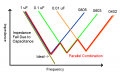
The tolerance of a 10 μF could easily be 10%. Hence the capacitance could be any value in the range 9-11 μF.
What difference would adding 0.1 μF in parallel make?
Answer: A significant difference.

Capacitors have series resistance and inductance. The two capacitors behave very differently at higher frequencies.
The lower value capacitor is better at attenuating higher frequency noise. We often put two or three different capacitors in parallel to suppress a wider range of frequencies.

1739227117546.png
 

MisterBill2

Joined Jan 23, 2018
27,615
i need three options: mono, unique to each channel (voice suppression) and common to both channels (voice only). How could eliminate the selector?
MY suggestion would simply remove the switching done for the pwm OUTPUT signal of that amplifier. THAT signal is not suitable for any purpose except driving a transducer. And REALLY, it is not suitable for feeding another amplifier. It is, after all, an audio POWER amplifier. So what ever mixing and canceling is to be done would be achieved before the input of the power amplifier. The advantage, aside from avoiding the distortion products of the power stage, is also avoiding the complexity of switching both side of the differential signal path, and removing the high frequency switching frequency present in the signal. Presently you do not have switching on the output, just a whole lot of filtering to attempt to get rid of that switching frequency. So what is the motivation of attempting to use the output of a power amplifier instead of the input??AND, why not use both halves of the package???
 
Last edited:

Thread Starter

royaaron

Joined Feb 19, 2024
110
no, the PAM8403 is there solely to amplify what I expect to be an attenuated signal from the monophonic portion (R5, R6,C1).
There aren't differential signals from the 8403; it is amplifying only the "center channel" (mono) signal I mentioned.
Pursuant to comments and suggestions I have updated the circuit which I have attached.
I should have added . . . I don't understand what you mean by ". . . PAM8403 (NOT U3 in the circuit from post #35.) to a single ended signal to feed into J1 and J2" --
There is only ONE PAM8403 which IS U3. And J1 and J2 are inputs. I must not understand your meaning here.
 

Thread Starter

royaaron

Joined Feb 19, 2024
110
I'm re-thinking what I posted earlier about the workings of #71, R15. Separate from that:

I don't see that. The signal inputs are direct connections to the inverting inputs of opamps. That is a virtual GND with approx. 0 ohm impedance. This means that the input impedance of the circuit is whatever resistor you place in series with the input. The datasheet suggests 18K as a minimum value. The larger the resistor value, the lower the gain. A lower value will increase the circuit gain to the point that the output might clip.

Your circuit has three optional inputs, and all of them are incorrect. Sorry about that, but the PAM is *not* a typical audio device.

Also, are you familiar with basic opamp concepts: non-inverting and inverting inputs, the "virtual ground" at the inverting input, input and output voltage ranges, etc?

ak
I was wondering about that. Would you recommend that I use 20K resistors instead of what comes after J1 and J2?

How are the three optional inputs - I presume you mean into the PAM8403 - incorrect? The output impedance of the 33171 is stated as 100 ohms. The center channel line I guess is more.

I chose the 8403 when a poster on another board (to a similar thread) suggested it. Had I known it generated a square wave you know I'd have found something else. Can you recommend something?

I have little familiarity with "virtual ground." I thought I understood what inverting and non-inverting means.
 

Thread Starter

royaaron

Joined Feb 19, 2024
110
This is a question frequently asked.

The tolerance of a 10 μF could easily be 10%. Hence the capacitance could be any value in the range 9-11 μF.
What difference would adding 0.1 μF in parallel make?
Answer: A significant difference.

Capacitors have series resistance and inductance. The two capacitors behave very differently at higher frequencies.
The lower value capacitor is better at attenuating higher frequency noise. We often put two or three different capacitors in parallel to suppress a wider range of frequencies.

View attachment 342340
thank you!
 

Thread Starter

royaaron

Joined Feb 19, 2024
110
I'm re-thinking what I posted earlier about the workings of #71, R15. Separate from that:

I don't see that. The signal inputs are direct connections to the inverting inputs of opamps. That is a virtual GND with approx. 0 ohm impedance. This means that the input impedance of the circuit is whatever resistor you place in series with the input. The datasheet suggests 18K as a minimum value. The larger the resistor value, the lower the gain. A lower value will increase the circuit gain to the point that the output might clip.

Your circuit has three optional inputs, and all of them are incorrect. Sorry about that, but the PAM is *not* a typical audio device.

Also, are you familiar with basic opamp concepts: non-inverting and inverting inputs, the "virtual ground" at the inverting input, input and output voltage ranges, etc?

ak
It really seems that the 8403 module was just a mistake. I didn't know at the time what a class D amp is. I have a bunch of LM386 ICs. Do you think I should just build an amp out of that to drive the speaker?
 

MrChips

Joined Oct 2, 2009
34,845
It really seems that the 8403 module was just a mistake. I didn't know at the time what a class D amp is. I have a bunch of LM386 ICs. Do you think I should just build an amp out of that to drive the speaker?
Depends on what you are trying to do and your expectations of quality sound and output levels.
LM386 might be ok for quiet mediocre listening. They make lousy hifidelity amplifiers.
 
Top