How to amplify an optical phone ringer?

Thread Starter

Straydog_1st

Joined Apr 13, 2017
16
Thank you very much to all. I can’t reply individually, but you have been very helpful. I only have a couple of questions at the moment. I apologise for having not posted earlier.

If I use the circuit on my picture above, there are three connections on the right side named NC, COM and NO. I am not sure what the abbreviations stand for and which ones will close the circuit to power a separated powered bell.

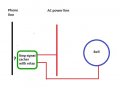
This seems to work. However, because I do not have AC power close to the phone, I wonder if it is possible to place any gadget elsewhere, where the phone line crosses the power line. I am thinking about using the pulse on the phone line just to operat some relay-like thing to close the power for the bell ringer. That would be perfect for me.
 

Thread Starter

Straydog_1st

Joined Apr 13, 2017
16
Sorry, I wanted to make some changes my post, but the 10 minutes editing time passed, so I rewrite here my last paragraph.

This circuit on my picture seems to work as I need. However, because I do not have AC power close to the phone and I need it for the ringer to be loud, I wonder if it is possible to place any gadget elsewhere, wherever the phone line crosses the AC line. I am thinking about the possibility of using the ringing pulse on the phone line just to operate some relay-like thing to close the AC power for the bell ringer. It must not overcharge the already week phone line, but if it does, a battery could be used, even if better not. With the AC line close it could eventually use it as a power source. That would be perfect for me and I wouldn't bother you any more with my silly questions.

Thank you.
 
If I use the circuit on my picture above, there are three connections on the right side named NC, COM and NO. I am not sure what the abbreviations stand for and which ones will close the circuit to power a separated powered bell.
NO = Normally Open
NC = Normally Closed
COM = Common

And in schematic mode: http://www.learningaboutelectronics...a-single-pole-double-throw-relay-in-a-circuit

So, when not energized, NC and COM are connected. When energized NO and COM are connected.
 

Thread Starter

Straydog_1st

Joined Apr 13, 2017
16
Thank you KeepItSimpleStupid. Good link. Now I remember. In fact I have used relays, but it was a very long time ago. I never new much, but I forgot that little and became a nullity.

Now I just hope someone could advice me about the possibility of what I wrote on the second paragraph of my last post.
 
I thought you had telephone line operated bells. In the US, these operate at about 20 Hz. I did show US type stuff that will interpret the ring signal with a small REN and do something with it. e.g. flash an attached lamp in cadence with the ring. That lamp could be a buzzer or bell.

So, yep it's still possible. But nothing will work unless your REN drive is > than the added up RENS of your bells. Again, this is a US thing.

About the one thing I know about BT telephones is that the ring is on a separate wire.

Way back when ours was: ground, power, tip and ring. Now it's just tip and ring. Ground and power were used for "princess phones" that had lighted dials.
 

Thread Starter

Straydog_1st

Joined Apr 13, 2017
16
Sorry if I did not quite understand your earlier explanation. As per my staring post, the problem is not how to make incorporated bells ring on old analogic phones because I believe that is either impossible or very difficult. Their bells just click when those phones are directly connected to an optical fiber line. So that, I want to make a separately powered bell ring, which seems to be much easier, but I do not know how. Those external powered bells are not difficult to find, even door bells could work. My problem is to activate them when the phone actually rings. How can I do it according to the second paragraph of this post above, please? It would save not my day, but my month or even more.
 

Thread Starter

Straydog_1st

Joined Apr 13, 2017
16
Thank you for your last posts, which I have read attentively and followed the links, but I am not sure I explained my problem properly, and we may be talking about different things. I think you are telling me about older analogic phone systems with a high ringing voltage of 50V or higher. I believe the newer optic fiber is standardized. Never mind about the jacks and connectors physical form, I have no problem managing that. The problem is electrical.

I have an optical cable, fiber, and since I have it, I can’t hear the phone ringing, so I want to do as I wrote above on post #22, second paragraph. This is not exactly amplifying the phone line signal, but for example, caching the ringing signal in any way to use a separately powered bell that could actuated be by a relay or any other way. It might be a problem caching the week electrical ringing signal.


Notes

I have the jacks as on these two links but I disregard their physical form; all I want is to catch the signal:
I happen to have exactly the same digital meter on a linked Sandeman page you recommended.
My phone dies not have any REN spec, even on the nanual.
Sorry for my rusty English for lack of practice for a few decades.
Going to sleep mow…
 
Last edited:
Well, here https://www.quasarelectronics.co.uk...ephone-ring-detector-with-relay-output-module is exactly what you want//
The potential free contacts are likely rated for 24 V @ 1A, non-inductive. You also need a 12 V power supply to go with the detector.

No ringer equivalence numbers though,

Here's http://www.vellemanusa.com/downloads/0/illustrated/illustrated_assembly_manual_k8086.pdf the schematic for the USA version. No REN info, but it's no where near a full bell.

The REN amplifier would be the perfect solution because you said you had phones that worked using ADSL. Another point, is that ring isn;t hooked up. i.e. that 3 wires vs 4 wire system.

This http://www.helpdeskcomms.co.uk/downloads/BTRingerGeneratorInstallationGuide_1.pdf isn't a REN amplifier, but it's a generator. It does not tell you how many REN's it draws from the line. This could drive sounder devices only I would assume.

https://en.wikipedia.org/wiki/Ringing_(telephony)

Also see: http://www.perrettcommunications.co.uk/BT-Ringing-Generator-2A
 

Thread Starter

Straydog_1st

Joined Apr 13, 2017
16
Thanks again. It seems that is exactly what I need. I will tell you about it in one or two days, maybe more because of the weekend and holiday. Meanwhile I am going to look through your links.
 
I think I nailed it concisely this time. The REN amplifier in the uk seems to be scarce. A few options are presented, but you don't have all the facts.

I have about 14 devices at home that could be considered phones. It's a mess to troubleshoot which I am going to fix. Some even have disconnected bells.

The "phones" center on an answering machine/cordless 4 station "model" with a UPS backup now with the one "baby monitor" that moves the distinctive ring from the page to another room and a medical alert system with two stand-alone bells.

The phone system "evolved' from one fixed phone when the house was built in the 60's to 3 old style 4-prong jacks, 2 phones, 3 locations and a fixed bell. You rented the phones then. In limbo-land, we acquired phones and disconnected the bell (less of a signature at the time). Two WE 500 series sets was purchased from the phone company.

Then we acquired phones and the modular jack system took over. They really were not compatible wiring schemes. We acquired a 900 Mz cordless phone (no speaker phone) and I got a big button phone with volume for my father because he could not hear well and mom had trouble dialing. Touch-tone became mandatory to use banking etc. That phone was switchable on the fly.

Then there was the 56K modem additions in a few locations.

Then a 4 handset speakerphone/answering machine which has served well except it's difficult for mom to do anything but dial, so the handset phone book is useless, That was primarily because of the speaker phone.

Now, upgrade to DSL and a splitter because filters won't work. I had free dial-up wifi before DSL.

Then came the spiders and the difficult to troubleshoot inside wiring. The spiders invaded outside too and so did the critters in another splice box, The tech came back with the splice and said, I just took off 1000' off your phone line.

And I don;t need a REN booster. But, the inside wiring is a real mess.
 
Last edited:

Thread Starter

Straydog_1st

Joined Apr 13, 2017
16
I know, it is a very long time since my last post, and many things happened meanwhile. Well, I was ill for a while, but that was not what made this long delay, it just added to. What took me really long was the search finding out whether this module recommended by KeepItSimple Stupid would work with my telephone line before I bought it. So I posted on the Velleman forum, and after days insisting (even on other threads it looks like they just want to get rid of the questions), even giving them the brands, models and specs of the components on the line, the best answer I got was this:

"Chances are that it will work but I will not say one way or the other.
I'm just trying to explain from my experience.
If you have a digital PBX that you are trying to plug it into I can say no it will not work."

Then I contacted the manufacture, thinking they should know what they make. Then, I had an automatic reply from the person I contacted at Velleman's, Belgium, saying she would be absent for a two week holiday. Very discouraging. I waited patiently, and then, when she came back she replied:

"I have asked my colleagues at R&D directly and they have seen your post. Here is some feedback that they have sent me:

Dear sir,
I’m really sorry, but nobody here or on the forum can guarantee that this module will work at your telephone line.
Your line must be PSTN compatible, and yes there is a difference between the tel line technologies.
"

I now believe my line is PTSN compatible, and I probably could have asked my IP. However, I was so fed up with all this write-and-wait that I bought the module, and for the same reason of being fed up, I bought the assembled version thus avoiding 60 soldering points. If it did not work it would be an additional waste of time. Even if it didn't work it wouldn't make me that poor and I desperately need something to make me hear the phone ringing. Well, after all this I plugged it to the phone line and it worked straight away, and without the 12v power supply.

Now I have to pick up a bell,but I am undecided between a 230VAC one or a lower voltage one. There is something I don't quite understand of I connect a low voltage bell. If the module will have a 12VDC power supply. how can it have a 24V output unless it includes a voltage amplifier in it? You can see in on the the first two links on your post #32.

By the way, I asked the British supplier, Quaser (not to always go back to the same source), about the REN, and he said it was 1.

Thank you very much for your patience.
 
Last edited:

crutschow

Joined Mar 14, 2008
38,536
..........Now I have to pick up a bell,but I am undecided between a 230VAC one or a lower voltage one. There is something I don't quite understand of I connect a low voltage bell. If the module will have a 12VDC power supply. how can it have a 24V output unless it includes a voltage amplifier in it?.........
The relay is just a contact closure to whatever voltage you want to switch.
24V is the maximum voltage the contacts can switch, so you definitely don't want to apply 230VAC :eek:.
It supplies no additional power of its own.
 

BobaMosfet

Joined Jul 1, 2009
2,211
Well, FTTP (Fiber to the Prem) falls into FTTH and FTTB Categories, if they are actually delivering it to the prem, and not to a Fiber NIU outside on a pole or the wall, or a vault, etc. FTTH is Fiber to the Home-- sounds like what the OP is describing-- one phone in a room gets it. But usually once fiber is delivered, there is a panel or some converter in the home to convert the signal from fiber to UTP for placement in the property itself-- they aren't going to rewire the home with Fiber, they'll use the existing wiring or UTP. FTTB is Fiber to the Basement which is ideal for multiple-dwelling situations (apartments, etc).

Either way, the ringer change needs dealt with after the conversion from Fiber to copper. The phone is going to be powered by something other than the fiber- either a wall adapter or something from the inside interface (or POE type arrangement if they convert the fiber to ethernet on the inside box-- which would make sense).

If the phone has a light associated with the ringer, one could tie a circuit to that to make a louder noise circuit.
 

Thread Starter

Straydog_1st

Joined Apr 13, 2017
16
Thank you BobaMosfet, I would d like to make it as simple as possible because it is a simple installation with not many phones.

I had not remarked that the contacts labelled "24v/1A max." are in fact a "contact closure" of the inner relay, hence the silly question on my last post, and I could also have checked on the diagram. Sorry for that question, but then I need a 12V bell. Anyway, I need another power supply, but with 12V there are lots of noise makers to connect, even auto horns. I think this will be all thanks to people help here.
 
You should be able to use the same power supply if it's rated high enough.

Bad move on their part, that you don't have access to the 12 V. You could run a couple of wires from the DC jack, a hole, grommet and underwriters knot and a pigtail to a connector to your 12 V bell.

Note, the manual states: "the unit will feature a relay output IF connected to a 12VDC power supply"

They do SUGGEST a 100 mA supply, but I'll bet it needs much less than that.
The relay coil takes the most current and then add about 20 mA. So, IF you bought the supply, you have 200 mA to play with,

the PS1203 http://www.velleman.eu/products/view/?id=13872 is rated for 300 mA and 100 mA seems reasonable for the device. The plug is 5.5/2.1 and the input is 230/50Hz so it works for you. The schematic of the phone thingy suggests the center is positive.

Be careful, because the 5.5/2.5 DC power connector (Don't get) fits, but doesn't make good contact.

Note the jumper for continuous ring.
 
Top