How is LED Christmas light string wired with 4 wires ?

MisterBill2

Joined Jan 23, 2018
27,504
LEDs are available in a wide range of colors.PLUS, I have not seen a white LED with a colored cap to provide a color. No need for that. AND, white LEDs are already, mostly, already color-shifted.
 

Thread Starter

Chuck99

Joined Jan 6, 2025
18
You say: " The new LED string advertises up to 2X brighter than their basic lights, and they are brighter than my old lights. Would this mainly be a function of being full wave rectified or operating without resistors & therefore slightly higher current, but still below maximum levels?"

Or consider what is shown in Post #7 with a "bidirectional LED" where half the LED is lit during the half cycle. Hence 2X the amount of light with less flicker while LED current remains the same.
It looks like the LEDs are getting full wave rectified power so both half cycles are the same polarity.
 

Thread Starter

Chuck99

Joined Jan 6, 2025
18
Are the LEDs colored, or are they white with colored bulbs?
I haven't taken the colored lens / cap cover off one yet. Guess I'll have to do that. If they're like my old set they don't come apart easily.

That said, if they are like the old set, the LEDs look clear but light up in colors. You don't know what color they are until lit up.
 

wraujr

Joined Jun 28, 2022
259
It looks like the LEDs are getting full wave rectified power so both half cycles are the same polarity.
Did you find the rectifiers? I am a little confused as your scope traces don't show full-wave rectification.

Also, is there a dummy bulb socket in the string, a LED bulb socket with no bulb, just a cover.
 

Thread Starter

Chuck99

Joined Jan 6, 2025
18
Did you find the rectifiers? I am a little confused as your scope traces don't show full-wave rectification.

Also, is there a dummy bulb socket in the string, a LED bulb socket with no bulb, just a cover.
Posting #10 shows the voltage across a socket in the first 2 photos. The AC photo indicates it is 120HZ.

The 3rd photo shows voltage across the AC plug wire that's connected to the first LED and the power line neutral, and it is rectified. As mentioned it is not full wave at this point because it not across the LEDs. But it does show a rectified signal coming out of the power plug.

There is no dummy bulb socket.
 

Thread Starter

Chuck99

Joined Jan 6, 2025
18
Are the LEDs colored, or are they white with colored bulbs?
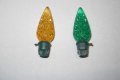
As mentioned I have not taken one of the new LEDs apart yet. But here's what a couple LEDs from the old set look like. There is just a tinge of color in the clear plastic which has to be coming from the "doped" LED. When these light up they are in full bright color.

IMG_5228C.jpg
 

Thread Starter

Chuck99

Joined Jan 6, 2025
18
There is a huge spread in the luminous outputs of LEDs. Even in production runs there was "bin sorting', not sure about now, but fairly recently there was a real variation.

If there is no other regulation scheme, the series resistor is needed because of the extreme NON-LINEARITY of LEDS. And crossing the limit of the "do not exceed " current does cause problems, some times very fast.
I understand what you’re saying. I had a cascade failure with my old lights that took out a series section of 30 LEDs all at once. I was changing some LEDs around when this happened. Some LEDs have resistors but it isn’t consistent. Some yellow LEDs have resistors, some don’t. Some blue LEDs have resistors, some don’t.

You have to take one apart to know what you have or what you are replacing it with. Or use a magnifier & look at the wire leads coming out of the plastic base the LED sits in. If the leads look different it’s because one is a resistor. From looking at several, all yellow LEDs that had resistors had the same value. And all blue LEDS that had resistors had the same value. Etc.

That said, the new LEDs have a shorter base that could not fit a resistor, at least not the same way as the old ones. Of course the plugs could have resistors.

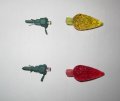
First photo shows LEDs from old string, with & without resistor.
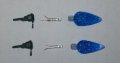
Second photo shows LEDs from new string, and how they’re keyed with a flat spot on the base.

IMG_4657C.jpg


IMG_5389C.jpg
 

BobTPH

Joined Jun 5, 2013
11,514
That is odd. The resistor on any LED affects the entire string. I guess they just distributed the total resistance so that the heat is distributed.
 

wraujr

Joined Jun 28, 2022
259
Your "old" string was only 30 LEDs so you needed an additional 20 resistors to create a string of 50 LEDs/resistors.
Your "new" string is 50 LEDs so no resistors needed.
120VAC is approx. 170V peak with 50 LEDs gives a Vf or 3.4V each.
A typical Lite-On LED has a Vf = 3.4V and i = 20ma
So your old string needed 20 resistors dropping 3.4V (same as LED) at lets say 20ma gives 170 ohms.
That all said, the quantity of resistors will vary with LED specs, etc.

You really have to stop mixing your discussion between old and new strings, you're just making it confusing. How your old and new work is irrelevant as they are different designs and clearly not compatible.
 

Thread Starter

Chuck99

Joined Jan 6, 2025
18
That is odd. The resistor on any LED affects the entire string. I guess they just distributed the total resistance so that the heat is distributed.
I believe that's why I had a cascade failure with the old set. One of my strings didn't match the others in color order. I had a bunch of spare bulbs so I swapped 5 or 10 of them. Probably took out ones with resistors & replaced some without resistors which created too much current. They didn't even flash, they just died. I checked a bunch in a good string & they were dead.

This makes me want to know how the new strings are wired. All the new strings came with 1 green & 2 blue spare bulbs which are the higher voltage LEDs.
 

Thread Starter

Chuck99

Joined Jan 6, 2025
18
The instructions state “Replace lamps only with 3.4 volt. 0.068 watt spare LED lamps provided with this product” and “Missing bulbs should be replaced promptly”.

Apparently they don’t want you using a bunch of 2V red LEDs. This makes me think there are no series resistors & they are using the right combination of LEDs to work with 165-170V.
 

Thread Starter

Chuck99

Joined Jan 6, 2025
18
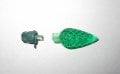
I pried off the lens / diffuser from a spare green LED. Inside it looks like a 3mm LED with a slight green tinge. Hopefully you can see that in the photo. I didn’t remove the LED because I didn’t want to risk breaking off a wire lead. I did shine a light through the LED/base & there is nothing else there.

I lit it up in the string & you can see how green it is compared to a regular green LED bulb.

IMG_5402C.jpg


IMG_5401C.jpg
 

BobTPH

Joined Jun 5, 2013
11,514
The instructions state “Replace lamps only with 3.4 volt. 0.068 watt spare LED lamps provided with this product
That implies to me that each LED has a resistor to make it run on 3.4V at 50mA.

Note that the 50mA would be peak current at the 170V peak in the AC power. Average power would be much less.

This all makes sense and suggests a good design to me.
 

wraujr

Joined Jun 28, 2022
259
That implies to me that each LED has a resistor to make it run on 3.4V at 50mA.

Note that the 50mA would be peak current at the 170V peak in the AC power. Average power would be much less.

This all makes sense and suggests a good design to me.
3.4 volt. 0.068 watt is 20mA, no resistor required in new string with 50 LEDs
 

BobTPH

Joined Jun 5, 2013
11,514
3.4 volt. 0.068 watt is 20mA, no resistor required in new string with 50 LEDs
You’re right, my mistake. Did the divide the wrong way.

But there is no such thing as a 3.4V LED. The forward voltage varies. All colors other than blue will be way less than that. To get a controlled current, you need resistors. Some blue LEDs might be 3.4V at 20 mA and they, perhaps, left out the resistor.
 

wraujr

Joined Jun 28, 2022
259
You’re right, my mistake. Did the divide the wrong way.

But there is no such thing as a 3.4V LED. The forward voltage varies. All colors other than blue will be way less than that. To get a controlled current, you need resistors. Some blue LEDs might be 3.4V at 20 mA and they, perhaps, left out the resistor.
Lite-On LTW-2R3D7 WHITE LED has a Vf = 3.4V @ 20ma (with manufacturing variance), operating spec, no max spec.
Are we sure his newer LEDs are not all white LEDs with tinted encapsulation?
There is confusion in this discussion as TS jumps between the new and old strings and they are clearly different designs.
I am only referring to the newer 50 light strings.
 

Thread Starter

Chuck99

Joined Jan 6, 2025
18
Lite-On LTW-2R3D7 WHITE LED has a Vf = 3.4V @ 20ma (with manufacturing variance), operating spec, no max spec.
Are we sure his newer LEDs are not all white LEDs with tinted encapsulation?
There is confusion in this discussion as TS jumps between the new and old strings and they are clearly different designs.
I am only referring to the newer 50 light strings.
They only provided green & blue spare bulbs. I opened a green bulb because green LEDs have a lower voltage rating & should have a resistor if resistors are used, but there is none.

Would that slight tinting on a white LED be enough to have the LED look bright green when lit up?

Could the clear plastic encapsulation be reflecting whatever is used on the inside to create the color?

If I buy cheap or generic 3mm green LEDs are they going to look clear or have a light green tint?
 

BobTPH

Joined Jun 5, 2013
11,514
If I buy cheap or generic 3mm green LEDs are they going to look clear or have a light green tint?
Some are green, others are clear. But, they will not be 3.4V at 20mA. Typical is 2.2V.

It is possible the LED itself has a resistor built in. Anyone know if they are available that way?
 
Top