How is LED Christmas light string wired with 4 wires ?

Thread Starter

Chuck99

Joined Jan 6, 2025
18
I bought a some Home Depot "Steady Lit”, Super-Bright, flicker-free, 150-ct LED Christmas lights & am trying to figure out how they are wired.

They would be similar to the ones mentioned in this thread but mine have 150 LEDs.
https://forum.allaboutcircuits.com/threads/cutting-xmas-lights.196316/

They are 120VAC, no control box, & plug in like your garden variety C6 LED strings.

Flicker-free so would have to be full wave rectified. There are 3 wires coming out of both the male & female plugs which should mean 2 diodes in each plug. IOW the full wave bridge rectifier is split.

The plugs look normal size & there are no obvious resistors. They could be in the plugs or the bulb sockets.

Three wires come out of the plug, one goes into the first LED but two come out. Now there are 4 wires.

When we get to LED #51, one wire goes in & two come out. This makes 5 wires until LED #100 when the process is reversed & the goes back to 4 wires up to LED #150 where it goes back to 3 wires & into the other plug. The wires are pretty tightly twisted which makes it difficult to trace them.

You can remove an LED from the socket & all the others stay lit, which is what they’re advertised to do.

How are the LEDs wired?
 

DickCappels

Joined Aug 21, 2008
10,661
For one thing, LEDs for Christmas lights often have relatively high intrinsic resistance, which used to be made with a layer of resistance between the LED chip and the mounting point so no additional resistan is needed.

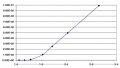
Below is the current as a function of voltage for an LED from a string of Christmas lights bought in 2002.
1736162505163.png
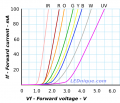
Below shows typical IV curves for "normal" LEDs.
1736162720025.png
Notice that the current increases much more slowly with Christmas light LED. Die sizes would be similar.
 

MisterBill2

Joined Jan 23, 2018
27,312
Certainly this is VERY INTERESTING indeed. The multiple wires indicate that the lites are in groups, not just in parallel. That is common among most strings of more than about 30 lights, both LED and incandescent types, unless they each use the full mains voltage, not likely in this case.

Are the lights polarized, so that they can only plug in one way? Do the bases look similar to the very common wedge-style bases? Or are they quite a bit different??

I have a guess that there is some scheme within each socket that bypasses the bulb, since even the strings where they stay lit when one bulb fails go out when one bulb is removed.

AND CERTAINLY these are quite unusual lites that you have!!
 

Thread Starter

Chuck99

Joined Jan 6, 2025
18
Certainly this is VERY INTERESTING indeed. The multiple wires indicate that the lites are in groups, not just in parallel. That is common among most strings of more than about 30 lights, both LED and incandescent types, unless they each use the full mains voltage, not likely in this case.

Are the lights polarized, so that they can only plug in one way? Do the bases look similar to the very common wedge-style bases? Or are they quite a bit different??

I have a guess that there is some scheme within each socket that bypasses the bulb, since even the strings where they stay lit when one bulb fails go out when one bulb is removed.

AND CERTAINLY these are quite unusual lites that you have!!
My previous sets are like you mentioned - Two sections of 30 LEDs in series but in parallel to each other & in opposite polarity. Some LEDs have resistors in their base & some don't.

The new sets look the same other than having heavier wiring. They are not polarized. The bases look similar to the old lights but I'm sure they're keyed differently.

There could be some type of shunt or resistor in each base. But why would there be a need for 4 wires?
 

MisterBill2

Joined Jan 23, 2018
27,312
Multiple wires would probably be to supply power to the several strings of lights. Consider a series string of LEDs at 2 volts each. That would be 300 volts end to end. Not Reasonable at all. So shorter series groups with some magical shunt scheme. (Based on the description in post #1) So aside from some magic, I see a trick of some sort. AND, as I am guessing that the string was rather expensive, I suggest waiting until the string fails enough so that it will not be used any more. At that time we can work thru a complete analysis. I make this suggestion because a deeper probe may cause damage, and I certainly do not want that.
 

Thread Starter

Chuck99

Joined Jan 6, 2025
18
Multiple wires would probably be to supply power to the several strings of lights. Consider a series string of LEDs at 2 volts each. That would be 300 volts end to end. Not Reasonable at all. So shorter series groups with some magical shunt scheme. (Based on the description in post #1) So aside from some magic, I see a trick of some sort. AND, as I am guessing that the string was rather expensive, I suggest waiting until the string fails enough so that it will not be used any more. At that time we can work thru a complete analysis. I make this suggestion because a deeper probe may cause damage, and I certainly do not want that.
Doing some rough figuring, 120VAC is about 170V Peak which should be enough to light up a series of 50 mixed color LEDs. Not during the whole sine wave, but at some some point. Maybe at 120V they would light.

The old string did the same thing. It has 30 LEDs in series & some have resistors hidden in their green plastic base. At some point during the 170V wave form they would conduct.

I don't see any capacitor in the new string and FWIW the old set didn't use one. In either case the LEDs conduct for only a small portion of the sine wave, except the old is half wave & the new is full wave.

They were not cheap so I don't want to dissect a string. I'm going to unroll a string & make sure I didn't miss a wire tapping in at the 25 LED point and maybe feeding power midway in a 50 LED section, if that make sense.
 

wraujr

Joined Jun 28, 2022
259
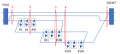
OK, here's my guess:

1736354755712.png
Key points:
Three (parallel), series string of "bipolar" LEDs
Bipolar LEDs allow half of LED to light every half cycle reducing flicker
@120 RMS or about 170V gives max forward voltage of 3.4V (using chart above for white LED, give 40 ma peak)
The resistors in base (not shown above) are "bypass" resistors should a LED burnout or bulb fall out of socket.
 

Wendy

Joined Mar 24, 2008
23,798
Don't forget there needs to be a ballast to limit current, either a resistor or a capacitor probably both.
 

MisterBill2

Joined Jan 23, 2018
27,312
Quite an interesting explanation, and I see no technical flaws in it. The one LED string outdoor piece that eventually failed was different in that it did have a rectifier bridge supply, so it was strictly unipolar, with the LEDs very seriously polarized. The failure mode was that it stopped lighting EXCEPT during rain. I was able to get it to light up any time just by spraying it with a mist from the hose. It would slowly illuminate as more of the leds became quite wet, and slowly fade away as they dried out.
When I experimented with a variable voltage transformer, it would start to light up about 70 volts, and reach full brightness about 110 volts AC. That implies that it started lighting around 2.5 volts per bulb and continued getting brighter up to a bit over 3 volts per bulb. I did not measure the current, not having a suitable AC ammeter at the time. They were powered by DC, but measuring that unfiltered current was not on my agenda.
 

Thread Starter

Chuck99

Joined Jan 6, 2025
18
I unrolled part of the string & did not see anything unusual within the first 25 LEDs which is half of the first group of 50 LEDs. IOW no additional wire feeding power.

I pulled the first 3 LEDs and measured resistance across the socket contacts & got 499, 495, & 495 ohms. Same with the DVM leads reversed. Since the sockets are still connected I could be measuring something else in the circuit. I don’t know.

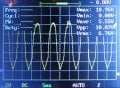
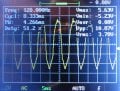
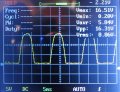
Used my cheap oscilloscope & looked at socket #1with all the other LEDs in place & powered on. See the first 2 photos, DC & AC. Was difficult to make good contact with the socket terminals & take pictures of the scope. Really needed another pair of hands. There was some noise on the waveform depending on scope polarity. Also looked at socket #2 when it was the only empty one & it looked the same.

The AC power plug has 3 wires, two bypass the first group of 50 LEDs. The other one goes to socket #1 and photo #3 shows the voltage from that first socket contact to power line neutral using a 10X probe. It is clearly a rectified signal. Initially I was confused why it's half wave, but this is not across the load.

Any thoughts why there is 10V peak to peak across an empty socket? I'm presuming plugging in the LED would change that.


LED_1_1X Probe_DC IMG_5357 copy.jpg


LED_1_1X Probe_AC IMG_5360 copy.jpg


AC Neutral to LED1 10X Probe IMG_5355 copy.jpg
 

BobTPH

Joined Jun 5, 2013
11,483
But you did not measure it with all 50 LEDs out.

The resistor is there to allow current to flow when a small number of LEDs go open. If you take out all the LEDs your reading will be

170 / 50 = 3.4V
 

Thread Starter

Chuck99

Joined Jan 6, 2025
18
But you did not measure it with all 50 LEDs out.

The resistor is there to allow current to flow when a small number of LEDs go open. If you take out all the LEDs your reading will be

170 / 50 = 3.4V
If it's 3.4V when all LEDs are removed, what is it when all 50 LEDs are in place?
 

MisterBill2

Joined Jan 23, 2018
27,312
There is no reason to believe that the situation is linear! And while it is quite interesting to know the voltage across an empty socket, and seeing the resistance across one empty socket, what we are seeing may not be as simple as guessed.
 

BobTPH

Joined Jun 5, 2013
11,483
If it's 3.4V when all LEDs are removed, what is it when all 50 LEDs are in place?
Same, it has to equal the input voltage! KVL.

The resistors are chosen so that they will conduct enough if the LED is open, but not too much if the LED is operating.
 
Last edited:

Thread Starter

Chuck99

Joined Jan 6, 2025
18
The set uses 5 different colored LEDs in a repeating pattern. If I add up 50 LEDs in series their voltages total roughly 120V. They should only conduct for the time when the sine wave goes above 120V across that series.

My old lights were 120VAC, no rectifier, 30 LEDs per section, some with series resistors.

The new ones are 120VAC, rectified. 50 LEDs per section. Would the duty cycle and/or average DC current let them operate without a series resistor?

The new LED string advertises up to 2X brighter than their basic lights, and they are brighter than my old lights. Would this mainly be a function of being full wave rectified or operating without resistors & therefore slightly higher current, but still below maximum levels?
 

MisterBill2

Joined Jan 23, 2018
27,312
There is a huge spread in the luminous outputs of LEDs. Even in production runs there was "bin sorting', not sure about now, but fairly recently there was a real variation.

If there is no other regulation scheme, the series resistor is needed because of the extreme NON-LINEARITY of LEDS. And crossing the limit of the "do not exceed " current does cause problems, some times very fast.
 

wraujr

Joined Jun 28, 2022
259
You say: " The new LED string advertises up to 2X brighter than their basic lights, and they are brighter than my old lights. Would this mainly be a function of being full wave rectified or operating without resistors & therefore slightly higher current, but still below maximum levels?"

Or consider what is shown in Post #7 with a "bidirectional LED" where half the LED is lit during the half cycle. Hence 2X the amount of light with less flicker while LED current remains the same.
 

wraujr

Joined Jun 28, 2022
259
You ask " The new ones are 120VAC, rectified. 50 LEDs per section. Would the duty cycle and/or average DC current let them operate without a series resistor? "

With 50 LEDs in series there is no need for a series resistor, any resistor is the "bypass" resistor that maintains the string if a LED burns out of the bulb falls out.
 
Top