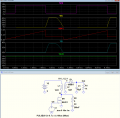
Don't know if you question has been answered to your satisfaction, but below is the LTspice sim of your basic circuit to show what happens:
(R2 and C2 are just to suppress small oscillations that occur when the MOSFET turns off).
When the Ctl signal (purple trace) is high the MOSFET is on and it's drain voltage is near zero (yellow trace), causing the current to rise in the transformer primary (red trace), and the transformer output is -9V (blue trace) from the transformer action due to the supply voltage being applied across the transformer primary.
When MOSFET turns off, V(d) rises due to the stored inductive energy, which is now seen at the transformer V(t) output as a positive voltage when V(d) exceeds the supply voltage.
This goes through diode D1 to generate the positive output voltage (green trace), transferring the inductive energy to the output.
The output voltage is a function of the transformer inductance and turns ratio, the output load, and the control signal duty-cycle.
Not sure what you mean by that. Current does have a polarity of sorts because in a circuit it often depends which way the current is flowing in a wire. Clamp on meters have the polarity marked with a plus "+" sign (and maybe a minus sign too) so you can tell which way the current is flowing, subject to the standard being used (conventional vs electron flow).
On the other hand, the magnitude of the current (or anything else really) is the absolute value of the quantity (current) so that would have no polarity.
If we assume the current is flowing in one direction and then it starts to flow in the other direction, we can say the polarity changed or reversed, or the current is flowing in the opposite direction. I agree though that the original wording of the post in question was not quite descriptive enough. That could be from the level of experience of the user or the original language of the user. I do think it is clear now though what was meant.
I just asked about your language because some people who translate from their first language to another language sometimes translate in a way that may be accurate but not quite rendered into the form more usually heard from the people of the land. This makes it possibly a little harder to be sure of the meaning.
It also comes from experience though too, where a person involved with a given subject matter has heard the common phrases over and over again and when something is phrased in a slightly different way it may bring up questions as to what was actually meant.
However, I am sure everyone here now knows exactly what you were referring too.

 Facebook
 Google
 GitHub
 Linkedin