Okay, it doesn't really make sense to me that the energy is stored in the gap, since that would seem to mean you don't need any magnetic material, just air for a power inductor, and we that's not true but I'll accept it since I can't prove otherwise.
Okay, it doesn't really make sense to me that the energy is stored in the gap, since that would seem to mean you don't need any magnetic material, just air for a power inductor, and we that's not true but I'll accept it since I can't prove otherwise.
Theoretically (in reality?), you can build an air core coupled inductor whose self- and mutual- inductances are equivalent to that of a ferrite cored device.
It would be huge, likely, and spill stray magnetism all over, but it would have the benefit of not exhibiting saturation, and the current/energy would only be limited by the coil resistance.
The whole point of ferrite cores is to keep things practical.
Actually, I believe this is the case.
Theoretically (in reality?), you can build an air core coupled inductor whose self- and mutual- inductance are equivalent to that of a ferrite cored device.
It would be huge, likely, and spill stray magnetism all over, but it would have the benefit of not exhibiting saturation, and the current/energy would only be limited by the coil resistance.
The whole point of ferrite cores is to keep things practical.
See attachment. ADDED: ..."the main advantage of the present designs compared to a
solenoid is the nearly complete absence of an external field.
The conventional solution that comes closes to approximating
that advantage is a wire-wound air-core toroid."
Since it's the inductance that determines the energy stored for a given current, and most of that inductance is provided by the magnetic core, how then does the air gap, which actually reduces the inductance, store much of the energy, math notwithstanding?
Since it's the inductance that determines the energy stored for a given current, and most of that inductance is provided by the magnetic core, how then does the air gap, which actually reduces the inductance, store much of the energy, math notwithstanding?
I believe you already know that.
The core would saturate at a lower current, since the air gap reduces the flux density for a given ampere-turns. so would store less energy..
But that just begs the question.
As I previously stated, a gapped core can store more energy because the air gap reduces the the flux density so the core can tolerate more ampere-turns before saturation. Since the stored energy is proportional to the square of the ampere-turns, the gapped core can store more energy.
That the gap stores the energy is the assumption we are discussing.
There is less stored energy because the core saturates at a lower current.
It the core didn't saturate, then you wouldn't need the gap.
The energy is stored in the magnetic flux of the coil and the maximum flux before core saturation is the same for a gapped and un-gapped core.
The difference is that the gapped gapped core can tolerate more ampere turns before saturation so stores more energy.
But I think we at a loggerhead, so I doubt that further discussion will provide any further enlightenment.
I was proposing a hypothesis to test the theory that the energy is stored in the air gap.
If the gap could be closed -- while the inductor is energized -- it should be possible to measure, quantitatively, the energy that was stored in the gap, but is no longer (i.e. conservation of energy). It has to go somewhere!
It was just a thought to myself, as an answer to the question:
I was proposing a hypothesis to test the theory that the energy is stored in the air gap.
If the gap could be closed -- while the inductor is energized -- it should be possible to measure, quantitatively, the energy that was stored in the gap, but is no longer (i.e. conservation of energy). It has to go somewhere!
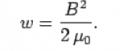
But I have found a simple formula that helps me understand how the gap stores high energy.
The unit-volume energy density in a magnetic field is:
- - - - - -
thus the density is inversely proportional to twice the magnetic permeability for a given magnetic field intensity (B).
(This was somewhat a surprise to me, but I guess it makes sense, and fills in a gap in my understanding.)
Since the magnetic permeability of a ferrite magnetic core is likely well more than a thousand times that of air (free space), the air gap can store a lot more energy per unit volume than the magnetic core for the same field intensity.
So basically the magnetic core creates a large field intensity in the gap for a low value of ampere-turns as compared to an air core, allowing the gap to store a lot of energy.
But I have found a simple formula that helps me understand how the gap stores high energy.
The unit-volume energy density in a magnetic field is:
- - - - - - View attachment 311845
thus the density is inversely proportional to twice the magnetic permeability for a given magnetic field intensity (B).
(This was somewhat a surprise to me, but I guess it makes sense, and fills in a gap in my understanding.)
Since the magnetic permeability of a ferrite magnetic core is likely well more than a thousand times that of air (free space), the air gap can store a lot more energy per unit volume than the magnetic core for the same field intensity.
So basically the magnetic core creates a large field intensity in the gap for a low value of ampere-turns as compared to an air core, allowing the gap to store a lot of energy.
Yes. That was the explanation I was originally Googling for. I liked the paper I found better because it was a far more general (and complicated) explanation.
What causes the secondary diode to be reverse biased during tON? Is it to do with the opposing trafo polarity?
During tON, the MOSFET is on and current flows from the input through the primary inductor, linearly charging the coupled inductor and creating a magnetic field around it. In the secondary inductor, the rectifier diode is reverse-biased, which means the transformer is disconnected from the output.
All you have to do is look at the polarity dots on the transformer.
When the top of Lp is positive, the top of Ls is negative, and the diode is reversed biased.
When the transistor opens, the bottom of Lp becomes more positive than the top, and thus the top of Ls is now positive which allows energy to flow to the output which also acts as a pseudo clamp on the primary voltage. This clamp is not perfect because of leakage inductance so most often some sort of snubber or other means is used. If the diode were to be removed, the primary voltage at the bottom of Lp would go up to a very high level, theoretically infinite. With the diode in place, there could be a short time when the primary voltage shoots up to a higher voltage than expected before the output can follow (imperfect coupling) and thus some means to handle that is often required.

 Facebook
 Google
 GitHub
 Linkedin