Next idea for you to think about. The insulation is 600V. I have some good HV supplies. I could charge up the broken wire to some HV and limit the current to 1mA. There is a chance it will spark to ground. An AM radio might pick up the noise. Probably the RF noise will jump to all the wires.
There is a method for locating the point of a broken cable core. A capacitor is charged and connected to the broken cable core.Using a sensitive microphone, which is placed on the ground, the discharge sound is listened to with headphones.
I tried a 10khz 30V tone on the wire. I have a setup for listening to water flow in pipes with a headphone. Did not work for me.
Yesterday I thought I could measure the pulse I am sending down the wires, with a current probe. I have a very large collection of current probes. One is Rogowski. Several are prototypes I made years ago. I could not see any current from the generator. Gave up.
I have three holes dug down to the wire. I pushed a pin into the wire at two of the points and measured resistance. The brake is closer to the shop than I thought. Not under the road like I feared. I have several cans of High Voltage insulation repair to go over the pin holes. This afternoon I will keep digging North. My new thought is that the installer had a role of wire and needed 25 more feet, so he spliced the wire just North of my last hole.
I found the break in Neutral about were the TDR method said it would be. Neutral has zero volts. The time was not right but the "break at 1/8 the distance" was right on. The wire is #2 for 100A service. The wire is about twice as large in this area, with factory yellow insulation over it. There was white tape over the break so I could not see it from above.
There are two theories. This might be a factory splice. Or There was a pin hold in the insulation what someone taped over. Over 50 years, water ate up the wire, the resistance became high and caused heating.
I have some underwater splice kits and maybe by noon I will have power back. I think I will cover the splice in "liquid insulation" then use the heat shrink, liquid insulation again, then tape.
Thanks for all the help.
Thank you Jon Chandler for the kind offer.
I've never seen a splice in a cable coming from the factory. (And I've seen quite some km of cable in my life. For some years I've been working in the proximity of a cable factory . . .) Considering the manufacturing a splice is just impossible - during the following process steps an increased of diameter would result in the cable getting stuck in the machine.
Some damage from cable routing (mishandling) could be. The increase in diameter is difficult to explain - unless the "innards" applied pressure from the inside (corrosion products?).
I found a spot on one of the hot wires that also had white tape over it. Some special tape that is 4 inches wide. Under that tape there was a small mark in the insulation. My guess is that Neural insulation was damages and, in many years, the ground water gate away the Aluminum wire until it became high resistive then exploded. There was lots of white powder in the hold at the break.
---------------------------------------------------------------------------------------
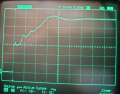
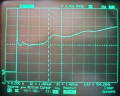
While I am here, I have the scope pictures of the reflections on the cable.
This trace shows the reflection from a square wave. The slope upward at about 45 degrees is probably caused by charging up the capacitance to ground.
This is zoomed in on the reflection, which is at 1.5uS. The scope is reading 1.42uS.
If that was hard to see here is a clear picture. The noise at first is probably from the coax cable, the length of the ground rod and leads. The ring back is 1/3 of what it is using network cables. This ware is not built for high frequency signals. I don't remember the numbers, but I think it forms a 100khz low pass filter.
By dark I have 2 of 3 holes filled and light on in the shop.
RonS.
I did. It was a special silicone cable shipped in drums, from Austrian supplier. It's good that the cableman understood that something was wrong with this cable, and they left this drum for later installation. Then he cut through this thicker part of the cable and saw the splice
Aluminum wire? Al does react with humidity, forming aluminum hydroxide that occupies more volume than the bare metal itself. For underground installations wouldn't consider aluminum at all. (It has more issues that make it undesirable wherever the cable weight is of lesser importance.)

 Facebook
 Google
 GitHub
 Linkedin