how can i filter my computer's 5V usb port?

LadySpark

Joined Feb 7, 2024
194
2) The datasheets for most electret mics say that thier Fet has a current of 0.5mA and a minimum operating voltage of 2VDC.
Then your R1 resistance of 10k is too high for a 5V supply because 0.5mA x 10k= 5V on R1 then the mic has zero VDC.
I use 10k with a 9V supply.
You got a point. Don't know what requirements to the mic. But its hard to say if a 10K wouldn't work even if it was a FET type. But it would most likely work considering how they use a FET in an electret element.
 

LadySpark

Joined Feb 7, 2024
194
A common-source Jfet does not amplify when it is turned-on hard because its supply voltage is too low and/or its drain load resistance is too high.
so how many of these electret mic posts show up on this site? Quite a few. Is somone holding a class and others are using this site for external help?
Btw, I pulled one out from an old electronics hobby kit and connected it. Got signal.
Current meter says 0.48mA on the bench power supply with 5 V applied.
The problem the TS has is more associated with with the gain they set as they would only need a gain of 10 at the most and not 100. Also, I think their Rin resistor is too low and needs to be 2.5K and ditch the input capacitor.
 

Audioguru again

Joined Oct 21, 2019
6,826
The problem the TS has is more associated with with the gain they set as they would only need a gain of 10 at the most and not 100.
No. The output level of an electret mic is only 10mV when talking to it in your hand. Also, its output level is frequently much less.
Therefore the preamp needs extra gain that you can turn down when less gain is needed.
 

LadySpark

Joined Feb 7, 2024
194
No. The output level of an electret mic is only 10mV when talking to it in your hand. Also, its output level is frequently much less.
Therefore the preamp needs extra gain that you can turn down when less gain is needed.
it really depends on what its plugged into.
But if its a computer mic input, it wouldn't need much other than being connected correctly.
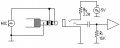
Because the computer's mic power is on the ring connection with a 2.2K loading resistor for the FET.
standard_sb_input.png
 

LadySpark

Joined Feb 7, 2024
194
Doesn't the mic preamp in a computer have a very low gain because it expects the headset mic to be very close to your mouth?
not usually. Sound cards mic pre gain is 50- 80 db of gain and were designed for electret mics. Some even have an extra 30db gain stage on top of this. Low impedance dynamic mics are the only mics that have issues interfacing. One thing I find interesting, is that some of the transformer-less FET condenser mics can run off of 5V. I bough a cheap one off ebay and it came with a computer mic cord and tried that mic and some other low end ones I had laying around (MXL 3000 & Behringer C3). So if a pod caster really didn't want to invest into an audio interface, there are possibilities. I find it interesting that they try to use the SM7. About 25 years ago, I modded them for my now husband so he can use them while on a gig and in the studio. They just needed the standard step up transformer that is in most dynamic mics installed in them. Then they work just as well as other dynamic mics on the same pre. They end up having the same gain structure settings like a sm57 or sm58. That is why I laugh at those guys buying the cloudlifter. Even though companies like Focusrite are making interfaces not really compatible to dynamic mics.
 

Audioguru again

Joined Oct 21, 2019
6,826
The only tImes I have not seen a microphone near a person's mouth is on TV where they hide the mic so that the room echoes and background noises are as loud as they can be.
 

LadySpark

Joined Feb 7, 2024
194
The only tImes I have not seen a microphone near a person's mouth is on TV where they hide the mic so that the room echoes and background noises are as loud as they can be.
even that they are using several microphones instead of one.
But acoustics of mic positioning and the room reflections is going to make the mileage vary.
A lot of people just use the built in one on their laptop. Like this guy.
 

Audioguru again

Joined Oct 21, 2019
6,826
Post #31 has the specs for the new H version (2021 datasheet) for the TL071H single opamp (and the dual and the quad).
Its inputs must be 1.5V or more, more positive than the negative supply.

The old original TL071 (1978 datasheet) has different specs, a recommended minimum supply of 10V and an input must be 4V or more, more positive than the negative supply voltage.

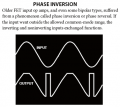
For both versions, if an input voltage goes too low the the output goes as high as it can (opamp phase inversion):
 

Attachments

MrAl

Joined Jun 17, 2014
13,720
I'm working on a project that requires a 5V supply, I cut a cable and connected it to my computer's USB. I was having too much noise in the circuit so I replaced the supply to a 5V battery and the noise went away.

my question is how can I filter the noise coming out of the computer? because using a battery isn't practical.
Hello there,

Despite some complains about the LM358 used in audio work, it is possible to use it for that, but you have to know how to use it for that. More about that later.

It sounds to me that it's not the USB port that is causing the noise. Audio circuits are notorious for picking up line frequency noise. That means almost everything needs to be shielded. If not, you are going to hear something that sounds like hum.
The circuit may have to be encased in a metal case and use shielded cable for the input. If you do not use shielded cable, it's very likely it will pick up the line frequency and that will appear as noise at the output, a low frequency hum.
 

Audioguru again

Joined Oct 21, 2019
6,826
The first sentence in this thread says," The 5V USB supply was replaced by a battery and the noise went away".

Sure the mic cable should be a shielded audio cable. I have an electret mic connected to a preamp with a shielded audio cable that is less than one inch long. No hum.
 

MrAl

Joined Jun 17, 2014
13,720
Yes I have found audio circuits to be very sensitive to hum from the power line. That's always a consideration with audio work.
 
Top