Shelving Filter study

Thread Starter

rpschultz

Joined Nov 23, 2022
850
Hi,

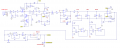
I'm trying to understand the high/mid/low control of this circuit (on the right). The pots are neutral at 50%.
  • Firstly, what kind of filter is this?!? Doesn't seem to fit any of the classic Sallen Key, LP, HP, BP, Butterworth, etc.
  • U2A seems to be a summing amplifier into the next stage.
  • I guess the mid is not a shelving filter, most be a band pass.
  • Why does the high not have an op amp? I noticed from spice that it is not symmetrical, roughly +10db, but only -2 db. Is there a way to fix this?
  • Could the Low be separated from U2A? Then use that op amp for a better High filter?

Thanks.
FishmanMiniPreamp.png
 

joeyd999

Joined Jun 6, 2011
6,378
U2a is not a summing amp. It is a filtered non-inverting amp with very high input impedance. The input signal is loaded by the three filter sections, each with a reactance centered about some frequency, and attenuated by the pots.

You can't look at this whole circuit as a filter "type". You need to break it into parts (stages) and figure what each stage is doing.
 
To understand a circuit; divide and conquer. And only use the elements of interest.
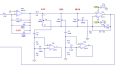
I would simulate only the section I am copying below. But divide it in three simulations, one with the "LOW" components only, another with the "MID" components only, and lastly with the "HIGH" components only.
 

Attachments

The LOW and MID have RCL-network to form band-pass filtering. OPAMP U2C helps form an inductance with R14, R15 and C12. Together with C11, it achieves an equivalent impedance of 1/sC11 + R14 + R15 + sR14R15C12. Same for U2D and its surrounding components.
 

Ian0

Joined Aug 7, 2020
13,181
It‘s a gyrator-based graphic equaliser circuit.
The op-amp, and the capacitor and the two nearest resistors synthesise an inductor, which resonates with the capacitor connected to the pot wiper.
With no tuned circuits connected, U2a is a unity gain buffer.
When a pot is moved to the - side, the gyrator (which makes as series resonant circuit) has very low impedance and in conjunction with R13 causes a dip in the response at the resonant frequency.
When the pot is moved to +, the resistance of the pot stops it having much effect on the incoming signal, but it turns U2a into a non-inverting amplifier with gain of 1+(R19/gyrator_series_resistance) at the resonant frequency of the gyrator and the capacitor.

Have a look at any graphic equaliser projects for a fuller explanation.
https://sound-au.com/project226.htm
 

joeyd999

Joined Jun 6, 2011
6,378
It‘s a gyrator-based graphic equaliser circuit.
The op-amp, and the capacitor and the two nearest resistors synthesise an inductor, which resonates with the capacitor connected to the pot wiper.
With no tuned circuits connected, U2a is a unity gain buffer.
When a pot is moved to the - side, the gyrator (which makes as series resonant circuit) has very low impedance and in conjunction with R13 causes a dip in the response at the resonant frequency.
When the pot is moved to +, the resistance of the pot stops it having much effect on the incoming signal, but it turns U2a into a non-inverting amplifier with gain of 1+(R19/gyrator_series_resistance) at the resonant frequency of the gyrator and the capacitor.

Have a look at any graphic equaliser projects for a fuller explanation.
https://sound-au.com/project226.htm
Yeah, that's what I was trying to say, but not in so many correct words.
 

Thread Starter

rpschultz

Joined Nov 23, 2022
850
I have a spice model of this entire circuit. The Low and Mid with the op amps are peaking, whereas the High (without the op amp) is shelving, with +10 or -2 db. The +10 and fc can be adjusted, but the -2 seems set no matter what I do.

ESP stuff is a gold mine, just when I think I've read all his stuff, you send me something I hadn't seen before. Thanks for the TI sheet too, the graphics EQ explanation makes a lot of sense now. Although it doesn't help with manipulating the shelving knob. So really I should look at the Low and Mid as a peaking graphic EQ style (which is fine), and the High as shelving... so maybe I should come up with a better shelving method. A Baxandall may be better in that regard.
 
ESP stuff is so good, that I once sent him a small monetary contribution via PayPal, as a token of appreciation for his hard work and willingness to share it.
I would encourage anyone who has benefited from his articles to donate similarly, but that is your choice.
 
Top