High-side switch (P-MOS) question ...

Thread Starter

tim987

Joined Aug 25, 2017
11
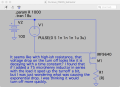
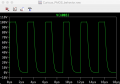
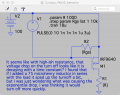
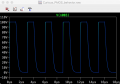
Hi - I have been trying to teach myself a little bit about electronics, and today that was high-side switching with a power P-MOSFET (IRF9640, picked essentially at random from LTspice's library). I have seen the small-signal model for mosfets and I think that I sort of understand what is going on with small signals, but with this circuit I saw a curious exponential drop on the turn-off part of the waveform that I didn't understand.

Any hints (or links to websites or books) that you might have would be appreciated.
(pictures of the circuit and the drain voltage waveform are attached)
 

Attachments

GopherT

Joined Nov 23, 2012
8,009
Hi - I have been trying to teach myself a little bit about electronics, and today that was high-side switching with a power P-MOSFET (IRF9640, picked essentially at random from LTspice's library). I have seen the small-signal model for mosfets and I think that I sort of understand what is going on with small signals, but with this circuit I saw a curious exponential drop on the turn-off part of the waveform that I didn't understand.

Any hints (or links to websites or books) that you might have would be appreciated.
(pictures of the circuit and the drain voltage waveform are attached)
The IRF9640 is specified at 10v to turn on completely. I believe you are using 5V pulses.

Repeat with 10V and repost.
 

Thread Starter

tim987

Joined Aug 25, 2017
11
Good catch!
I had been messing with that parameter ... sadly the performance is almost identical.
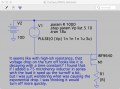
It is hard to see in the graphic because the blue plot (-10V pulse applied to gate) is almost the same as the green plot (-5V pulse applied to gate).

Circuit and drain voltage waveform attached.
 

Attachments

AnalogKid

Joined Aug 1, 2013
12,086
MOSFETs, and especially power MOSFETs, have a measurable capacitance from the gate to the source. Your circuit has no discharge path for the stored charge, so that capacitor is acting as a small power supply holding the gate negative with respect to the source, which is why it turns off slowly. Add 10 K from the gate to the source.

ak
 

Thread Starter

tim987

Joined Aug 25, 2017
11
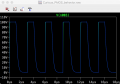
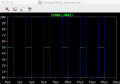
Didn't seem to change it much either. I tried a 1 ohm and 10k ohm ... 1 ohm is the green, 10k ohm is the blue that almost overlaps the green.

I have included the drain voltage waveform, and the gate-source voltage waveform as well.
 

Attachments

AlbertHall

Joined Jun 4, 2014
12,623
When the MOSFET turns off, the drain to source capacitance of the MOSFET (plus the stray capacitance of the resistor and wiring in a real circuit) are charged. The only discharge path for this capacitance is R1 and so you will get the standard exponential decay with a rime constant of R1 times the capacitance. See what effect changing the value of R1 has.
 

Thread Starter

tim987

Joined Aug 25, 2017
11
Hi Albert - changing the value of R1 to something like 100 ohms indeed does make the circuit behave as expected. Perhaps all of my confusion with this is because I am asking the mosfet to drive a resistor that is too large? My experience with "power" electronics is very limited. Once the drain resistor gets as large as a k-ohm or so, things begin to go slowly. Perhaps I have discovered the obvious?

Thanks everyone for taking a look.
 

phranzdan

Joined Aug 4, 2017
40
Hi - I have been trying to teach myself a little bit about electronics, and today that was high-side switching with a power P-MOSFET (IRF9640, picked essentially at random from LTspice's library). I have seen the small-signal model for mosfets and I think that I sort of understand what is going on with small signals, but with this circuit I saw a curious exponential drop on the turn-off part of the waveform that I didn't understand.

Any hints (or links to websites or books) that you might have would be appreciated.
(pictures of the circuit and the drain voltage waveform are attached)
Hi: Not certain of what you are expecting the turn off waveform to look like. The delay time given for the IRF9460 is 140 ns max. The fall time is given as 140 ns also. You should try to get a single pulse with higher sweep speed and look at the actual delay and fall times. It is hard to make a judgement from the waveforms you are showing, but some of this decay is normal fall time. There are a lot of good papers published on measuring switching times on mos devices. Look for application notes from the semiconductor houses like On or the former RCA and Motorola.
 

Thread Starter

tim987

Joined Aug 25, 2017
11
I think that what got my attention originally was that when the drain resistor was 50 ohms, the turn off was pretty fast, like 30 ns or so. When the drain resistor was 500 ohms, the turn off time was more like 300 ns. Thanks for the information on the switching time application notes - I will probably try to rig up some tests ...

I know that the small-signal model can be quite different from the large-signal model. I guess I was trying to understand how something like the hybrid-pi model could generate an output like I saw. I know that the link does not have the model with the gate-source and gate-drain capacitors. I was also not sure how the gate-source and gate-drain capacitors could cause the increase in fall time.

I had looked around for large-signal MOSFET models, but couldn't find anything really illuminating on the internet, but I figured that was because the good information was in some textbook that I didn't have ...
 

crutschow

Joined Mar 14, 2008
38,407
I guess I was trying to understand how something like the hybrid-pi model could generate an output like I saw.
That's a small-signal model and cannot be used to determine the large signal response of a MOSFET.
I was also not sure how the gate-source and gate-drain capacitors could cause the increase in fall time.
The gate-source capacitance requires time to charge/discharge the gate voltage which controls the MOSFET turning on/off. The higher the gate driver resistance the slower the change in gate voltage and the slower the rise/fall times.

The gate-drain capacitance is also called the Miller capacitance.
This provides negative feedback between the drain and gate which amplifies the negative effect this capacitance has on slowing the change in gate voltage as the MOSFET is turned on and off.
This further slows the rise-fall time.
 
Top