High power solenoid driver economizer circuit

Thread Starter

Backyard

Joined Oct 15, 2024
16
I'm having trouble building an economizer circuit for a high power solenoid. The solenoids are 12 volts and about 5 amps. They are not continuous duty rated and will burn out if left on for about 5 seconds. I don't need to have them on for more then a second or so, but even then they do get warm.

I'm trying to make a circuit that will use a higher voltage pulse to quickly open the solenoid and then drop down to 12 volt PWM to reduce current and thus heating.

The issue is if I use an N mosfet on the positive side for either the high voltage turn on pulse or the PWM it doesn't turn on. This is expected as I don't have any good way to drive the gate with the appropriate voltage to make it trigger. When using P channel mosfets the also have trouble with them not turning on completely. They seem to only turn on a little bit with a large voltage drop across them.

And since the circuit needs to drive more then one solenoid, I would like to have the high voltage and PWM side the same for all solenoids and another set of mosfets on the negative side of the solenoids to choose which solenoid gets triggered. Solenoids will only be triggered one at a time and no overlap.

I am driving the gate drivers with a processor to time the driver precisely and to generate the PWM signal. I have a decent amount of control on the timing, frequency and duty cycle so there will be some experimenting to find the best frequency and duty cycle that will hold the solenoid open with as little current as possible

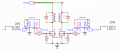
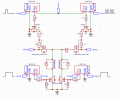
This is the circuit that I currently built. I've played around with various resistors trying to get the P channel fets to trigger with no luck. All I get it a partially turned on fet and in increase in voltage on the gate only destroys the fet shorting it out

Any idea what I have wrong here and what to do to fix it?Solenoid Driver-1.png
 

ronsimpson

Joined Oct 7, 2019
4,647
Q5,6 are too small. You need a higher current part. I think you know that. Just a part number error.
I think we can greatly reduce the part count.

If I was doing this, I would use the 48V to run the relays and not have the 12V option.
Turn on at 48V for 0.5 seconds to get started.
Drop to 25% to get 12V at 5A for 5 seconds.
If the relays are too hot reduce the duty cycle more.
Can you do this in software?
If not we could add a logic gate to mix the PWM signal into the ON/OFF signal(s) The logic gate will have a PWM input and On/Off (0-8)

If you can live with this, remove the top half of the schematic.
----------edited----------
There is another way that used only a 12V supply. It used a voltage doubler to get 24V for 200mS. Pretty simple.
 
Last edited:

Thread Starter

Backyard

Joined Oct 15, 2024
16
Q5,6 are too small. You need a higher current part. I think you know that. Just a part number error.
I think we can greatly reduce the part count.

If I was doing this, I would use the 48V to run the relays and not have the 12V option.
Turn on at 48V for 0.5 seconds to get started.
Drop to 25% to get 12V at 5A for 5 seconds.
If the relays are too hot reduce the duty cycle more.
Can you do this in software?
If not we could add a logic gate to mix the PWM signal into the ON/OFF signal(s) The logic gate will have a PWM input and On/Off (0-8)

If you can live with this, remove the top half of the schematic.
----------edited----------
There is another way that used only a 12V supply. It used a voltage doubler to get 24V for 200mS. Pretty simple.
Oh, good catch. Yes that part number is incorrect. I should check the rest too.

Ok, double checking the parts and here is what I have.

Q1 & Q3 are Infineon IPB200N25N3GATMA1 but I'm considering something like Goford G2003A which is an SOT-23 rated at 190V & 3A if I don't need anything that strong to drive the gates of Q2 & Q4.

Q2 & Q4 are the P channel mosfets: Vishay SQM120P10_10M1LGE3

Q5 & Q6 are either Infineon IPB200N25N3GATMA1 or AGM AGM025N13LL. I've tested both of these parts and both mosfets work excellent. So the lower part of the circuit under the solenoids works well

I tried relays but at 48V the contacts are short lived. I measured the current and it's about 20 amps. I'd have to go with a contactor rated at much higher current rating to have more then a few dozen cycle life I got out of the ice cube test relays I tried. Plus I want to get away from any relays to gain better cycle life but more importantly precision in opening. It needs to open and close at microsecond accuracy.

I've been wondering if there is a way to move the top half of the circuit to the bottom so I can just use N channel Fets. I know there is a way to use Q5 & Q6 to do the PWM with some code changes to the processor. Would have to have it do 100% duty cycle during the turn on and then drop back to something like 50% to reduce current. But I would like to be able to switch between the 12V and 48V at the top half if possible using mosfet or IGBT
 

Sensacell

Joined Jun 19, 2012
3,768
I would also suggest just using the low-side switch from 48 V.

In software, give a short pulse to pull the solenoid in, then switch to PWM low duty to reduce power dissipation.

Beware - if the PWM is at an audible frequency... you will hear it.
 

Thread Starter

Backyard

Joined Oct 15, 2024
16
I would also suggest just using the low-side switch from 48 V.

In software, give a short pulse to pull the solenoid in, then switch to PWM low duty to reduce power dissipation.

Beware - if the PWM is at an audible frequency... you will hear it.
I'm currently running it around 80KHz. So shouldn't be audible. But I don't think it matters. There is going to be a lot of other noise in the area to mask it.

I'll need to test out running the solenoid on straight 48V and then PWM to reduce the power draw. I don't know if the 48V has the power to keep up if used like this. It's running from a 4 amp supply that charges a capacitor. The turn on pulse already shows this capacitor voltage drop down to about 25 volts before the pulse ends. I'm using about a 90 uS pulse to activate the solenoid. I'll have to test to see if the current is low enough on the supply when using PWM. The other issue is the magnetic saturation or collapsing of the field to close the solenoid will take longer if running it on a higher voltage. I can adjust the duty cycle to try and reduce this but I have my doubts I can drop the duty cycle low enough to still hold the solenoid in without it starting to buzz or vibrate the plunger in and out which I've been told to avoid.

I am helping another with the build so I am to some degree constrained by their needs and wants

The processor gets it's turn on and off signal from another processor that we don't have any ability to modify as it's a main part of the machine. The circuit we are building is going to be added onto it to run just the solenoids. The main processor expects this solenoid to activate and deactivate with a delay in single digit uS range. Lower the better. So that's the reason for the high voltage turn on and low voltage PWM turn off so we can try and get the solenoid to react as soon as possible.
 

Sensacell

Joined Jun 19, 2012
3,768
80 Khz is really high, you will have very high switching losses.

20 khz is better- no sound, lower losses.

No real-world solenoid performs at "single digit uS" speeds? what kind of solenoid are we talking about here?
 

Thread Starter

Backyard

Joined Oct 15, 2024
16
80 Khz is really high, you will have very high switching losses.

20 khz is better- no sound, lower losses.

No real-world solenoid performs at "single digit uS" speeds? what kind of solenoid are we talking about here?
We have not settled on a particular frequency but the manufacturer literature hints at 80kHz and just under 50% duty cycle.

Are you saying the switching losses will be in the mosfet or the solenoids?

They are precision control solenoids specifically built for high speed. But as a consequence they require high current to operate. The plunger movement is about 1 or 2 mm maximum. They operate not too unlike a pilot solenoid for a larger valve. Small valve controlling a larger one.

The solenoids measure about 120 uH and about 0.5 ohms if that helps at all
 

Sensacell

Joined Jun 19, 2012
3,768
If these solenoids are to be pushed for maxim performance, 48 volts will make for a fast rise, but the simple catch diode means the energy will dissipate slower on release. Ideally, you would have a slow recirculation path when you are holding the solenoid in PWM mode, then when you turn it off, dump the energy into a high voltage clamp for fast decrease of current.

This is how you get the best performance
 

Thread Starter

Backyard

Joined Oct 15, 2024
16
If these solenoids are to be pushed for maxim performance, 48 volts will make for a fast rise, but the simple catch diode means the energy will dissipate slower on release. Ideally, you would have a slow recirculation path when you are holding the solenoid in PWM mode, then when you turn it off, dump the energy into a high voltage clamp for fast decrease of current.

This is how you get the best performance
I'm hopping when/if I get the PWM circuit working well I'll be able to remove the snubber diodes as the voltage spikes at turn off will be less intense. If needed I can add something to absorb the spike and reduce the energy in the solenoid even faster
 

ronsimpson

Joined Oct 7, 2019
4,647
snubber diodes as the voltage spikes at turn off will be less intense.
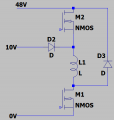
Simple schematic. No tetails.
Clost voltage is 48V for fast turn on.
The hold voltage is 10V or something chosen by you. (no PWM)
The release voltage is 48v-10v=38V so it will release fast. With a diode across the coil the release voltage is 0.6V so it takes a large amount of time for the current to ramp back down. 38V/0.6 about 40 times faster.
This will put the extra energy back in the 48V supply.
1729092282965.png
 

Thread Starter

Backyard

Joined Oct 15, 2024
16
Simple schematic. No tetails.
Clost voltage is 48V for fast turn on.
The hold voltage is 10V or something chosen by you. (no PWM)
The release voltage is 48v-10v=38V so it will release fast. With a diode across the coil the release voltage is 0.6V so it takes a large amount of time for the current to ramp back down. 38V/0.6 about 40 times faster.
This will put the extra energy back in the 48V supply.
View attachment 333779
I tried something similar but couldn't trigger M2 without a 60 volt supply to get the right VGS. It's my understanding that to use an N channel on the positive side you'll need higher then the supply voltage to trigger it. Unless there is some trickery that can overcome this limitation that I am unaware of...
 

ronsimpson

Joined Oct 7, 2019
4,647
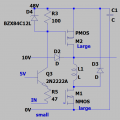
M2 pulls up all the loads.
M2 is turned on by pulling the Gate below 48V. A 12V to 15V Zener is for safety.
Q3 makes a current. If the Base is at 5V and IN is at 5V there will be no current in Q3. R3 turns off M2.
If IN is at 0V there will be 4.3V in R5 which will result in about 8.5V across R3, turning on M2. The reason I chose to Gate drive this way is that if 48V drops in voltage there will be good Gate voltage on M2. I think 48V could drop to 12V and still work.
1729102469457.png
 

Thread Starter

Backyard

Joined Oct 15, 2024
16
M2 pulls up all the loads.
M2 is turned on by pulling the Gate below 48V. A 12V to 15V Zener is for safety.
Q3 makes a current. If the Base is at 5V and IN is at 5V there will be no current in Q3. R3 turns off M2.
If IN is at 0V there will be 4.3V in R5 which will result in about 8.5V across R3, turning on M2. The reason I chose to Gate drive this way is that if 48V drops in voltage there will be good Gate voltage on M2. I think 48V could drop to 12V and still work.
View attachment 333791
What about the body diode in M2? Wouldn't current just bypass the mosfet through the diode and nullify it's purpose?
 

Thread Starter

Backyard

Joined Oct 15, 2024
16
Also, to add a little history and explanation as to why I believe I need both 48 volt and PWM. When I was first testing the solenoids I made a 5 amp boost converter to charge a bank of capacitors. Then had an N channel mosfet for the negative side switching. This did work for the most part. But turn off was a little slower then expected. But more importantly the solenoid and boost converter got hot.

One aspect of the boost converter is I was able to switch off the converters switch so current would flow through unboosted. This would give me a bank of capacitors at 48 volts and when I turned on the solenoid and turned off the boost converter it would deplete the capacitors and the voltage would drop down to the supply voltage of 12 volts. This worked except for the solenoid and converter ran hot.

So, my plan was to split the 48 volt line and 12 volt line and PWM the 12 volt. Then the turn on pulse could be trailered to be only as long as it needs to open the solenoid. Then the bost converter only has to restore the energy in the capacitors that was used instead of the whole bank. The PWM would then hold the solenoid at a lower current so as to reduce power and heating. With a benefit of quicker turn off.

But this is my issue. As I needed to be able to turn off the 48 volt supply and switch over to the PWM supply.
 

Thread Starter

Backyard

Joined Oct 15, 2024
16
A little caveat:
If you’re planning to run the PWM at 80 or even 20 Khz, the freewheeling diodes must be of the fast-recovery type.
In plain English, don’t use plain vainilla 1N400x diodes, use instead the UF400x variant.
I am currently using a schottky diode as indicated in the schematic. Aren't the inherently ultra fast?
 

MisterBill2

Joined Jan 23, 2018
27,182
The whole concept is confusing because going to the huge effort of slamming the solenoid at 4 times the design current to get it to "OPEN" something very rapidly. Then switch to PWM to hold it, when the total on time is given as one second. Then adding a diode to slow the release time, AND CERTAINLY that diode will slow the release time.
What we are not told is how frequently these devices are operated. Nor the actual operating movement time. Those times matter a great deal. AND, will they actually be held fully opened for one whole second?? Consider that the same instant that they are fully operated the holding current requirement is reduced, that would be the time to start ramping the current down, rather than PWM driving it. If the current were ramped back to zero over 50 to 100 milliseconds, the voltage spike would be a whole lot less and it could be ignored. Remember that V= L x (dI/dT) and if the time is stretched just a bit then the spike is a whole lot less.
 

Thread Starter

Backyard

Joined Oct 15, 2024
16
The whole concept is confusing because going to the huge effort of slamming the solenoid at 4 times the design current to get it to "OPEN" something very rapidly. Then switch to PWM to hold it, when the total on time is given as one second. Then adding a diode to slow the release time, AND CERTAINLY that diode will slow the release time.
What we are not told is how frequently these devices are operated. Nor the actual operating movement time. Those times matter a great deal. AND, will they actually be held fully opened for one whole second?? Consider that the same instant that they are fully operated the holding current requirement is reduced, that would be the time to start ramping the current down, rather than PWM driving it. If the current were ramped back to zero over 50 to 100 milliseconds, the voltage spike would be a whole lot less and it could be ignored. Remember that V= L x (dI/dT) and if the time is stretched just a bit then the spike is a whole lot less.
The snubber diode is only there during testing and hopefully won't be needed in the end. I'm just trying to protect the mosfets right now as I was getting some large voltage spikes when turning off. I'm hopping the PWM will reduce the current in the solenoid enough that it will lower the spike and not repeatedly drive the mosfets into avalanche.

There really isn't a "current spec" on the solenoids. They are listed as 48 V open and 12 V hold with PWM at 80kHz to reduce current. Not much information on them as they are discontinued or obsolete parts. So keeping them alive with reduced heat is important. We do have plenty of spares at this point bit don't want to burn any we don't have too. They are high speed solenoids designed to open and close very quickly and operate as quick or often as several times a second. The duration they are on and when they are on is controlled by the processor and we don't have the ability to alter this. It sends the commands as needed to open and close. I am just trying to make a circuit that can receive the main open and close commands and drive the solenoids with it. The original manufacturer has ceased any support for it long ago so we are stuck repairing and replacing parts as we can. The solenoid driver is one of them we are working on. Sorry if I can't give you more on what the machine does or what it's for.
 
Top