Disagree on that statement as worst case specs vary as just shown. I design for the actual part being used.
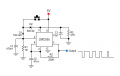
The TS results will vary depending on the chip used and component values can be adjusted as needed.
So, if a part in one of your designs should go bad and need to be replaced, you have to go back and redo the design for the actual part you happen to get as a replacement?
I know none of my customers would have been very happy with me if replacing a single chip with the same part number from the same vendor, but from a different lot, resulting in the system not working any more and them having to come back to me for me to redesign part of the system based on the specific behavior of the new part.
So, if a part in one of your designs should go bad and need to be replaced, you have to go back and redo the design for the actual part you happen to get as a replacement?
If I couldn't get the exact same part possibly. What's new about that scenario? What if a part in one of you designs becomes obsolete what are you going to do that's any different.
Let's be realistic here. I'm not making products for anyone but myself and this has been working just fine for 50 years.
And besides I posted another design using a LMC555 that should make everyone happy even you crutschow.
If I couldn't get the exact same part possibly. What's new about that scenario? What if a part in one of you designs becomes obsolete what are you going to do that's any different.
Note that I very specifically said the replacement was the same part number from the same vendor. I expect my designs to work with ANY part that meets the manufacturers specs, not just parts that happen to closely match the specific parts I had on hand when I did the design.
Let's be realistic here. I'm not making products for anyone but myself and this has been working just fine for 50 years.
That fine, except that in this case you did a design based on the actual part you happen to have and then seemed to expect it to work for someone else who didn't have parts from the same lot you did. If the TS's results can vary based on the specific part they happened to have, at least enough so that they have to go tweaking component values, then it's not a very good design (though it may well be good enough for the designer for their own use).
But I also noted in post #18 that the components values might need to be changed based on the chip the TS has on hand or needs to order.
The schematic is not written in stone. Modifications are made all the time
There is any way to simulate it before?I want to proof the concept to my boss, I cant find LMC555 in LTSpice
What is the main difference between them? That the Reset does not need to discharge to 0.4V? I can’t understand…
There are a number of differences between them, so of which are significant and others of very minor. You need to compare and contrast the two data sheets to see what they are and determine what does and doesn't apply to your situation.
You can access the data sheets for the TI parts here (and also simulation models):
One thing that I don't know if it has been mentioned or discussed, but the approach you are trying to use has one potential hiccup that may or may not be a major problem. The number of pulses you get it being determined by one timing element while the pulses themselves are being generated by another. This means that there is a good likelihood that you will not end up with an integer number of pulses, but rather that if you wanted, say, four pulses that you would end up with the fourth pulse being shorter than the others because the overall window expired too soon, or you might end up with a fraction of a fifth pulse because the overall window expired too late. So it's worth asking yourself if either of these situations is a deal breaker. If it is, then you need to devise a solution that doesn't have this flaw. If not, meaning that the performance of the system this is being used in can tolerate either or both cases, then you are in good shape.
Bob Pease, the renowned analog guru of National Semiconductor, once famously said that the best simulation program is a soldering iron.
A protoboard is even better.
Below is the sim of a more complex circuit that adds a counter to the 555 to give exactly 8 pulses, with no possibility of the last pulse truncation that WBahn mentioned.
It use a 555, a CD4049 inverter IC and a CD4017 counter IC.
The 555 includes pot U2, to adjust the output duty-cycle (shown set to the 50% point) as you also requested.
The switch S1 is connected to ground to start the sequence.
When S1 is closed (yellow trace) the counter is reset and the 555 output goes high (red trace).
When S1 is released the 555 generates 8 pulses and then the 9Out signal from the counter (green trace) sets the 555 Reset input low, stopping the 555 output low until the next S1 closure.
Bob Pease, the renowned analog guru of National Semiconductor, once famously said that the best simulation program is a soldering iron.
A protoboard is even better.
To each his own.
He seemed reluctant to embrace new things (he didn't like Fuzzy Logic either, as a replacement for analog PID control systems).
His preferred vehicle was a 1969 VM Beetle without a seatbelt which he was driving when he died in a head-on crash with a tree.
When S1 is released the 555 generates 8 pulses and then the 9Out signal from the counter (green trace) sets the 555 Reset input low, stopping the 555 output low until the next S1 closure.
I have brakes in system, when the brakes suddenly stop with logic 1/0 the brakes make the arm to swing, when I release the brakes as like PWM the swings more soft and user friendly.
This is a variation of my previous design using a LMC555.
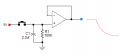
Instead of a series of constant duty cycle pulses this mod produces a PWM signal where the duty cycle decreases as C3 discharges through R3. Thus the average voltage declines possibly making a "more soft and user friendly" brake.
Not directly. I'm offering an option that might work better.
It's not just 4 pulses, that output waveform is only a representation of what it would look like.

 Facebook
 Google
 GitHub
 Linkedin