Help with AC motor wiring?

LesJones

Joined Jan 8, 2017
4,511
I don't think your diagram in post #54 is the way Max intends you to wire it.
Is the other end of the winding with one end A1 connectedto terminal A2 ?
You don't tell us which resistance readings relate to which windings.
I am guessing that.
A1 to ? is 1.5 ohms.
A3 to A4 is 1.5 ohms.
? to ? (Right hand winding.) is 3 ohms
Are these guesses correct ?
Is Z2 joined to a wire going to the switches ?
Is wire K connected to terminal marked KZ ?
Is one end of the 3 ohm winding connected to terminal KX ?
Is the other end of the 3 ohm joined to a wire going back to the switches ?
I my thinking the the wires K and Z2 are the centrifugal switch which has failed open circuit.
To confirm this you will have to dismantle the motor. You may be able to repair the centrifugal switch.
Is there an information plate on the outside of the motor. If so will you post a clear picture of it.

Les.
 
Last edited:

Thread Starter

elioti

Joined Mar 5, 2023
50
I don't think your diagram in post #54 is the way Max intends you to wire it.
Is the other end of the winding with one end A1 connectedto terminal A2 ?
You don't tell us which resistance readings relate to which windings.
I am guessing that.
A1 to ? is 1.5 ohms.
A3 to A4 is 1.5 ohms.
? to ? (Right hand winding.) is 3 ohms
Are these guesses correct ?
Is Z2 joined to a wire going to the switches ?
Is wire K connected to terminal marked KZ ?
Is one end of the 3 ohm winding connected to terminal KX ?
Is the other end of the 3 ohm joined to a wire going back to the switches ?
I my thinking the the wires K and Z2 are the centrifugal switch which has failed open circuit.
To confirm this you will have to dismantle the motor. You may be able to repair the centrifugal switch.
Is there an information plate on the outside of the motor. If so will you post a clear picture of it.

Les.
Hi Les, thanks, yes correct about the ohm readings. I disconnected the wires from the terminal block to test but luckily colour coded so later I'll drawn a diagram showing where each of the winding looms where connected, guess I'll be able to know where k and z2 were connected to. Thanks :)
 

Thread Starter

elioti

Joined Mar 5, 2023
50
OK Seems to make sense If I read it right, the two run windings are in series across the 240v and the common start winding is remotely reversed.
Yes I was just thinking, the two low windings correct, alternate the connections of the higher ohm winding to change direction? Reference the switch setup, I presume a live and neutral feed went from A4 and A1 ( the mains feed to the motor) to the switches that changed polarity then back to the start winding?
 

MaxHeadRoom

Joined Jul 18, 2013
30,684
Looking at the various pic's again, it would appear the start winding Z1, Z2 , is always in parallel with one of the main windings, A2 & A1, whether 120v or 240v ?
 

MaxHeadRoom

Joined Jul 18, 2013
30,684
No the way I see it, the start winding requires 120v, so it is either across the supply (120v) or in parallel with one of the series windings when connected to 240v, of which each series winding will have 120v across it.
 

Thread Starter

elioti

Joined Mar 5, 2023
50
No the way I see it, the start winding requires 120v, so it is either across the supply (120v) or in parallel with one of the series windings when connected to 240v, of which each series winding will have 120v across it.
Morning, thank you :) again, appreciate your help . Pretty sure the start winding was definitely connected to 240v. This could work as did? But ultimately destroy the windings? He initially wired it up after taking the motor to a shop in Plymouth, they drew him a diagram shotwherw wires had to go
 

LesJones

Joined Jan 8, 2017
4,511
I agree with Max that the start winding is always supplied with about the same voltage weather the windings are in series or parallel. I have only seen information on motors designed like this for the American market where the two required voltage ratings have a ratio of 2 : 1. Someone mentioned early in this thread that it may be designed for use in Europe for use between phase and neutral (240 volts) or phase to phase (415 volts.) a ratio of Root 3 to 1.
This is why I asked if there was an information plate on the motor that would confirm what the low and high coltage ratings are.
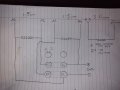
In you drawing the right hand end of the 3 ohm winding (Marked to switch) is Z1. The other end of this winding is connected to wire K at terminal KZ. The other wire Z2 would normally have continuity to one end of the 3 ohm (Start winding) via the centrifugal switch. So I believe that Z2 and K go the the centrifugal switch. As there ps no continuity between these two wires I believe that the centrifugal switch is open circuit. It should be cloase when the motor is stopped.
I think that this was probably the original fault. I thik your next step is to dismantle the motor to look at the centrifugal switch.
Can you confirm that when you mantioned Plymouth it is the one in the UK.

Les.
 

Thread Starter

elioti

Joined Mar 5, 2023
50
I agree with Max that the start winding is always supplied with about the same voltage weather the windings are in series or parallel. I have only seen information on motors designed like this for the American market where the two required voltage ratings have a ratio of 2 : 1. Someone mentioned early in this thread that it may be designed for use in Europe for use between phase and neutral (240 volts) or phase to phase (415 volts.) a ratio of Root 3 to 1.
This is why I asked if there was an information plate on the motor that would confirm what the low and high coltage ratings are.
In you drawing the right hand end of the 3 ohm winding (Marked to switch) is Z1. The other end of this winding is connected to wire K at terminal KZ. The other wire Z2 would normally have continuity to one end of the 3 ohm (Start winding) via the centrifugal switch. So I believe that Z2 and K go the the centrifugal switch. As there ps no continuity between these two wires I believe that the centrifugal switch is open circuit. It should be cloase when the motor is stopped.
I think that this was probably the original fault. I thik your next step is to dismantle the motor to look at the centrifugal switch.
Can you confirm that when you mantioned Plymouth it is the one in the UK.

Les.
Hi Les, I've eventually got my head around what you wrote, being that the motor wouldn't be run for long as for a car ramp, could I not wire up the start winding bypassing a clutch? It's a heavy lump and extremely difficult to take down as put up there with a tractor. I'll check the continuity again, but think I understand things now, it's likely definitely a clutch in there?
 

Janis59

Joined Aug 21, 2017
1,894
Sometimes exist, yet generally under 1/2 kW, motors wound with 90 deg between coils. Then one coil is named work-coil, it can be recognized to be those with smallest resistance and thicker wire. And other coil named the start coil, with small wire and larger resistance what is dedicated to few seconds long swithing, no more. That all on condensator-less motors.
 

LesJones

Joined Jan 8, 2017
4,511
A centrifugal switch is nothing like a clutch. It has a totally different function. The function of a centrifugal switch is to apply power (It's contacts closed.) to the start winding when the motor is stopped and to remove power from the start winding by openining it's contact when the motor reaches about 80% of it's rated rotational speed thus removing power to the start winding. This is totally different from a clutch which provided mecanical drive between an input shaft and output shaft which is controlled. For example the clutch on a car connects or removed the drive between the engine and the input of the gearbox. It MAY be possible to to dismantle the motor in position. The centrifugal switch is normally mounted on one of the end covers.

Les.
 

Thread Starter

elioti

Joined Mar 5, 2023
50
A centrifugal switch is nothing like a clutch. It has a totally different function. The function of a centrifugal switch is to apply power (It's contacts closed.) to the start winding when the motor is stopped and to remove power from the start winding by openining it's contact when the motor reaches about 80% of it's rated rotational speed thus removing power to the start winding. This is totally different from a clutch which provided mecanical drive between an input shaft and output shaft which is controlled. For example the clutch on a car connects or removed the drive between the engine and the input of the gearbox. It MAY be possible to to dismantle the motor in position. The centrifugal switch is normally mounted on one of the end covers.

Les.
Thanks Les, i used the wrong wording, was meant to put centrifugal switch. Yesterday I connected up the start winding to the connections on the other two windings, it now works :) So I'm guessing to change direction, I just invert the polarity of the start windings. So maybe there is no centrifugal switch, or that it works. So thinking back , reference the switch setup, the switches just changed polarity to the start windings. There's a direct mains feed to the motor via an on off switch. This mains feed is connected to the two run windings. Then a mains feed ( 240v) taken from the motor to the switches to invert polarity back to the start winding. No drop to 120v , and no change from parallel to series. It worked like this for years,only failed due to the switch setup ( pressing a switch the wring way). Maybe the fact that is only run for short periods at a time ( for a car ramp) that its ok? Happy to get it going again, I may have not done it correctly but it works :)
 

LesJones

Joined Jan 8, 2017
4,511
You are correct that the motor is reversed by changing the polarity of the start winding with respect to the main winding. It could be that the centrifugal switch was never connected in circuit OR it could be that it was originally connected but failed open circuit which is when the wiring to the switches was disconnected to try to diagnose why the motor would not start.
I am assuming when you say th on / off switch that you mean the switch on the switched fuse box. you only need two of the double pole circuit breakers to do the polarity reversal so I assumed that the third one was used as an on / off switch. I now think it may have been used to switch off the feed to the start winding once the motor had started. This would make sense if the centrifugal switch had allways been faulty. The way that it is wired is VERY BAD PRACTICE. I think you should get it wired properly using interlocked forward and revrse contactors or at the very least using a proper DPCD reversing switch. It is over 50 years since I woked as an electician in a factory so I dont know exactly what the current regulations are. I am sure that the way you have it wired would have never met the regulations.

Les
 

Thread Starter

elioti

Joined Mar 5, 2023
50
You are correct that the motor is reversed by changing the polarity of the start winding with respect to the main winding. It could be that the centrifugal switch was never connected in circuit OR it could be that it was originally connected but failed open circuit which is when the wiring to the switches was disconnected to try to diagnose why the motor would not start.
I am assuming when you say th on / off switch that you mean the switch on the switched fuse box. you only need two of the double pole circuit breakers to do the polarity reversal so I assumed that the third one was used as an on / off switch. I now think it may have been used to switch off the feed to the start winding once the motor had started. This would make sense if the centrifugal switch had allways been faulty. The way that it is wired is VERY BAD PRACTICE. I think you should get it wired properly using interlocked forward and revrse contactors or at the very least using a proper DPCD reversing switch. It is over 50 years since I woked as an electician in a factory so I dont know exactly what the current regulations are. I am sure that the way you have it wired would have never met the regulations.

Les
Hi Les, thanks. Do appreciate what you're saying, but it's for private home use, do understand perhaps bad practice . Eventually will wire up properly but in the mean time would be good to get going with the switches already have as need weld my old car for it's not soon. Would there be any chance to tell me how to wire up with the two double pole switches as you say please?. I'm sat looking at a wiring diagram of the existing setup, and with a diagram of two switches as you say but I can't get my head around it. There are infact 4 switches in all. A mains feed off on fuse switch to the motor that feeds back to 3 more switches that change polarity. I was thinking aswell at one point only needed two switches, but as I say I can't figure it out now. If at all possible to tell me how to wire with the two double pole switches please. Do appreciate the time you've already spent helping. Would be good also if someone could tell me the cheapest way to operate it properly, money often a little tight that's all. Thanks again much , Eliot
 
Top