Help with AC motor wiring?

LesJones

Joined Jan 8, 2017
4,511
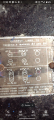
The black and earth colour wires exit the motor connector box. (I assume to the switch unit.) Z1 and Z2 are two wires that come from inside the motor. (The ends of the start winding.) If you look at the picture in post #1 you will see that they would normaly be connected terminal A2 and the unmarked bottom right terminal. The note on the left of the picture tells you to swap them over to reverse the direction of the motor. If the two wires that are taped up are just the ends of two wires from inside the motor and not connected to anything then I don't see how it could have ever worked.

Edit. Where I said "the unmarked bottom right terminal" I should have said terminal A1. (I had seen the letter Z aginst the the bottom right terminal and assumed it was Z2)

Les.
 
Last edited:

Thread Starter

elioti

Joined Mar 5, 2023
50
The black and earth colour wires exit the motor connector box. (I assume to the switch unit.) Z1 and Z2 are two wires that come from inside the motor. (The ends of the start winding.) If you look at the picture in post #1 you will see that they would normaly be connected terminal A2 and the unmarked bottom right terminal. The note on the left of the picture tells you to swap them over to reverse the direction of the motor. If the two wires that are taped up are just the ends of two wires from inside the motor and not connected to anything then I don't see how it could have ever worked.

Edit. Where I said "the unmarked bottom right terminal" I should have said terminal A1. (I had seen the letter Z aginst the the bottom right terminal and assumed it was Z2)

Les.
Hi Les, I'll take another look shortly. The two wires that are taped up, if not connected to anything on the joints on the motor, could have been connected at the switch end to the existing connected wires at the switch?
 

MaxHeadRoom

Joined Jul 18, 2013
30,684
You need to remove the straps and detect the three or four separate windings, Record their resistance.
Do you know if it has a internal centrifugal switch, The one common failure symptom is having to spin it at switch on.
 

Thread Starter

elioti

Joined Mar 5, 2023
50
You need to remove the straps and detect the three or four separate windings, Record their resistance.
Do you know if it has a internal centrifugal switch, The one common failure symptom is having to spin it at switch on.
Thanks I wouldn't know if has a centrifugal switch, though it was working with the 4 wires connected, now only 2.
 

MaxHeadRoom

Joined Jul 18, 2013
30,684
As per your post #9, If these are for selecting fwd/reverse, then the straps would have to have been removed and then replaced by the switch contacts
 

Thread Starter

elioti

Joined Mar 5, 2023
50
As per your post #9, If these are for selecting fwd/reverse, then the straps would have to have been removed and then replaced by the switch contacts
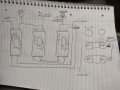
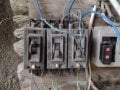
I've some more info, I've drawn a wiring diagram. I can write clearer if needed. There's a mains power switch to make work after setting the 3 switches to correct positions. The mains power switch live goes to A4, neutral to A1. Can see from the diagram the two taped wires go direct to motor windings , not to joints. With regards to the switch setup, not sure what he was doing ( guess you'll probably work out) but had to set the first switch in up position, the other two in down position, hit power and would go down. Flick all switches then power to go up. I note from the diagram, the first switch is connected to A1 which is connected to 240v neutral, but the 240v positive is connected to a loose wire that was connected to one of the three switches I presume, as the switches have no live feed? He melted a wire by putting all the switches in the same direction, problems since. He said should have turned the first switch 180 degrees then less likely to make a mistake. He worked out the switch setup after being given a diagram from a chap in a shop years ago after showing him the cover. No he's forgotten what he did
 

Attachments

MaxHeadRoom

Joined Jul 18, 2013
30,684
What I would do is attempt to start from scratch, IOW, remove the straps, and measure/detect the 3? different windings, normally you would see 2 that are the same resistance and one higher resistance.
If it is in fact a 120v/240v motor then the two low resistance ones would be in series, across the supply, together with the 3rd hi-res winding.
Do a quick test to see if it runs OK first..
 

Thread Starter

elioti

Joined Mar 5, 2023
50
What I would do is attempt to start from scratch, IOW, remove the straps, and measure/detect the 3? different windings, normally you would see 2 that are the same resistance and one higher resistance.
If it is in fact a 120v/240v motor then the two low resistance ones would be in series, across the supply, together with the 3rd hi-res winding.
Do a quick test to see if it runs OK first..
Hi, ok thanks I'll do that :)
 

Thread Starter

elioti

Joined Mar 5, 2023
50
What I would do is attempt to start from scratch, IOW, remove the straps, and measure/detect the 3? different windings, normally you would see 2 that are the same resistance and one higher resistance.
If it is in fact a 120v/240v motor then the two low resistance ones would be in series, across the supply, together with the 3rd hi-res winding.
Do a quick test to see if it runs OK first..
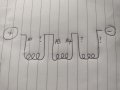
Hi :) I've got some readings, disconnected the terminal as you said. There are 8 wires in all. 3 sets give the following reading when the meter was put on the 200 ohm setting. 1.5,1.5 and 3. The two remaining wires were labelled K and Z2, I did a continuity test between them and the other wires, nothing, or no continuity between themselves . Unsure about these, but when you say connect the 3 sets up, I didn't want do it wrong so drew a diagram, is this right please? On the diagram I've labelled 3 of the wires that had A1, A3 and A4 on them. I couldn't tell the others. Thank you :)
 

Attachments

MaxHeadRoom

Joined Jul 18, 2013
30,684
It would seem that the two identical ones are the run windings, and if so would be wired either in series or parallel for the two voltage ranges, the third higher value winding would be the start winding, and is usually across the supply, if no other element such as start cap is needed.
You could see if this jives with the connections when wired in the motor terminal box.
Reversal is usually achieved by reversing either of the windings, start or run.
It would help if the source of the open pair are known?
.
 

Thread Starter

elioti

Joined Mar 5, 2023
50
It would seem that the two identical ones are the run windings, and if so would be wired either in series or parallel for the two voltage ranges, the third higher value winding would be the start winding, and is usually across the supply, if no other element such as start cap is needed.
You could see if this jives with the connections when wired in the motor terminal box.
Reversal is usually achieved by reversing either of the windings, start or run.
It would help if the source of the open pair are known?
.
Thanks :) without stripping the motor, it's difficult to tell where the open wires k and z2 go. Just to test the motor, could I wire up as in my previous drawing please? When you say " across the supply", I'm not really sure what you mean, sorry for sounding a bit daft!.
 

MaxHeadRoom

Joined Jul 18, 2013
30,684
You could also confirm it by tracing the strap connections to the various windings.
IOW, draw the relationship of the straps to the windings.
 
Top