Facebook
 Google
 GitHub
 Linkedin
Hi All,
Thank you for taking a look.
I used TI webench for AC/DC power design and entered the following criteria:
VAC (RMS) min: 22
VAC (RMS) max: 26
VDC out: 24
Iout: 2A
I selected
UCC28C45
because it is one of the only designs that put a part number for T1, all others don't give a part number and I don't feel I can reliably select one.
Can you suggest if this is an appropriate design but more importantly, can you answer my question below:
How do I connect the transformer T1 as it is in the schematic? The part number from the BOM (VPH5-0083-R) has 6 coils, 3 on each side. Pictured below. The webench schematic shows only 3 coils, 2 on left and 1 on right and the orientation dots are reversed on the left side coils. No pin numbers. Thank you for your help.
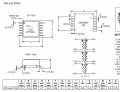
Picture from VPH5 data sheet (above)
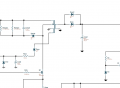
Picture from webench, closeup of T1 (above)
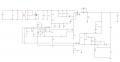
Picture from webench of overall AC/DC schematic.
Thank you for taking a look.
I used TI webench for AC/DC power design and entered the following criteria:
VAC (RMS) min: 22
VAC (RMS) max: 26
VDC out: 24
Iout: 2A
I selected
UCC28C45
because it is one of the only designs that put a part number for T1, all others don't give a part number and I don't feel I can reliably select one.
Can you suggest if this is an appropriate design but more importantly, can you answer my question below:
How do I connect the transformer T1 as it is in the schematic? The part number from the BOM (VPH5-0083-R) has 6 coils, 3 on each side. Pictured below. The webench schematic shows only 3 coils, 2 on left and 1 on right and the orientation dots are reversed on the left side coils. No pin numbers. Thank you for your help.
Picture from VPH5 data sheet (above)
Picture from webench, closeup of T1 (above)
Picture from webench of overall AC/DC schematic.