Help understanding forward current in 3W RGB LED

Thread Starter

Sfantry

Joined Apr 25, 2020
16
Track down information about similar LED modules and read up on what they have to say about proper thermal management.
I have already started looking. Once I figure out what my power requirements are for the LED, I can determine how much dissipation I will need and will start those calculations next. Thanks for your help!
 

ElectricSpidey

Joined Dec 2, 2017
3,336
I'm curious, did you order the discrete LED COBs or mounted on the 20mm star spreaders?

If you are using the discrete COBs and plan to simply sink them on a PCB, I would limit the current quite a bit, maybe 100mAs max with a large area.

If you are planning to go anywhere near the max current, I hope you are using the ones already mounted on spreaders, and are ready to use a rather large heatsink.
 
Last edited:

Thread Starter

Sfantry

Joined Apr 25, 2020
16
I'm curious, did you order the discrete LED COBs or mounted on the 20mm star spreaders?

If you are using the discrete COBs and plan to simply sink them on a PCB, I would limit the current quite a bit, maybe 100mAs max with a large area.

If you are planning to go anywhere near the max current, I hope you are using the ones already mounted on spreaders, and are ready to us a rather large heatsink.
I purchased the individual COBs not already on a PCB. I was planning on designing my own PCB for them. I was thinking I would have to have a large PCB copper pad under it and on the back side of the PCB connected with vias, and with a heat sink mounted to the back. Since I want to have 9 LEDs close together, I was thinking a single large heat sink with a fan that covered the whole area.
 
Last edited:

Thread Starter

Sfantry

Joined Apr 25, 2020
16
So i have been running some calculations. I have looked at a 5V supply and chose resistors to limit current to approximately 500 mA per segment of the LED. If these calculations are correct, each LED will use roughly 1.55 A and will have to dissipate 3.26 W.

Below is the chart that I made with the resistor value chosen for 500 mA, and then I looked at the nearest available resistor value and calculated the power dissipation and current based on the available resistor selection.
With 5V supplyResistor Value
(Ω Ohms)
Dissipation
(Watts)
Avail Value
(Ω Ohms)
Dissipation
(Watts)
Current
(mA)
3W RGB LED @ 500 mA
Red: 2.1 Vf
5.8​
1.45​
5.6​
1.5​
518​
Green: 3.3 Vf
3.4​
0.85​
3.3​
0.88​
515​
Blue 3.3 vF
3.4​
0.85​
3.3​
0.88​
515​

For power, I thought that I would use an LM1084IS-5.0 or LM1084IS-ADJ set to 5V. Datasheet here: http://www.ti.com/lit/ds/symlink/lm1084.pdf. These regulators can output up to 5A, so I would like to power 3 LEDs per regulator (4.65 A required for the 3 LEDs according to the calculations above).

This all sounds pretty reasonable to me, but If anyone sees something that looks wrong, feel free to let me know. Thanks to everyone for their input.
 

ElectricSpidey

Joined Dec 2, 2017
3,336
Be aware that with matching currents the green LED will be brighter than the other 2 with the blue bringing up the rear. (dimmest)

So if you plan on creating secondary or tertiary colors from standard RGB mixtures, you may want to experiment with the currents until you get matching brightness from the LEDs.

Of course if you just mix them on the fly or don't plan to mix at all, then you need not match the brightness.
 

WBahn

Joined Mar 31, 2012
32,898
You have three power dissipations that you need to consider: How much power is your regulator dissipating, how much power are your resistors dissipating, and how much power are your LEDs dissipating. Don't ignore any of them.

Also, there are better driver techniques for high power LEDs than a linear voltage regulator and current limiting resistor. Look into any of the many switch-mode constant current regulators specifically designed for driving high power LEDs.
 

Thread Starter

Sfantry

Joined Apr 25, 2020
16
Be aware that with matching currents the green LED will be brighter than the other 2 with the blue bringing up the rear. (dimmest)

So if you plan on creating secondary or tertiary colors from standard RGB mixtures, you may want to experiment with the currents until you get matching brightness from the LEDs.

Of course if you just mix them on the fly or don't plan to mix at all, then you need not match the brightness.
Good point. I was wondering this, actually. I wasn't sure if just matching currents would match brightnesses but I am not sure how to measure brightness other than with my eye, which is not very technical.
 

Thread Starter

Sfantry

Joined Apr 25, 2020
16
You have three power dissipations that you need to consider: How much power is your regulator dissipating, how much power are your resistors dissipating, and how much power are your LEDs dissipating. Don't ignore any of them.

Also, there are better driver techniques for high power LEDs than a linear voltage regulator and current limiting resistor. Look into any of the many switch-mode constant current regulators specifically designed for driving high power LEDs.
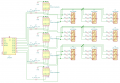
I will need to do some more research before I determine the best way to drive these LEDs. I was thinking of using an LP5009 (https://www.ti.com/lit/gpn/lp5009). I want to have 3 LEDs connected in parallel to be controlled together, so basically output 1, 2, and 3 from the LP5009 would be for R, G, and B of the first row of 3 LEDs. Because the LP5009 cant handle the current, I thought I would use MOSFETS to switch the higher power. Its a little confusing to type out, so here is a partially finished schematic that I'm working on.
1588281713554.png
 
Top