Help understanding DTL NAND gate

Thread Starter

xso111

Joined Oct 12, 2017
24
this is the schematic for the DTL NAND gate in my lesson.
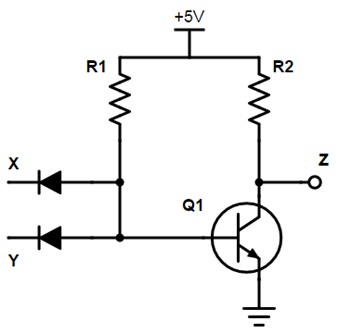

from what i understood from the explanation when the 2 inputs are both 0/low the diodes are on, but the transistor is in cutoff because the input only provides 0V for the base of the transistor. When the 2 inputs are in 5V/high the 2 diodes are off, but the VCC provides the needed voltage for the base of the transistor to put it in saturation.


if the 2 inputs are 0/low and the diode is on why can't the Vcc provide the necessary voltage for the base like what it does when the 2 inputs are 5v/high?
 

ebp

Joined Feb 8, 2018
2,332
This looks like homework help, where answers usually are "what do you think ...", but in this case it is quite clear you understand the intent of the circuit.

You are quite right. When the cathode of either diode is connected to ground, there may be sufficient voltage at the base to allow some conduction of the transistor. It comes down to a question of forward voltage of the diode(s) versus Vbe of the transistor and though they are all approximately the same they cannot be predicted precisely and vary from unit to unit.

The simple circuit is insufficient to make a good gate.

Now for the homework help approach:
What would happen if the inputs were driven with the output of another gate?
Can you think of ways to improve the circuit for better-defined behavior? Hint - you are allowed additional part(s).
 

crutschow

Joined Mar 14, 2008
38,513
Yes, that circuit is marginal as shown and would not be built for actual use.
It needs some additional parts for reliable operation, as ebp stated.
 

WBahn

Joined Mar 31, 2012
32,852
this is the schematic for the DTL NAND gate in my lesson.


from what i understood from the explanation when the 2 inputs are both 0/low the diodes are on, but the transistor is in cutoff because the input only provides 0V for the base of the transistor. When the 2 inputs are in 5V/high the 2 diodes are off, but the VCC provides the needed voltage for the base of the transistor to put it in saturation.


if the 2 inputs are 0/low and the diode is on why can't the Vcc provide the necessary voltage for the base like what it does when the 2 inputs are 5v/high?
If one of the inputs is at 0 V, what will the voltage at the base of the transistor be? It will be clamped at about one diode-voltage drop. To first approximation, this is also the same as the Vbe voltage drop when the transistor is turned on in the active region. So what state is the transistor in? It's really unknown.

But now let's say that you had to implement this circuit and had no choice but to use this topology. First, you would pick a value of R1 that was as large as you could make it and still get the output to be acceptably LO when both X and Y are HI. That means that and current that is steered away from the base by either diode will quickly reduce the drive of the transistor and raise the output. The next thing you would do is size the diodes such that their forward voltage drop is considerably less when conducting all of the R1 current than what the Vbe of the transistor is at that same current. That's not hard to do. It's a lot easier if you use Schottky diodes, but that's not what is being used here.

The real challenge is that the input isn't going to be a hard 0V, but rather the saturation voltage resulting from a LO from another gate similar to this one. That makes the design decisions a lot more tricky if you are going to use this topology. However, there is a very simply way to get reliable performance from this circuit and it only involves adding two resistors. Can you see how to do it?
 

Bordodynov

Joined May 20, 2015
3,431
Everything can be much simpler! The main one, so that the direct voltage drop across the diode was less than the base-emitter voltage by about 400 mV. This can be done by using the Schottky diodes. for example use BAT54.
Draft7.png
 

ebp

Joined Feb 8, 2018
2,332
While one might use Schottky diodes in a circuit built with discrete devices, they are incompatible with the basic fabrication process that was used for DTL ICs. A larger improvement can be produced with a process-compatible modification. (Even resistors are something to be avoided because they take a lot of area on the IC die.)
 

Bordodynov

Joined May 20, 2015
3,431
Schottky diodes are very easy to obtain in any basic bipolar process. It is sufficient to open contact over a highOhm collector area (without using additional phosphorus ligation). To reduce leakage, it is possible to use a guard ring from Borom along the perimeter of the Schottky diode. I got Schottky diodes with unique parameters and in technology with complementary field-effect transistors (CMOS).
 
Top