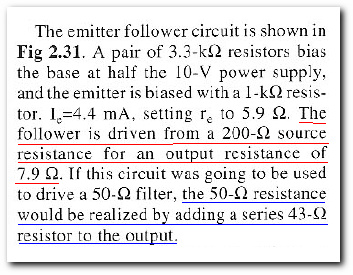
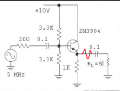
It's the output resistance of the emitter follower, calculated from the intrinsic emitter resistance (dependent on the emitter current), the emitter resistor, and the 3 resistors on the input of the transistor (including the 200 ohm source resistance) divided by the transistor beta.Hi
For the first red sentence, I do not understand where the value 7.9 ohm is came from?
Since it's supposed to drive a 50 ohm circuit, it must be for the purpose of impedance matching (7.9 + 43). I suppose this would be to reduce signal reflection or something, since there's not a lot of power involved.The same for the second blue sentence 43 ohm?
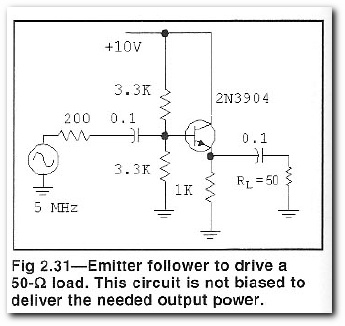
Please show me how the 3 resistors on the input of the transistor (including the 200 ohm source resistance) divided by the transistor beta = 2 ?? (Let beta = 100)It's the output resistance of the emitter follower, calculated from the intrinsic emitter resistance (dependent on the emitter current), the emitter resistor, and the 3 resistors on the input of the transistor (including the 200 ohm source resistance) divided by the transistor beta.
Thank you(200||3.3k||3.3k)/100 = 1.8. Close enough.
I can not imagine it in parallel. Can you help me so that I can be convinced it is in parallel?Actually, the 200 ohm resistor is in parallel with the 3.3k resistors.
It's resistance is not so much lower than the others: 1650/200 = 8.25 . In electronics, to be so much it must be ten times lower!A good estimate of resistance is to consider the 200 ohm resistor by itself, since it's resistance is so much lower than the others.
200/100 = 2 ohm added to 5.9The reason books don't mention it is because source resistance is usually so high that it doesn't need to be considered.
In the analysis, set all independent sources to zero. Redraw the circuit, and you'll see why it's in paralle.I can not imagine it in parallel. Can you help me so that I can be convinced it is in parallel?
The other two resistors are 3.3k. 3.3k/200 = 16.5It's resistance is not so much lower than the others: 1650/200 = 8.25 . In electronics, to be so much it must be ten times lower!
Source resistance is typically several tens to hundreds of K ohms. But is this case, 200 ohms must be considered.200/100 = 2 ohm added to 5.9
if it is usually so high In this case, it becomes unreasonable ignored. I mean, it's become big to the point that ignoring it makes the calculations inaccurate
thank you very much
Yes, now I understand, thank youIn the analysis, set all independent sources to zero. Redraw the circuit, and you'll see why it's in paralle.
The other two resistors are (3.3k//3.3K) = 1.65KThe other two resistors are 3.3k. 3.3k/200 = 16.5
Let Source resistance (Rs) = 6kSource resistance is typically several tens to hundreds of K ohms. But is this case, 200 ohms must be considered.
thank you very muchClose, it's (12.9 + re) || Re.
But (1.65k/beta)/(200/beta) = 1.65k/200 = 8.25. Further 3.3k || 3.3k || 200 = 178.4. The error in estimating it at 200 is a little over 10%.The other two resistors are (3.3k//3.3K) = 1.65K
1.65k/ beta = 16.5
16.5//(200/beta) = 16.5//2 =1.8 ,,,,,,,,,, it is ok
Thank you very muchThey do when output impedance needs to match load impedance.
BTW, in post #9, you wrote:
But (1.65k/beta)/(200/beta) = 1.65k/200 = 8.25. Further 3.3k || 3.3k || 200 = 178.4. The error in estimating it at 200 is a little over 10%.
Thank you very muchSimply put a 43 ohm resistor in series with 100nF output capacitor.
Who said I want to complicate things!!!!No reason to complicate things so just use the resistor.
Ok thanksThat was proper answer.In practice you would go with something that is simple but at the same time does the job properly.That's why IC exist.