Help me please with some parts in the Schematic

Thread Starter

AQAE

Joined Sep 4, 2025
5
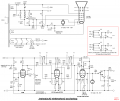
Hello everybody. I'm trying to build this analog scope and I'm a little unsure about some parts in it.
1000052329.png
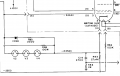
There are those two parts marked as
DT Uzáp = 100-120V
DT Uzáp = 50-80V
I've searched a lot and think they are neon tubes?
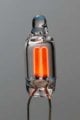
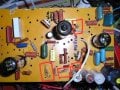
1000053136.jpg
I can find several to buy but how to know the working voltage? 100-120v / 50-80v
I've read about them and most likely the working voltage can be determined from its dimensions. But how can I be sure about the exact value.
The other part is that circle with a cross in. It marked mini bulb.
The schematic is from this web page;
https://danyk.cz/osc_en.html
Any help would be appreciated.
 

sagor

Joined Mar 10, 2019
1,046
The schematic symbol seems to indicate a cold cathode voltage regulator tube like the OC2. There are several different ones with different voltage ranges like OB3 90V, OC3 108V, OD3 150V.
OA3 is a 75V tube, OC2 is 72V, OB2 108V
They would all need some form of current limiting, which seems to be missing in the schematics.

That all said, it could also be a neon tube used as an over voltage protection device.

EDIT: Further investigation suggests it is a neon tube of some sort. Cold Cathode tubes have a cathode symbol of a dot, not a line.
 
Last edited:

Thread Starter

AQAE

Joined Sep 4, 2025
5
Thank you for your reply.
I pretty much believe that they are neon tubes.
The writer has shared several photos of the circuit he made on the website. (I've mentioned the address)
osc6.jpg
In his PCB you can see several neon lamps but the problem is that they sell neon tubes without any specifications but size (big, small, etc). Just regular neon tubes you find in phase detector screw drivers or raker switches.
I've just found 1 online shop that notes voltages for each one
https://www.svetziaroviek.sk/svetziaroviek-sk/eshop/86-1-Tlejivky
But another problem is that you can't buy things internally here in my country. Only local shopping. So I'm hoping there is a way to test these neon tubes to spot their working voltages.
 

ericgibbs

Joined Jan 29, 2010
21,395
I've read about them and most likely the working voltage can be determined from its dimensions. But how can I be sure about the exact value.
Hi AQ,
They are simple gas discharge tubes/valves used to clamp an excess voltage between two circuit nodes.
The tube, on the CRT Cathode to control Grid, will conduct when the voltage across these two points exceeds the rated voltage of the tube.
The 'brightness' control and its series resistor will limit the tube current.

The other gas discharge tube will clamp any excess voltage between the grid to the Cathode on the ECC85.

If you buy spare gas tubes, you easily determine the clamp voltage by testing them on the bench, by using a suitable power supply and a series dropping resistor, say a 470K to 1meg, 1W.
Measure the voltage across the tube.

E
 

Thread Starter

AQAE

Joined Sep 4, 2025
5
Hi there. Thank you so much. I completely understand that parts of the circuit. So helpful.
Could you please take another look at the other parts? The "mini bulb" I don't know what to place there. Is it just a power-on indicator?
The other part is the transformer, The first secondary winding converts 230 to 240 volts. Is that just an insulation from the city network? Should it output somehow precisely 240V? I measure 224 volts here in my city. Do I need to modify a transformer to achieve that?
Hi AQ,
They are simple gas discharge tubes/valves used to clamp an excess voltage between two circuit nodes.
The tube, on the CRT Cathode to control Grid, will conduct when the voltage across these two points exceeds the rated voltage of the tube.
The 'brightness' control and its series resistor will limit the tube current.

The other gas discharge tube will clamp any excess voltage between the grid to the Cathode on the ECC85.

If you buy spare gas tubes, you easily determine the clamp voltage by testing them on the bench, by using a suitable power supply and a series dropping resistor, say a 470K to 1meg, 1W.
Measure the voltage across the tube.

E
 

ericgibbs

Joined Jan 29, 2010
21,395
The "mini bulb" I don't know what to place there. Is it just a power-on indicator?
Hi AQ,
You are correct the mini-bulb is just a Scope Powered ON indicator, a 6V 0.15A lamp bulb, [ bicycle lamp] either a screw type or wired ended would be OK, mounted on the front panel of the Scope.

E
 

ericgibbs

Joined Jan 29, 2010
21,395
The other part is the transformer, The first secondary winding converts 230 to 240 volts. Is that just an insulation from the city network? Should it output somehow precisely 240V? I measure 224 volts here in my city. Do I need to modify a transformer to achieve that?
hi AQ,
The 230V~ transformer winding is connected to your local mains supply of 224Vac, remember to use a fused mains supply input.

The transformer should work OK with 224V, it is only 224v/230v = 0.97 ratio, that is a reduction of ~3%, so the output windings of 6.3V and 240V will be close enough not to cause any problems.

E
BTW: 'DT' on the circuit diagram indicates a Discharge Tube.

@AQAE
Added: DT PDF
 

Attachments

Last edited:

Thread Starter

AQAE

Joined Sep 4, 2025
5
BTW: 'DT' on the circuit diagram indicates a Discharge Tube.

man! You are a true scientist.
You've decoded "DT" and I find it so interesting making me read about them and yeah! The schematic is becoming more and more clear to me.
The symbol which a circle (a tube), two plates (electrodes) and a dot (means it is filled with a type of gas) is indeed a Discharge Tube (DT). A gas discharge tube. Then we've got "Uzáp = 50-80V / 100-120V". Because of some reason, in Czech they use U instead of V to address voltage. And "záp" means snapp/ignition (correct me if im wrong) so finally as you told, those are Discharge Tubes with threshold voltages around the given values.
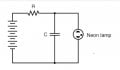
Also, I find a very nice description about DTs here in this Article. Looks like the symbol indicates neon lamps where the threshold voltage depends on the gas pressure and geometry of the lamp.
1000053668.jpg
I don't think I can find these lamps with the specific characteristics. But the parts you've addressed (GDTs) are good candidates. Thank you very much.
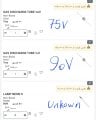
Unfortunately I couldn't find parts with the exact specs but I hope these would make it.
1000053670.jpg
 
Top