Facebook
 Google
 GitHub
 Linkedin
Swapping R1 & R2 along with using a PNP for Q2 will work too. Maybe even better.
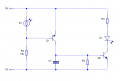
The beam will hold R2's resistance low, keeping a high current present on the base of a PNP transistor. When the beam drops out the base of Q2 should go low enough to conduct, thus, charging C1. If charge rate is of concern, add an additional resister in series with C1 to prevent the sudden rush into the capacitor. R3 will still be needed to drain C1 when the beam returns. Otherwise, like I said, the gate of Q1 will act as its own capacitor and tend to hold its state. With the addition of C1 the period in which the gate remains saturated will be greatly extended. That's why you need to pull the gate low with R3.
The original circuit (without the blue addition) held the gate (of Q1) low when the beam was present but sent the gate high when the beam disappeared.
I like the circuit - mostly. However, ambient light could also hold the resistance of R2 quite low. In the dark dank dungeon of my work shop the circuit would work great. But in the real world of my kitchen table I doubt the circuit would be as effective. But I guess because I haven't built the circuit myself to actually test it in the real world.
Perhaps using the IR LED's from an old TV remote along with an IR Receiver (IR = Infra Red) would work more reliably in the presence of strong background light.
And my circuit was a basic block build, not the absolute resolution of the problem. Using a transistor to charge a capacitor will give you the delay time to turn the LED off after the beam is restored. Using different values of capacitors and resistors create the RC Time circuit you need to hold the LED on for any set period of time. And like someone before me said, the LED won't be "LIT" then "GO OUT"; it will "Dim till it goes out". The MOSFET will act like a valve. As the capacitor's charge diminishes the gate will slowly close and slowly pinch off the current from the LED.
My gift is "Concept" on how to solve the problem. Your job is to engineer exactly what you want. I only hope to have given you some direction. But you COULD use an Op Amp configured as a comparator. A diode to block reverse grounding so the cap can discharge through a resistor. There are LOTS of ways to build your circuit. My idea was just one quick and dirty way of solving a problem.
The beam will hold R2's resistance low, keeping a high current present on the base of a PNP transistor. When the beam drops out the base of Q2 should go low enough to conduct, thus, charging C1. If charge rate is of concern, add an additional resister in series with C1 to prevent the sudden rush into the capacitor. R3 will still be needed to drain C1 when the beam returns. Otherwise, like I said, the gate of Q1 will act as its own capacitor and tend to hold its state. With the addition of C1 the period in which the gate remains saturated will be greatly extended. That's why you need to pull the gate low with R3.
The original circuit (without the blue addition) held the gate (of Q1) low when the beam was present but sent the gate high when the beam disappeared.
I like the circuit - mostly. However, ambient light could also hold the resistance of R2 quite low. In the dark dank dungeon of my work shop the circuit would work great. But in the real world of my kitchen table I doubt the circuit would be as effective. But I guess because I haven't built the circuit myself to actually test it in the real world.
Perhaps using the IR LED's from an old TV remote along with an IR Receiver (IR = Infra Red) would work more reliably in the presence of strong background light.
And my circuit was a basic block build, not the absolute resolution of the problem. Using a transistor to charge a capacitor will give you the delay time to turn the LED off after the beam is restored. Using different values of capacitors and resistors create the RC Time circuit you need to hold the LED on for any set period of time. And like someone before me said, the LED won't be "LIT" then "GO OUT"; it will "Dim till it goes out". The MOSFET will act like a valve. As the capacitor's charge diminishes the gate will slowly close and slowly pinch off the current from the LED.
My gift is "Concept" on how to solve the problem. Your job is to engineer exactly what you want. I only hope to have given you some direction. But you COULD use an Op Amp configured as a comparator. A diode to block reverse grounding so the cap can discharge through a resistor. There are LOTS of ways to build your circuit. My idea was just one quick and dirty way of solving a problem.
Last edited: