Facebook
 Google
 GitHub
 Linkedin
Hi everyone,
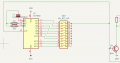
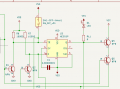
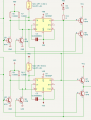
I'm working on my first ever circuit and PCB board for an automatic watering project that requires a long on/off time delay relay controller. I could really use some guidance from this knowledgeable community.
Project Overview:
I know I haven't explained everything in detail, but I plan to make a follow-up comment with my thought process behind each part of the circuitry so you can understand what I'm trying to achieve.
Best regards,
Nik
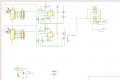
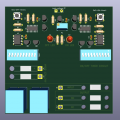
I'm working on my first ever circuit and PCB board for an automatic watering project that requires a long on/off time delay relay controller. I could really use some guidance from this knowledgeable community.
Project Overview:
- Objective: To design an on/off timer circuit that can manage long on/off time delays.
- Requirements:
- On Time: Separately adjustable from the off time. Currently, I'm planning to set a frequency and use a binary ripple counter (CD4060) to divide it, effectively making the frequency much lower.
- Off Time: Same approach as ON time.
- Load: Capable of switching various voltages/currents. The relay will likely support 12V or the electric grid (230V in my case).
- Accuracy: High accuracy isn't crucial, but I would like it to be repeatable. For instance, if I want an off delay of about 12 hours, I can set the approximate frequency required and select the correct output on the counter to divide it accordingly. A slight deviation of a few minutes is acceptable.
- Interface: I plan to use an Excel sheet with pre-calculated capacitor/resistor values for certain frequencies. Would it be beneficial to use a potentiometer on the frequency circuit for fine adjustment?
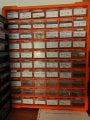
- Parts on Hand: I want to use the components I already have: NE555P, CD4060, 1/4W and 1/8W resistors, ceramic capacitors, transistors, etc. (I'll attach a photo of the labels on my component drawer. I have these parts because I enjoy fixing circuits with obviously broken/burned components.)
- Avoiding Microcontrollers: I'd like to make this circuit without any microcontrollers, even though I know it would have been faster and easier.
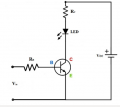
- Inexperience with Components: I have not used transistors or counters before, so I'm unsure if my current design would work. I haven't added any resistors to the transistors yet, but I know they are needed and plan to do so.
- Resetting the Counter: I assume that directly connecting the output of my counter to itself to reset its count might cause issues and uncertainty. How would you go about fixing this? Should I use some sort of delay or an additional IC?
I know I haven't explained everything in detail, but I plan to make a follow-up comment with my thought process behind each part of the circuitry so you can understand what I'm trying to achieve.
Best regards,
Nik