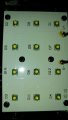
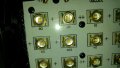
HELP Identifying/Discovering Specification of these LEDs

xox

Joined Sep 8, 2017
936
If you want to find the specs for each individual LED, just connect to a power source with a suitable variable resistor that's turned to its highest setting. Slowly decrease the resistance until the LED lights (to be safe, you can place a "minimum lower-bound" resistor in series with the adjustable one). Then use a multimeter to determine the forward voltage and current requirements. Extrapolate results to the entire circuit of lights. For good measure, run the test on all of the lights to see what kind of variations you get; depending on the manufacturing process these values can be fairly inconsistent. Anyway, if you do find major discrepancies then you may need to be a little more careful about how you design the driver circuit.
 

Thread Starter

Dimis123

Joined Oct 3, 2017
11
"Slowly decrease the resistance until the LED lights..?????." Something is missing or i do not get it :)))

How will i know where the highest luminosity will be and what is the safe margin since these leds would be lit for several hours continiously...
 

xox

Joined Sep 8, 2017
936
First off, let me just start by clarifying that I'm new to electronics myself, so it wouldn't hurt to get a second opinion. ;)

Also, LED's are easily damaged, so it's best to avoid this kind of method unless you absolutely cannot locate a data sheet.

Anyway, the basic idea is this. LED's are of course diodes and as such there is a minimum voltage that will turn them on. So you start with a sufficiently high voltage and a variable resistor and create a simple series circuit: (positive terminal of power supply)->(variable resistor)->(LED anode [+]) and (LED cathode [-])->(negative terminal of power supply). The initial current should be low, just to ensure that the LED aren't damaged by the test. I would start at say roughly one milliamp.

So if, for example, you're using a 12-volt supply then the resistor should be initially set to 12 / 0.001 = ~12K ohms. Now lower the value of the resistor ever so gradually until the LED just begins to light. Record the voltage across the terminals of the LED, and then the current between the LED anode and power supply. Finding the maximum voltage/current isn't so easy - barely exceed the limits and your LED is toast! So very carefully, lower the resistance further and stop just as soon as the LED doesn't seem to get any brighter. Record voltage and current.

Once you have a set of minimum/maximum values, calculate the actual resistance needed by the LED. It's simply R = (Vs - Vf)/C, where Vs is the supply voltage, Vf is the LED forward voltage, and C is the current draw that you measured. So if Vs = 12V, Vf = 2.2V and C = 20 milliamps then the minimum resistance needed to protect the LED would be ~490 ohms. Resistances between R1 (resistance right above LED cutoff) and R2 (resistance at full brightness) gives you the full range of illumination for the LED.
 
Last edited:

Thread Starter

Dimis123

Joined Oct 3, 2017
11
Thank you very much, for your thorough explanation. I believe i can manage it.
I was also thinking to light each led with my bench power supply which is current and voltage controlled. Assuming that i will limit the current to a very low value and retain the voltage to an expected value of 2,7 to 3,2 volts would i be able to draw conclusion or i might damage the leds?
 

xox

Joined Sep 8, 2017
936
The only problem with that approach is that you can't typically modify the current limit and voltage simultaneously (well, at least not with my cheap power supply you can't); you short the leads of the power supply to change the current limit whereas in adjusting voltage you don't.

That said, if you just want to err on the side of caution, by all means, but it probably isn't necessary and will ultimately just slow down the whole process of gathering measurements.
 

Thread Starter

Dimis123

Joined Oct 3, 2017
11
I believe my power supply can alter current and voltage at the same time.
Also i have read somewhere that using the diode option on a multimeter can determine the forward voltage of a led...

Also i have another question... When i will determine the voltage and the current required (lets assume it is 700ma at 3,2V)
i want to power 2 parallel stripes of 6 leds in series each....

Which is the minimum voltage i should apply and what is the minimum current the power supply should be able to provide?

I know than in series the voltage should be at least 6X3.2V and 700ma current
When i power 2 of the above stripes in parallel (12 leds total) i should apply 19.2V and 1,4Amps.

Am i correct or am i missing something...?
 

xox

Joined Sep 8, 2017
936
Oh, one more thing, very important. If you decide to use a variable resistor, be sure to test it first. I got a hold of an inexpensive set of them once off ebay and found that they had these "gap imperfections" where the resistance actually dropped to zero at random points along the dial! Had I not tested them I could have easily destroyed a circuit.
 

#12

Joined Nov 30, 2010
18,224
I feel a need to step in.
1) Many LEDs will keep getting brighter until the smoke comes out. That is not a safe test.
2) Those LEDs are rather high power such that 20 ma is a poor estimate. Go to superbrightleds.com or Cree and examine the pictures.

Stupid question time: Why don't you apply the voltage the whole assembly needs and measure one? Your second reference shows, "6V to 17V" and claims to have a regulating circuit.
I believe my power supply can alter current and voltage at the same time.
Not in a strict sense. Ohm's Law says you can control one or the other, but the load controls the parameter you aren't controlling. LEDs are current controlled devices which then reveal the voltage they need. If you're going to test one LED, think in terms of giving them a certain current and then measuring the voltage across an LED.
 

xox

Joined Sep 8, 2017
936
I believe my power supply can alter current and voltage at the same time.
Also i have read somewhere that using the diode option on a multimeter can determine the forward voltage of a led...

Also i have another question... When i will determine the voltage and the current required (lets assume it is 700ma at 3,2V)
i want to power 2 parallel stripes of 6 leds in series each....

Which is the minimum voltage i should apply and what is the minimum current the power supply should be able to provide?

I know than in series the voltage should be at least 6X3.2V and 700ma current
When i power 2 of the above stripes in parallel (12 leds total) i should apply 19.2V and 1,4Amps.

Am i correct or am i missing something...?
Sounds about right, but I honestly haven't built that sort of circuit myself so I can't really give you a definitive answer, sorry.
 

xox

Joined Sep 8, 2017
936
I feel a need to step in.
1) Many LEDs will keep getting brighter until the smoke comes out. That is not a safe test.
2) Those LEDs are rather high power such that 20 ma is a poor estimate. Go to superbrightleds.com or Cree and examine the pictures.
Unless you can't find a data sheet, in which case it may be the only way to do it. Maybe there is a more scientific or robust method out there, but that's the only one I know of at least. And yes, while there's a definite chance that you could inadvertently cook your LED in the process, from my experience with scavenged LED's it's proven to be a very reliable test. You just get a feel for it, I suppose. And if nothing else, you could use it as a sort of "make sure it's just bright enough for my needs and if it doesn't reach that level without burning out I don't want to use it anyway" standard. :p

The 20 ma wasn't meant as an estimate, just a hypothetical number to show the math.
 

philba

Joined Aug 17, 2017
959
#12 is right.

There is additional info to help you though. Looking at the first link, there are 12 LEDs and it claims to be an 18 W device. Simple math says they are 1.5W LEDs. Assuming a Vf of 3, that works out to an If of 500 mA, a common current for high power LEDs. A Vf of 4 gives you 375 mA. The pot approach of finding actual Vf is going to be too touchy. You'd need a pretty high wattage pot to avoid smoking it. I'm sure those LEDs are driven by a constant current supply (all the high powered ones are).

The 6-18V listed is most likely input to the power supply, not to the LED string. a string of 12 would probably need a 36-50V capable supply.

I think the more important question is how were you intending to drive these LEDs? I hope you have a driver IC in mind. Using a current limiting resistor approach works ok for indicator LEDs (10-20mA) but not for the high powered ones.
 

Thread Starter

Dimis123

Joined Oct 3, 2017
11
Hello to all of you, at firsat i would like to thank you for your help.
I have tried most of the aforementioned and here are some of the results

Min voltage per led to start lighting (very very dim) around 2,2 V
With controlled current i have recorded around 1A draw at 3,6V but i was afraid it might start smoking so i have lowered the voltage. It seems that 700-800ma @ 3,2V is a safe (?) voltage current ratio to operate. -
I still though can not be sure what type of leds are used and what are their nominal and max Operating Voltage Current....
I have a question here... the power supply was set at 3,2V while the power measured on the leds pins where 3,15 is this the forward voltage?

I then have tried to power the whole array (2 parallel streams of 6 leds in series) where in this case the odd was that despite i have reached 20V (assuming that 6X3,2=19.2) the total current draw was 800ma. At first i thought that it might be the power supply's problem but i saw that it is capable of delivering up to 4 amps @ 20V. Also from 19V to 20V the increase in amperage was very little 790ma to 810ma.
I do not know if this can reveal something different in regards to the 18W stated.

I forgot to tell you that @ 3,2V the temp of the leds after 5 minutes was around 50oC (the leds are soldered on aluminium and has a huge aluminium cooler with fins (do not know if this is the correct term). Is this a normal operating temperature from your experience? Since i am going to use these lights on video shootings that may last several hours this means that they will be operating at full power for at lease 2-3 hours and so on...

The next step is to drive and dim the leds. Of course i am not thinking resistors but i was interested in developing a circuit that will able to handle a wide range of voltage and be able to dim at least 10% to 100%.
These lights will be powered for the following sources
(a) 7.2-7.4V batteries Sony Type
(b) 14,4-16.4 @ full charge anton bauer battieries
(c) 12V power suplly from mains (this reminds me that the old light i was using was 2A and never had a problem)

So here i need some suggestions (and great help :) ) to make the above driver.

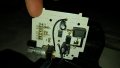
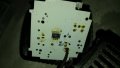
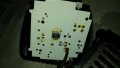
These leds were powered on a similar led light through the following circuit which seems very very simple (except the ic on its back)
(i have a damaged one-i attach some photos)

20171004_232819.jpg 20171004_232844.jpg
 

Attachments

xox

Joined Sep 8, 2017
936
This is all a bit out of my league, unfortunately, but some thoughts for you here...

First off, if you say that 19.2V is what you calculate to be the safest maximum voltage for each parallel string then you should be absolutely certain that there are resistors in place before going a single microvolt above that. Say you raise the voltage to 20V. That means that Ip = (20V - 19.2) / Rw current could be allowed to flow through those LED's (where Rw is the resistance of the copper wire itself). And since Rw is guaranteed to be very low (something like 10^-10 ohms per centimeter) then you could quite easily be dealing with several amps (or even the maximum current available to your power supply)!

As to the difference between the set power supply voltage versus what was measured at the LED pins, from my experience that's normal. The power supply lead wires have resistance plus there are internal resistances and what have you so ultimately it's what comes out at the ends of the supply leads that matters (3.15V in your case).

Why the whole array doesn't light together, I can't say. Maybe someone with more experience could shed some light on that.

The temperature reading might be a concern. That much heat just can't be good for a circuit board, even with a heat sink. I would seriously consider using a pulse-width modulation scheme or similar, preferably one where both the duty-cycle and mark-to-space ratio are adjustable. Beyond that I can't give you any advice as I haven't yet done any real experimentation with that sort of thing.

Anyway, good luck!
 
Last edited:
Top