Help identifying component

Thread Starter

Chuck Whitt

Joined Sep 23, 2015
6
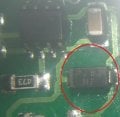
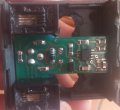
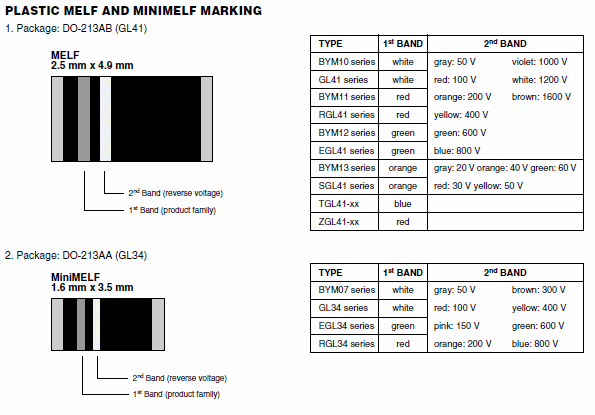
I believe this component is a MELF diode, probably a BB215 (based on the information contained in this web site - http://www.marsport.org.uk/smd/sod80.htm). Can anyone verify this for me? I have not dealt with a MELF diode before (never even heard of such a thing before beginning my research). Can any equivalent diode be used as a replacement?rudder_angle_sensor.jpg
 

Hypatia's Protege

Joined Mar 1, 2015
3,228
Can any equivalent diode be used as a replacement?
I'm uncertain I understand your question:confused: -- It goes without saying that 'leadless face' devices may be substituted with electrically equivalent devices of disparate geometry -- Provided they are 'mountable' in the applicable equipment...
Best regards
HP
 

Thread Starter

Chuck Whitt

Joined Sep 23, 2015
6
I'm uncertain I understand your question:confused: -- It goes without saying that 'leadless face' devices may be substituted with electrically equivalent devices of disparate geometry -- Provided they are 'mountable' in the applicable equipment...

Best regards
HP
I thought about how dumb that sounded after I posted it - of course, if the electrical characteristics are the same, then it can be substituted. nonetheless, thanks for your response.
 

Thread Starter

Chuck Whitt

Joined Sep 23, 2015
6
Can I indulge your favor with more questions? On the board above are two SMD capacitors (lower right). There are no markings on these. How would I go about identifying their values? I've never used a capacitance meter, if that is indeed the answer, would the devices need to be removed from the circuit to get a good reading?
 

Thread Starter

Chuck Whitt

Joined Sep 23, 2015
6
I'll kill two birds with one stone here. The picture shows one of two ceramic caps (the larger one) above the other circled component. The cap measures (approx) 3.4mm x 2.0mm x 2.0mm. The smaller one measures (approx) 3.3mm x 1.6mm x 0.8mm. The larger cap ties to V+ (pin 8) of the IC on one side, and to the V- (pin 4) on the other side. The smaller cap, in parallel with a 180k resistor, ties to the in (pin 2) and out (pin 1) pins of the opamp.

The circled device is marked "PJ93 HF" and measures 4.3mm x 2.7mm x 2.4mm. Looking in Blackwell's "The SMD Codebook" (http://www.marsport.org.uk/smd/mainframe.htm), it defines a device with a PJ code as a BB159 a "UHF Varicap 2-11pF" in a SOD-323 package. In the "Marking Codes of Diodes SMD Devices" reference (http://www.instructables.com/files/orig/F7W/GZZ8/HRTWJLRR/F7WGZZ8HRTWJLRR.pdf), it list devices with the PJ code as a DDZ20CS (or variant thereof), a "Precision Zener Diode" in a SOD-323. Digikey's datasheet verifies that this device has a "PJ" marking and is in a SOD-323 package. The problem, besides being defined as two different devices (BB159 and DDZ20CS), is that the dimensions don't match that of a SOD-323 package. So where do I go from here?

The IC that all of this stuff is based on is a LMC6492 dual op-amp. The purpose of the circuit is to detect movement through the 10k precision linear potentiometer that is the major component of the board.
 

Attachments

ian field

Joined Oct 27, 2012
6,536
Can I indulge your favor with more questions? On the board above are two SMD capacitors (lower right). There are no markings on these. How would I go about identifying their values? I've never used a capacitance meter, if that is indeed the answer, would the devices need to be removed from the circuit to get a good reading?
Very rarely do ceramic chip capacitors have any markings. You should remove them to get an accurate measurements without the influence of other components.

The Peak Atlas LCR is a very useable instrument, and you can buy an accessory lead kit that includes tweezer style probes for small SMD parts.

There are various similar instruments on the market - including ones with the whole instrument built into tweezer probes.
 

Thread Starter

Chuck Whitt

Joined Sep 23, 2015
6
The Peak Atlas LCR is a very useable instrument, and you can buy an accessory lead kit that includes tweezer style probes for small SMD parts.

There are various similar instruments on the market - including ones with the whole instrument built into tweezer probes.
Oh yeah, more toys! WooHoo!
P.S., don't let the wife know. ;-)
 
Top